
Unbiased headlines. Facts, not spin.
Unbiased Headlines is an independently owned news organization. We bring you the facts, not opinions, written fresh from 110+ named sources. Sources linked so you can verify it yourself.
 tech
Major Story (7/10)
Apple's Inventory Is Up 154% and Memory Purchase Commitments Rose $33 Billion Since June
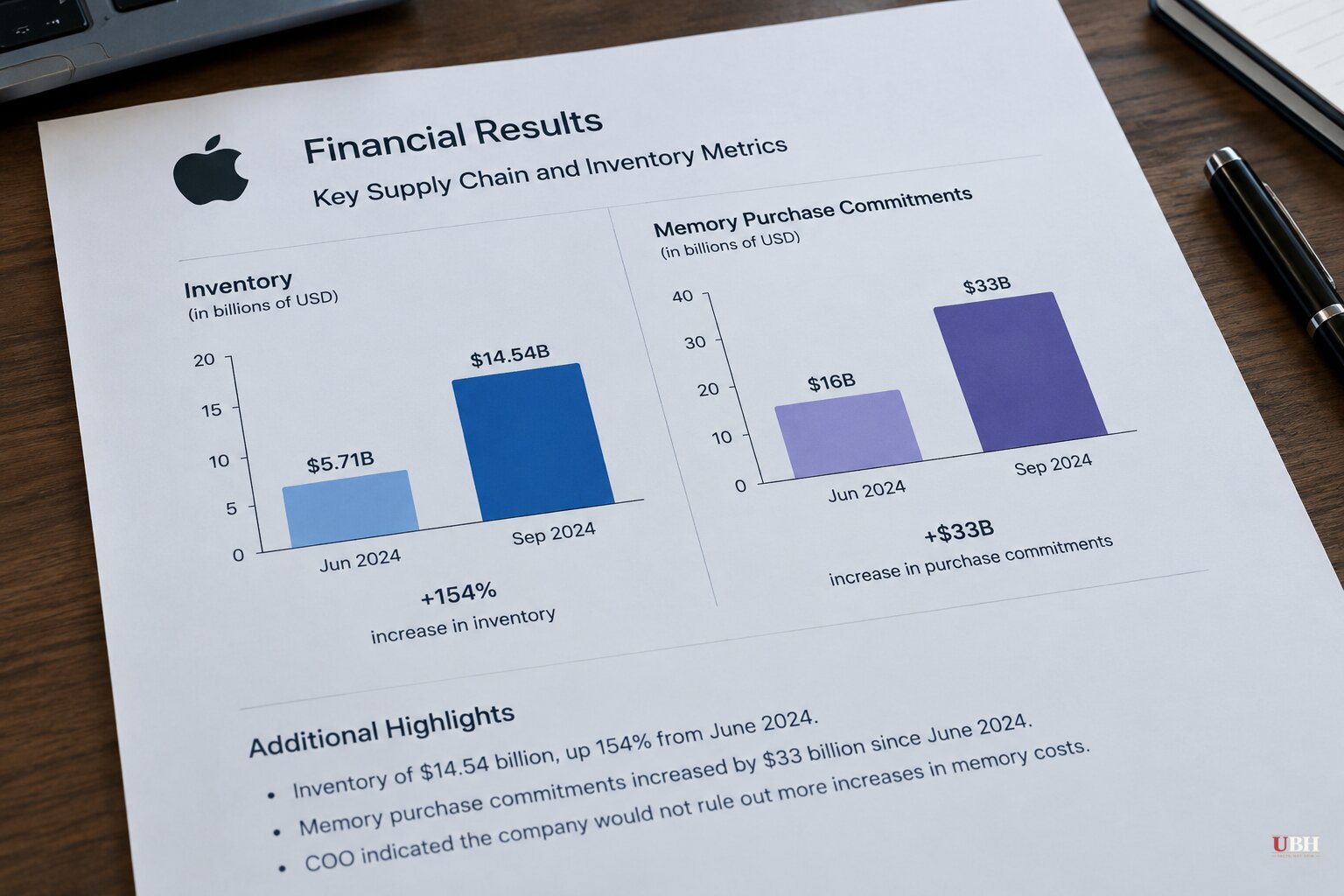
Since Apple posted its fiscal fourth-quarter beat today, Nov. 2, in John Ternus' first report as CEO, the call and the numbers behind it have shown how much Apple is spending to lock down memory chips.
Start with the balance sheet. Apple's inventory reached $14.54 billion, up from $11.09 billion in the June quarter, a 31.1% jump. Against the $5.72 billion a year earlier, that is growth of 154.3%.
Then the commitments. Ternus said Apple's manufacturing purchase obligations grew by $33 billion between June and the end of the September quarter. The figure will appear in the company's annual filing, which Apple said comes out tomorrow, Nov. 3.
Memory is the cost problem
"What we're seeing with memory pricing right now is unprecedented," Ternus told analysts. He said memory costs rose in the September quarter and will rise further in the December quarter. Beyond December, he said, "we see the pricing for memory purchases continuing to increase."
Apple cushioned September with memory it had bought earlier at lower prices, plus cheaper non-memory components. Ternus said that benefit from carried-in inventory will shrink over time.
The company guided December-quarter gross margin to 45% to 46%, down from 47.9% in September. Apple attributed the drop mainly to memory, with some costs from ramping up its Siri AI service.
CFO Kevan Parekh said tariff refunds lifted the September margin by roughly one percentage point. That implies a margin near 46.9% without them. Apple said the refunds added about two points in the June quarter. They also added 5 cents to the $2.10 earnings per share, which beat the $1.99 analyst estimate; without them EPS would have been about $2.05.
Prices and supply
Apple has already raised prices to offset the squeeze. Mac and iPad prices went up at the end of June, and iPhone prices in September. Apple raised the price of iPhone 17 models by $100 when it launched the iPhone 18 Pro lineup, and increased some MacBook prices.
An analyst asked whether more increases are coming. COO Sabih Khan, who runs supply chain and manufacturing, did not rule them out and did not give a direct answer. "We're really being thoughtful and deliberate at evaluating kind of the short-term and long-term considerations," Khan said. "And we really believe we're balancing this well." Parekh said the earlier increases were made "reluctantly."
Supply is also a limit. Apple said Mac and iPad availability will be constrained in the December quarter because of memory.
Where the quarter was weak
Revenue was $114.5 billion, up 12% and above the $113.39 billion consensus. Profit was $30.7 billion. iPhone sales rose 17% to $57.58 billion, and Services hit $31.57 billion, up roughly 10%. Mac revenue rose 24%, according to XTB's breakdown of the results.
iPad was the miss. Revenue of $6.2 billion fell 10% from a year ago and came in below the $6.7 billion analysts expected. Apple blamed supply constraints. Wearables also declined, and China revenue came in below expectations, according to XTB.
The iPhone figure does not include the foldable iPhone Duo. Ternus told Reuters that "a very small percentage" of Duo units were returned for display problems and that Apple is replacing them. He also said demand outstrips supply, with no date for when the two will balance. "Duo is constrained as of today," he said.
The guide and the market
Apple forecast December-quarter revenue growth of 7% to 10%, or about $153.8 billion to $158.2 billion, against the $153.2 billion analysts had expected.
The margin outlook did the damage. Shares of Apple, valued at about $4.9 trillion, fell as much as 4% in after-hours trading before trimming the drop to 2.7%, according to Fortune. XTB, by contrast, put the stock near its $338.50 regular-session close at the time of its report. After-hours moves on earnings can reverse before the next open, and regular trading resumes Tuesday morning.
Apple's own view is that the product slate carries it. "We're closing the year with our most ambitious lineup yet," Ternus said in a written statement. "Together with the all-new Siri AI, it's an incredible lineup to carry us into the holiday season."
The memory squeeze comes from an AI-driven price spike that former CEO Tim Cook called a "100-year flood," Reuters reported. It is still unclear how much of the $33 billion Apple has committed locks in prices that are still rising, and whether the annual filing tomorrow gives a breakdown of those obligations.
Sources used for this briefing
8 links from 7 independent newsrooms (syndicated copies of the same report count once)
These are the sources it draws on, linked so you can verify.


