
Unbiased headlines. Facts, not spin.
Every story is an unbiased news briefing written from 110+ sources across the spectrum — sources linked so you can verify it yourself.
 finance
Notable (5/10)
June 16, 2026 at 04:51 PM
finance
Notable (5/10)
June 16, 2026 at 04:51 PM
CFTC Grants Novig a Sports Prediction Market License, Adding to a Crowded Field That Includes Kalshi, Robinhood, and the Sportsbook Giants
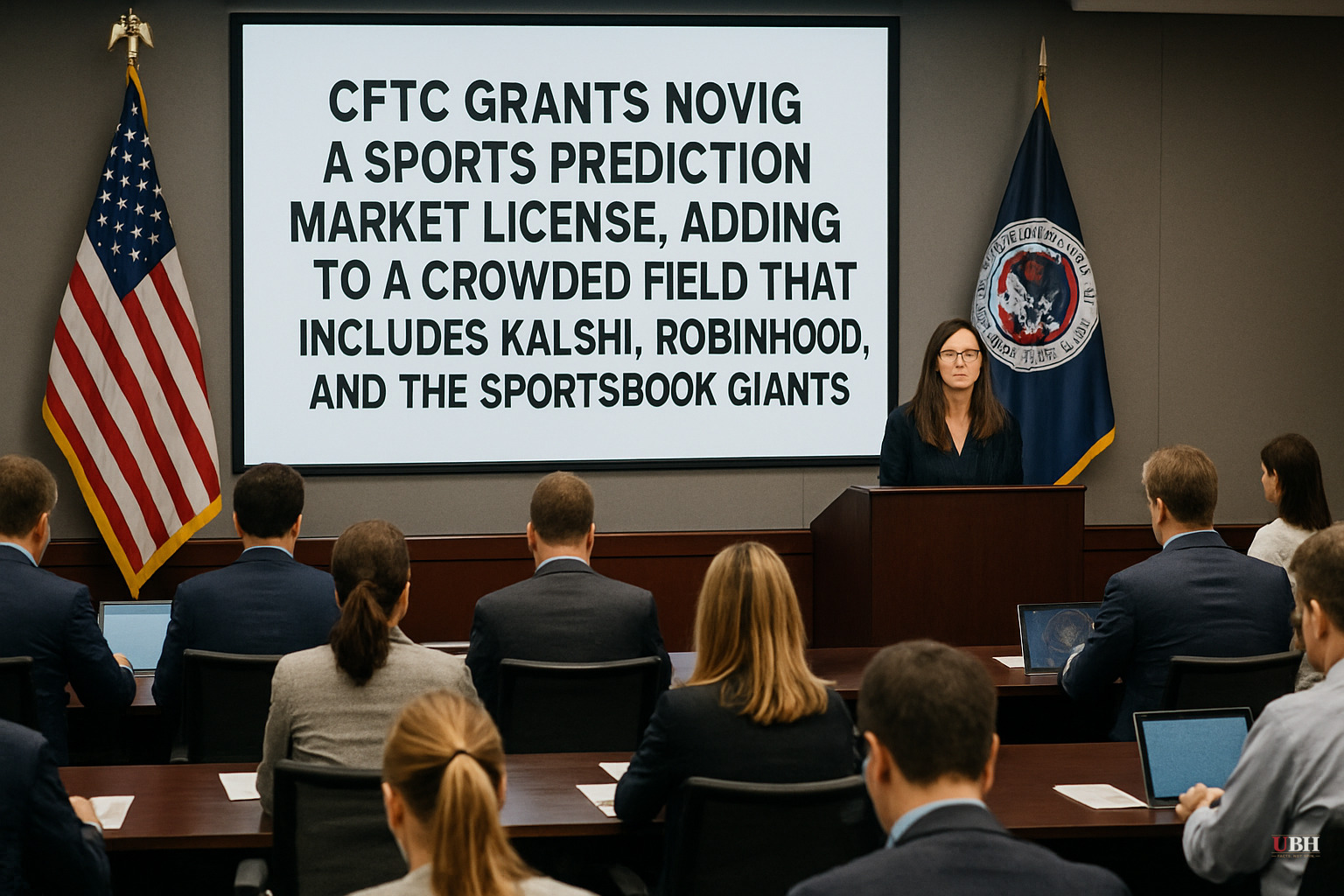
Since the CFTC approved perpetual crypto futures for Kalshi and Kraken earlier this month, the commission has kept moving. On Tuesday, June 16, it cleared Novig's designated contract market (DCM) application, according to CNBC. That follows ProphetX's approval roughly a week earlier.
Two new federally licensed prediction market exchanges in two weeks. The pipeline is not slowing down.
What Novig Actually Is
Novig was founded by Jacob Fortinsky and Kelechi Ukah. It is sports-first by design: the company is building a peer-to-peer trading platform where users trade directly against each other, not against the house.
"What we're doing is basically cutting out the middle man," Fortinsky told CNBC. "We're really rendering sportsbooks obsolete."
The model has a real structural distinction worth taking seriously. Traditional sportsbooks are the counterparty to every bet, meaning they profit when users lose. Novig, by contrast, says its platform is outcome-agnostic. It collects fees on trading activity regardless of who wins. This aligns the platform's incentives with users in a way a sportsbook's structure does not.
Novig previously operated under a Colorado state sports-betting license, then pivoted to a sweepstakes product before committing fully to the federal DCM model. It will maintain a 21+ age requirement. In February, it closed a $75 million Series B led by Pantera Capital, according to CNBC, which gives it real runway for a young company entering a brutal competitive market.
The Competition Is Not Light
Novig and ProphetX are not walking into open territory. Kalshi already dominates the prediction market space and set a new single-day trading volume record Saturday of $1.2 billion, driven by World Cup and NBA Finals activity, according to CNBC. Polymarket, Robinhood, and Crypto.com are all active competitors. FanDuel, DraftKings, and Fanatics, the three largest sportsbook operators in the U.S., are either already in the prediction market space or moving toward it.
JB Mackenzie, Robinhood's head of prediction markets, described the moment to CNBC as a "supercycle." He cited a packed sports calendar running from the World Cup through NBA Finals directly into NFL season, followed immediately by the 2026 midterm elections. That is an unusually long stretch of high-volume event trading.
But supercycles attract too many competitors. The sportsbook giants have existing user bases in the tens of millions, established apps, and marketing budgets that dwarf anything a startup can match. FanDuel and DraftKings have fought each other to a bloody draw over a decade of daily fantasy and sports betting wars. Novig's peer-to-peer model is a genuine differentiator, but differentiation alone doesn't pay customer acquisition costs.
Market Saturation
The TAM—total addressable market—is finite. The U.S. sports-betting and prediction-market audience is large but not infinite, and every new entrant is competing for the same depositing users. Liquidity in peer-to-peer markets is a chicken-and-egg problem: the platform needs enough users on both sides of a trade to function efficiently. Kalshi has that liquidity. A new entrant does not, regardless of how good the model is.
The history of legal U.S. sports betting is littered with operators who launched, burned through capital on promotions, and sold or shut down within three years. Peer-to-peer exchanges have an even harder liquidity problem than traditional sportsbooks because thin markets mean wide spreads and poor user experience.
Fortinsky's counter is that regulatory clarity changes the calculus. Under the CFTC framework, prediction markets are federally authorized derivatives, not state-by-state gambling licenses. That uniformity reduces compliance overhead and opens Novig to customers in all 50 states simultaneously, which is something no traditional sportsbook has achieved.
What the CFTC Approval Actually Means
A DCM designation is meaningful. It means the CFTC has reviewed the exchange's rulebook, surveillance capabilities, and financial safeguards and found them sufficient to operate as a federally regulated derivatives market. Kalshi spent years in regulatory limbo, including litigation against the CFTC, before its current standing was established.
Novig getting through that process as a startup is a legitimate operational achievement.
With at least a half-dozen federally licensed prediction market operators now active or imminently active, the CFTC will face pressure on how it oversees cross-platform manipulation, market integrity across fragmented liquidity pools, and whether the 21+ age floor is being enforced consistently. None of those questions have public answers yet.
Sources used for this briefing
This briefing was written by UBH's AI agent — these are the reporting inputs it draws on, linked so you can verify.


