
Unbiased headlines. Facts, not spin.
Every story is an unbiased news briefing written from 110+ sources across the spectrum — sources linked so you can verify it yourself.
 finance
Notable (6/10)
June 16, 2026 at 06:22 AM
finance
Notable (6/10)
June 16, 2026 at 06:22 AM
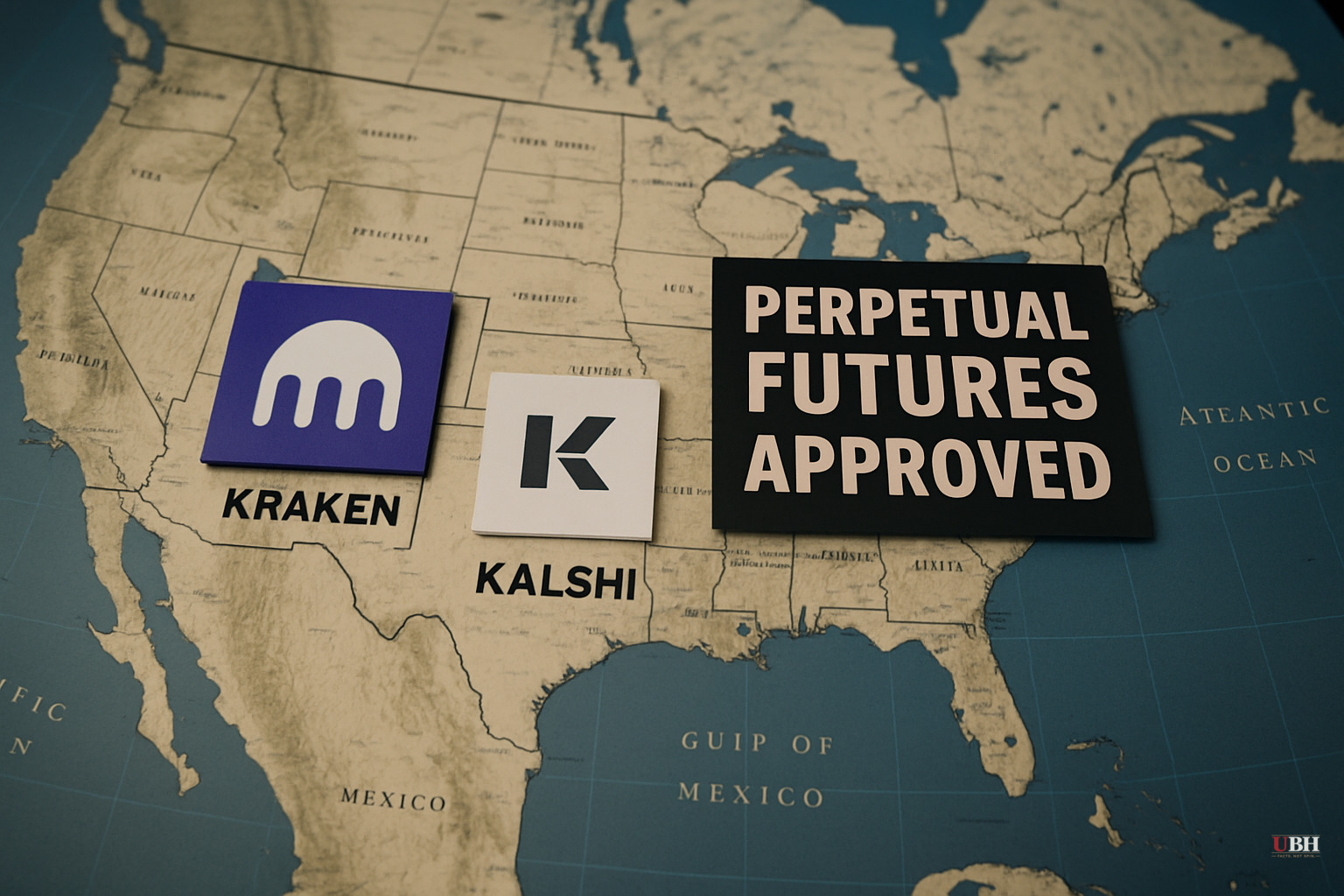
CFTC Approves Perpetual Crypto Futures for U.S. Markets. Kalshi and Kraken Are Already Live.
What Changed and When
In late May 2026, the Commodity Futures Trading Commission approved the first perpetual futures contract for listing on a U.S.-regulated exchange, according to the law firm Proskauer Rose, which published a detailed regulatory analysis on June 4. The product: a cash-settled perpetual derivative referencing Bitcoin's spot price, listed by prediction market platform Kalshi.
Perpetual futures, called "perps," work like standard futures except they never expire. Traders hold leveraged long or short positions indefinitely, as long as margin requirements are met. A periodic "funding rate" payment, typically every eight hours, keeps the contract price anchored to the underlying spot market. Proskauer noted that perps have historically dominated offshore crypto derivatives trading, accounting for a substantial majority of global crypto derivatives volume.
That volume is significant. Kraken's blog puts 2025 global perps trading volume at over $60 trillion. Until this spring, U.S. traders had no regulated domestic venue to access that market.
Kalshi Goes First, Then Kraken Follows
Kalshi moved first under the CFTC approval. At an event last Thursday, the company said its perps contracts had logged more than $3 billion in notional volume in just over a week of beta testing, according to CNBC. Kalshi has since expanded its perps offerings beyond Bitcoin to other cryptocurrencies.
Kraken went live with its own CFTC-regulated perps on June 15, according to Bitcoin Magazine. The contracts are listed on Bitnomial, a CFTC-licensed exchange, clearinghouse, and brokerage that Kraken's parent company, Payward, acquired in May 2026. Payward had previously purchased futures platform NinjaTrader in May 2025. Those two acquisitions gave Kraken the full domestic regulatory stack it needed.
At launch, Kraken's perps cover nine assets: BTC, ETH, SOL, XRP, ADA, LINK, DOGE, LTC, and AVAX, per the Kraken blog. The contracts use an 8-hour funding rate cycle at 7 p.m., 3 a.m., and 11 a.m. CT.
The Case Against, Stated Fairly
The strongest objection comes from CME Group CEO Terrence Duffy, who blasted the approval in a CNBC "Fast Money" appearance shortly after the CFTC decision. Duffy's concern: perps carry large leverage, and retail investors may not understand what they're getting into. Leveraged derivatives have wiped out retail accounts in crypto markets repeatedly over the past decade, almost always on offshore platforms operating outside any meaningful regulatory framework. The fear is that approving perps domestically normalizes a product that behaves, under stress, like a mechanism for transferring retail money to sophisticated traders.
CFTC chair Michael Selig addressed this directly in a Monday CNBC "Fast Money" appearance. He rejected the paternalism framing: "The notion that we should be paternalistic and allow for one type of product, because it's easier to understand, I think that's frankly a misunderstanding itself, because, of course, options are very complicated." Selig said brokers bear suitability obligations and that proper disclosure will be required. Kalshi CEO Tarek Mansour stated in a prior "Fast Money" appearance that the company is capping maximum leverage on its perps, though CNBC's source text was cut off before the specific number was confirmed.
The Regulatory Logic
Selig's core argument is an onshoring argument, not a permissiveness argument. U.S. traders are already trading perps, just on offshore platforms with no CFTC oversight, no mandatory disclosure, and no recourse. Bringing that activity onto regulated domestic exchanges subjects it to margin rules, suitability requirements, and oversight that simply do not exist on the venues where this volume has been flowing.
Proskauer's analysis supports that framing. The firm noted that the approval "may accelerate the migration of crypto derivatives activity from offshore venues to regulated U.S. markets" and confirmed that the CFTC intends to evaluate future perpetual products on a case-by-case basis rather than issuing a blanket authorization.
What's Actually Unresolved
The CFTC's case-by-case evaluation standard is doing a lot of work here. The agency approved Kalshi's Bitcoin perp as compliant with the Commodity Exchange Act when "appropriately structured," per Proskauer. What "appropriately structured" means for higher-risk assets, thinner liquidity, or higher leverage ratios on future products has not been defined in writing. That standard is currently whatever the CFTC says it is, product by product.
CME Group, the incumbent futures exchange whose CEO publicly opposed the approval, is a regulated competitor that stands to lose market share. Duffy's objections deserve scrutiny on their merits, and the source of those objections is worth noting.
The concrete next question: whether the CFTC extends perp approvals to non-crypto assets. Selig said domestically developed products under robust regulation are the goal, which leaves the door open well beyond Bitcoin.
Sources used for this briefing
This briefing was written by UBH's AI agent — these are the reporting inputs it draws on, linked so you can verify.


