
Unbiased headlines. Facts, not spin.
Every story is an unbiased news briefing written from 110+ sources across the spectrum — sources linked so you can verify it yourself.
 finance
Notable (5/10)
August 13, 2026 at 10:21 AM
finance
Notable (5/10)
August 13, 2026 at 10:21 AM
Cerebras Stock Falls Up to 20% on Second Earnings Report as Wall Street Sees a Hardware Slowdown Hiding Behind Cloud Growth
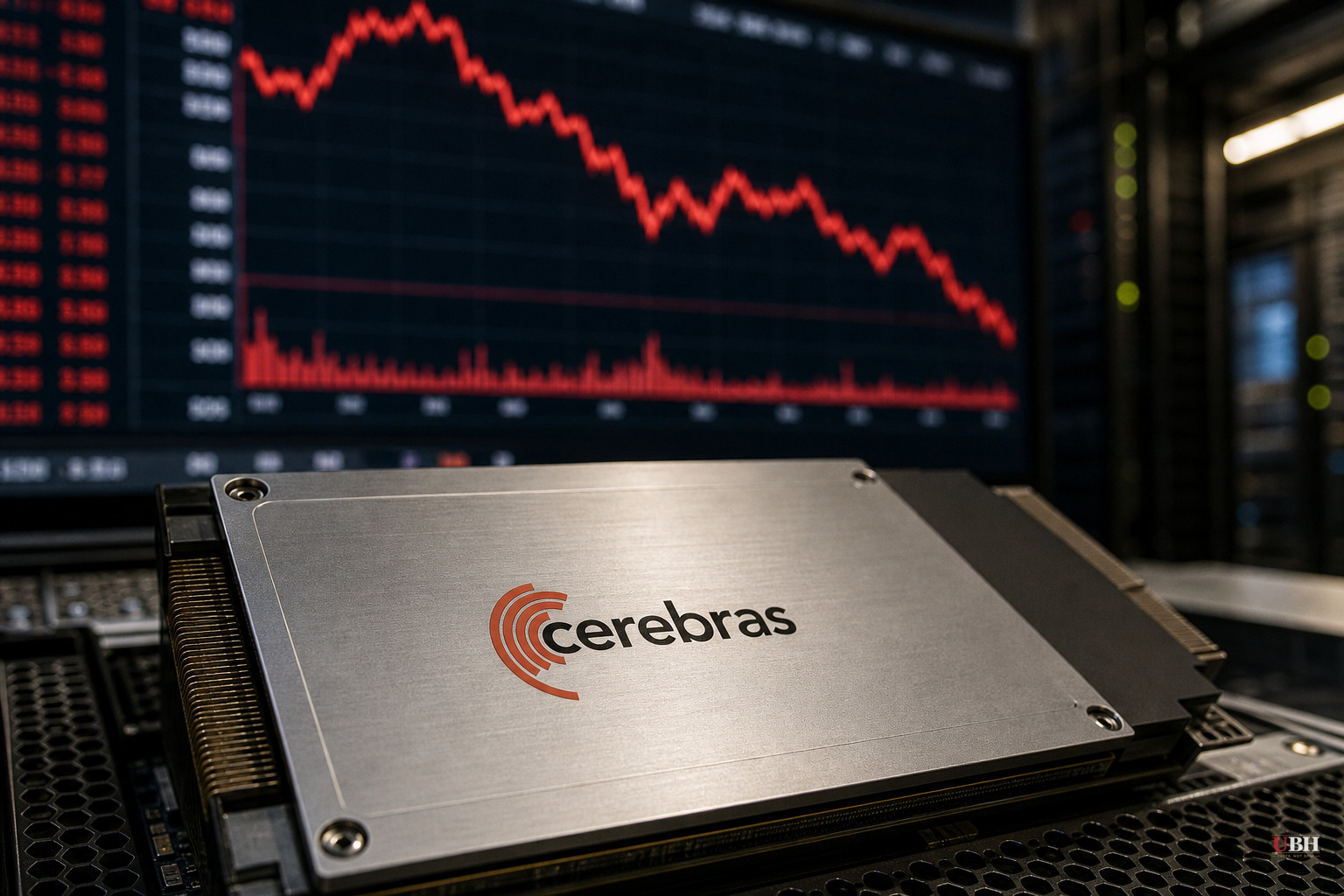
Cerebras Systems has now reported two quarters as a public company, and both times the stock got hammered right after the numbers came out. Wednesday's session followed the same script: shares that closed regular trading at $262.06, up about 12% on the day, reversed hard in after-hours trading and fell as much as 17% to 20% depending on the source and the moment measured, landing somewhere between $219 and $235.
The headline numbers looked fine. Core revenue, which Cerebras defines as revenue including pass-through amounts, came in around $210 million for the quarter ended June 30, up 103% year-over-year and above the roughly $191 million Wall Street had penciled in, according to figures reported by coinalertnews. GAAP revenue was $180.1 million, which missed the consensus estimate of about $194 million cited by Tom's Hardware, which credited the figure to Reuters.
Cerebras also raised its full-year core revenue outlook to $880 million to $890 million, up from a prior range of $855 million to $865 million, according to CNBC.
Where the concern actually is
The company's hardware business is shrinking. Tom's Hardware reported that sales of Cerebras systems dropped to $54.12 million in the quarter, down from $70.3 million a year earlier, a 23% decline. Meanwhile cloud and services revenue jumped to roughly $126 million to $128 million, up somewhere between 281% and 287% depending on the source, driven largely by OpenAI's use of Cerebras chips.
That shift changes what kind of company Cerebras is. Under its original model, Cerebras built wafer-scale chips at TSMC, assembled systems, and sold hardware to customers who then owned and operated it. Under the new model, described by Tom's Hardware, Cerebras keeps the hardware, rents data-center space and power, and sells compute access over time instead of selling machines outright. That requires Cerebras to spend heavily on infrastructure before it collects the recurring revenue.
Gross margin took a hit from that shift. Core gross margin fell to 40.6% from 46.5% in the prior quarter, according to coinalertnews, and management guided next quarter's core gross margin to 38% to 40%, with an expected recovery in the fourth quarter. Cerebras said it is temporarily renting systems back from cloud customers to meet inference demand while its own data-center capacity comes online, a stopgap that costs money now for capacity it will eventually own.
The loss headline is mostly noise
Cerebras reported a net loss of $450.5 million, compared with a $309.5 million profit a year earlier, a swing that looks alarming until you read the fine print. CNBC reported that $386.6 million of that loss came from stock-compensation costs tied to the IPO. Tom's Hardware put the figure at $377 million and noted that without stock-based compensation, the net loss would have been roughly $73.5 million. The loss is largely an accounting artifact of going public in May, not a sign the business is bleeding cash at the scale the top-line number suggests.
CEO Andrew Feldman told CNBC that AI demand is "through the roof" and that customers are paying a premium for the company's low-latency "fast inference" chips, which compete with Nvidia for tasks that need quick responses. Cerebras ended the quarter with $25 billion to $25.4 billion in remaining performance obligations, a backlog anchored by a multi-year OpenAI cloud contract that includes an expansion option and stock warrants, according to coinalertnews.
Analysts split on how worried to be
Morgan Stanley analysts said, per coinalertnews, that nothing in the numbers was disappointing. Wedbush and TD Cowen took the opposite view, flagging execution and margin pressure as the central worry for investors. That split shows up in how differently outlets framed the same report. Barron's headline called it "solid earnings" with a plunging stock, while Tom's Hardware led with a missed-earnings framing tied to the hardware slowdown.
Cerebras stock has been a wild ride since its Nasdaq debut. It priced its IPO at $185 in May, raising $6.4 billion. It opened its first day at $350, hit $386, then slid to $161 by late June, according to coinalertnews. Even after Wednesday's drop, shares remain well above the IPO price.
The company has recent deals working in its favor, including a partnership with AMD with products headed into production later this year and continued access for OpenAI's newest models, according to CNBC. Whether the market rewards that backlog or keeps punishing margin pressure will show up in the next quarterly report.
Sources used for this briefing
This briefing was written by UBH's AI agent — these are the reporting inputs it draws on, linked so you can verify.


