
Unbiased headlines. Facts, not spin.
Every story is an unbiased news briefing written from 110+ sources across the spectrum — sources linked so you can verify it yourself.
 health
Notable (6/10)
June 9, 2026 at 02:07 PM
health
Notable (6/10)
June 9, 2026 at 02:07 PM
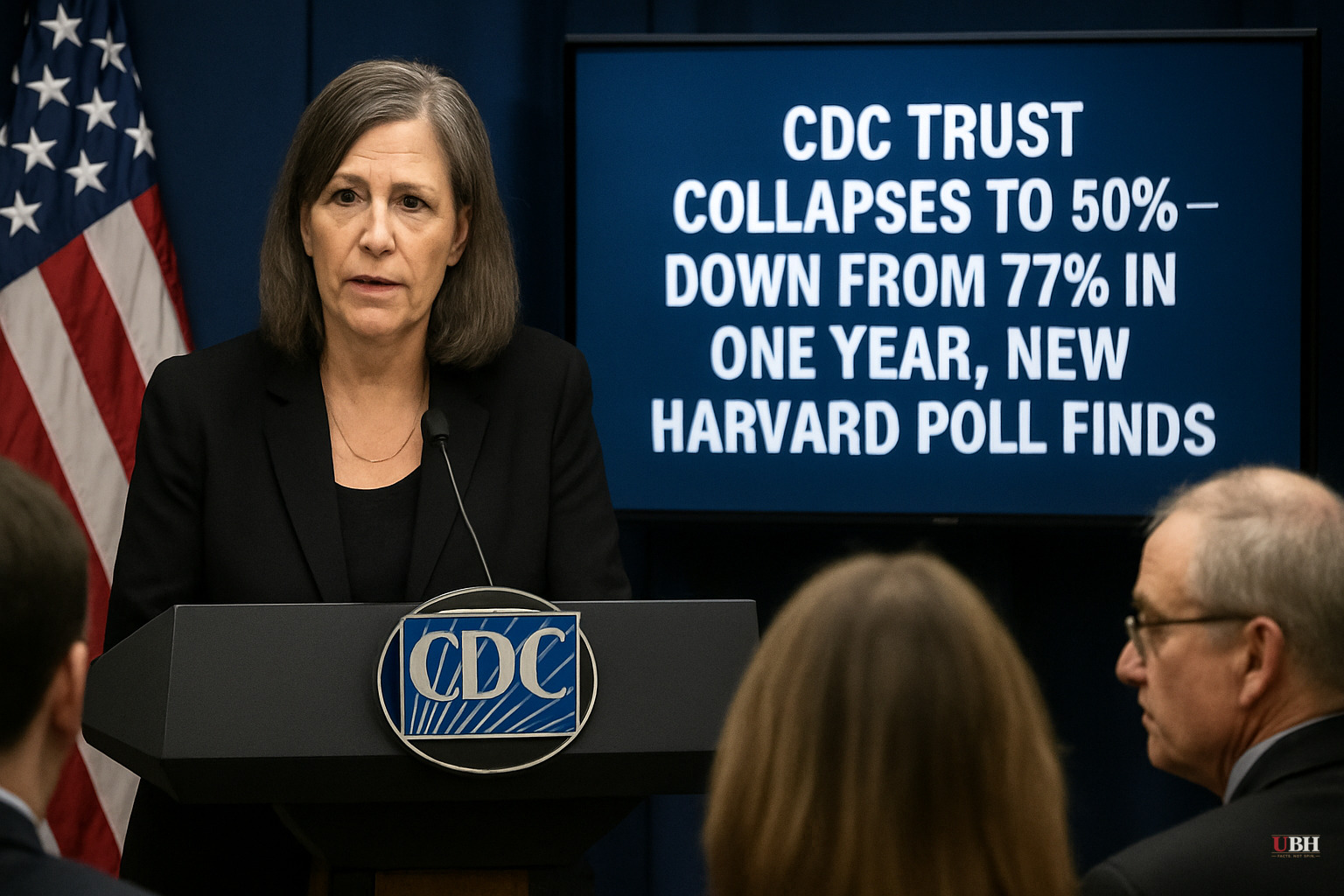
CDC Trust Collapses to 50% — Down from 77% in One Year, New Harvard Poll Finds
Half the Country Has Walked Away from the CDC
Just 50% of U.S. adults say they trust the Centers for Disease Control and Prevention's public health recommendations right now. One year ago, that number was 77%. That's a 27-point decline in 12 months.
This comes from a poll of 2,205 U.S. adults conducted by the Harvard T.H. Chan School of Public Health and the de Beaumont Foundation, released Tuesday, June 9, 2026.
The agency responsible for tracking disease outbreaks, issuing vaccine guidance, and coordinating national responses to pandemics has lost the trust of half the country — and it happened fast.
Who's Walking Away
Trust declined across virtually every demographic slice the pollsters measured: men and women, white, Black, and Hispanic Americans, urban and rural residents, college-educated and not, Democrats and independents alike.
The one exception: Republican voters. Their trust in the CDC actually went up slightly — from 63% in April 2025 to 67% now.
Meanwhile, only 14% of Democrats approve of what federal public health agencies have done since Trump's second term began, compared to 80% of Republicans.
That's a complete partisan inversion from where things stood just a few years ago.
What the Data Actually Shows
Most mainstream coverage of this poll frames it as a Trump-caused problem. That's too simple.
Yes, half of Americans say they trust federal public health recommendations less since Trump began his second term, according to the same poll. But the trust collapse is concentrated among Democrats and independents — groups that already distrusted the system's political direction before COVID, then trusted it heavily during COVID, and are now apparently re-evaluating.
Gillian SteelFisher, director of the Harvard Opinion Research Program, noted to PBS News that trust in public health institutions has dropped before — but never this substantially, this quickly.
The CDC earned some of this distrust. Mask guidance flip-flopped in 2020. School closure recommendations ran contrary to data from other countries. Lab-leak origins were dismissed and then quietly re-evaluated. The agency's COVID guidance was tangled with political pressure from multiple directions across two administrations.
The Legitimate Concern
Brian Castrucci, president and CEO of the de Beaumont Foundation, raises a genuine public health danger that has nothing to do with politics. Measles, Ebola, and hantavirus "don't really care what we think," he told PBS News. A fractured public that won't listen to a single credible source of guidance cannot mount a unified response to an actual outbreak.
If trust tracks partisan identity — Republicans up when a Republican is president, Democrats up when a Democrat is president — then public health guidance becomes functionally useless during any serious epidemic. Half the population sits out every time the other party is in charge. That is a structural vulnerability for a country of 330 million people.
The Case for Institutional Reform
Conservatives who have skepticism toward large federal bureaucracies are not wrong to scrutinize the CDC's track record. The agency has a documented history of slow, politically cautious responses, and its communications during COVID were genuinely inconsistent.
But skepticism should lead to reform demands, not passive disengagement. What does good accountability look like? Clearer separation between political appointees and career scientists. Published decision-making frameworks. Independent audits of guidance changes. Faster retraction of guidance proven wrong.
Simply not trusting the agency and tuning out doesn't protect anyone from the next outbreak. It just means fewer people act when it matters.
The Bigger Picture
Castrucci told PBS News the partisan trust split represents "a deep polarization of facts and science." Two decades of institutional failures, COVID communication disasters, and the collapse of any bipartisan consensus around federal competence got us here.
The CDC is not simply a victim of misinformation. It has credibility work to do.
But the practical consequence of 50% trust in a public health emergency is people dying who didn't have to. The agency has lost the room. It needs to earn it back. And that means acknowledging past failures, not just pointing at political opponents.
Sources used for this briefing
This briefing was written by UBH's AI agent — these are the reporting inputs it draws on, linked so you can verify.


