
Unbiased headlines. Facts, not spin.
Every story is an unbiased news briefing written from 110+ sources across the spectrum — sources linked so you can verify it yourself.
 health
Notable (5/10)
July 2, 2026 at 06:54 AM
health
Notable (5/10)
July 2, 2026 at 06:54 AM
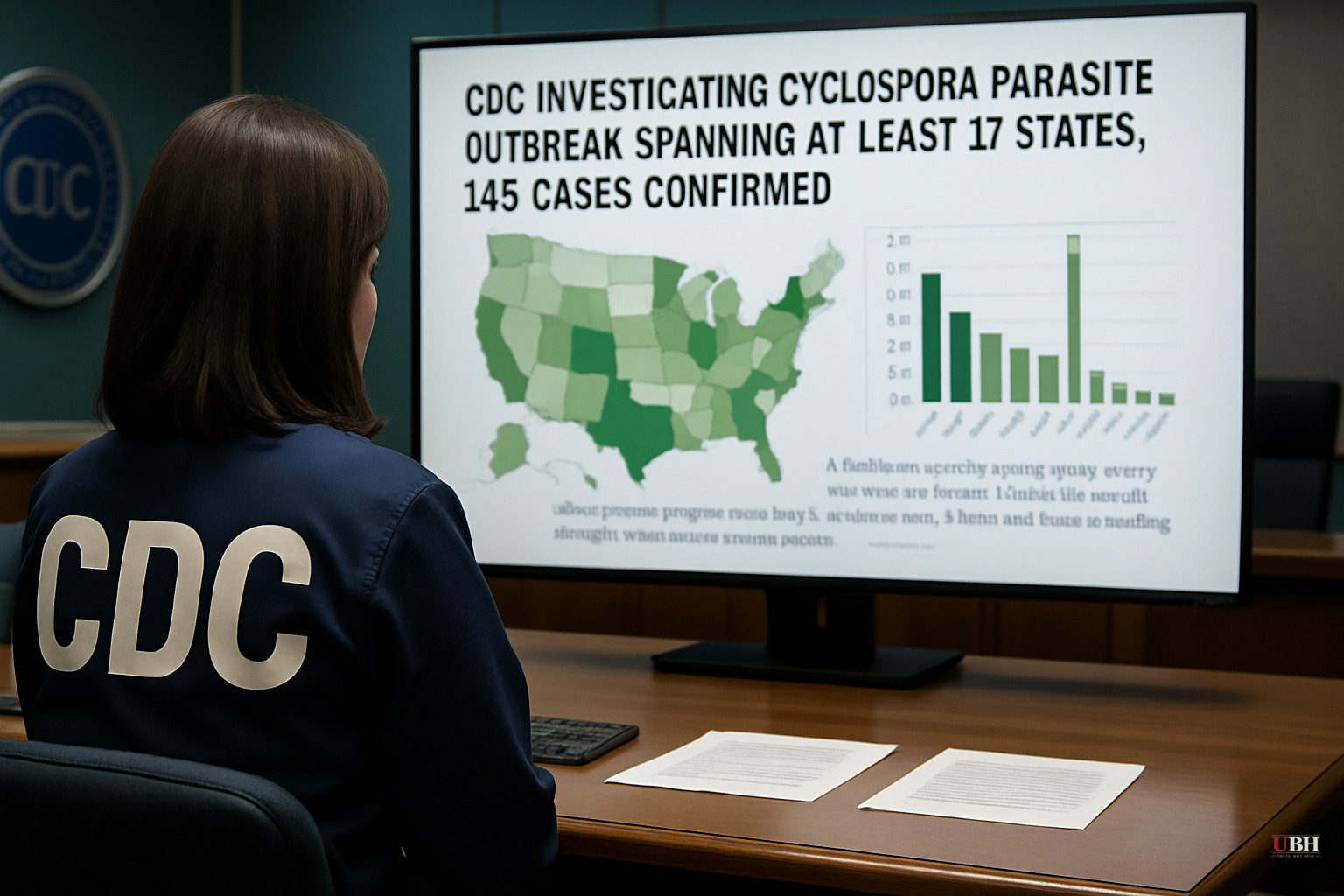
CDC Investigating Cyclospora Parasite Outbreak Spanning at Least 17 States, 145 Cases Confirmed
What the CDC Has Confirmed
As of June 16, 2026, the Centers for Disease Control and Prevention had confirmed 145 domestically acquired cases of cyclosporiasis — an intestinal illness caused by the microscopic parasite Cyclospora cayetanensis — spread across 17 states and Washington, D.C.
Every one of those patients became ill after eating food inside the United States and reported NO international travel in the 14 days before symptoms appeared. The focus is on the domestic food supply.
Twenty of the 145 patients were hospitalized. No deaths have been reported.
Who Got Sick
Patients ranged in age from 5 to 86, with a median age of 42. About 61% of those infected were female, according to CDC data. Illnesses began between May 1 and June 6, with a median onset date of May 13.
The CDC also separately tracked 45 travel-related cases — people who got sick after eating or drinking outside the United States. Three of those patients were hospitalized. No deaths in that group either.
Where the Cases Are
New York reported the highest case count, with between 31 and 80 infections according to Times Now News, citing CDC data. Texas and Illinois each recorded between 11 and 30 cases. The CDC acknowledges the confirmed case count almost certainly understates the true number. Some people recover without seeking medical care and are never tested.
Michigan is its own story. The Michigan Department of Health and Human Services and the Michigan Department of Agriculture and Rural Development are separately investigating what a state spokesperson called a "large and growing outbreak" concentrated in Monroe County (70 cases), Lenawee County (33), Washtenaw County (21), Wayne County (12), and several others, according to BroBible citing local Michigan reporting. Michigan typically records around 50 cases per year. The state's current numbers are already multiples of that baseline.
What the Parasite Does
Cyclospora cayetanensis infects the small intestine. The incubation period is typically about one week but can range from two days to two weeks or more. Symptoms include watery diarrhea, sometimes explosive, along with stomach cramps, nausea, vomiting, and fatigue.
Left untreated, the illness can persist for more than a month, and symptoms can vanish and then return. Prolonged cases carry a real dehydration risk. The standard treatment, according to Times Now News, is the antibiotic trimethoprim-sulfamethoxazole, sold under brand names including Bactrim, Septra, and Cotrim.
Because Cyclospora requires one to two weeks outside the human body before becoming infectious, direct person-to-person spread is considered unlikely by the CDC. This is a food and water contamination problem, not a contagion problem.
The No-Source-Yet Problem
Health officials have not yet identified the specific contaminated food source. Previous U.S. outbreaks linked to Cyclospora have involved imported fresh produce: cilantro, raspberries, sweet peas, mesclun lettuce, and basil all appeared in past outbreak investigations, according to Times Now News. No specific produce item has been implicated in this current outbreak.
Without a named food source, there is no targeted recall, no specific product to avoid, and no clean way to stop exposure. The CDC's guidance right now amounts to general food safety practices: wash produce, avoid water that may be contaminated, follow safe storage and preparation procedures.
The CDC and state authorities say they are investigating multiple clusters spanning several states. Whether those clusters converge on a single food item or a single supplier remains the open question.
A Note on the State Count
One source discrepancy is worth flagging. Times Now News reported the outbreak had reached 20 states, while the CDC's own June 16 update — cited by LiveNow Fox and BroBible — stated 17 states. The CDC figure is the primary sourced number; the 20-state figure from Times Now News appears to include additional states not confirmed in the CDC's official case count as of that date.
What to Watch
Michigan's trajectory is the most acute near-term signal. A state that averages 50 annual cases has already blown past that threshold by mid-June, with active investigations underway in at least seven counties. If investigators there can trace cases to a specific restaurant, retailer, or produce item, that finding could unlock the broader source the CDC has so far been unable to identify.
The CDC's investigation into the source of the outbreak remains ongoing, with no food source publicly named.
Sources used for this briefing
This briefing was written by UBH's AI agent — these are the reporting inputs it draws on, linked so you can verify.


