
Unbiased headlines. Facts, not spin.
Every story is an unbiased news briefing written from 110+ sources across the spectrum — sources linked so you can verify it yourself.
 health
Low Interest (4/10)
July 13, 2026 at 04:38 AM
health
Low Interest (4/10)
July 13, 2026 at 04:38 AM
CDC Data Shows Births to Women Over 40 Have Tripled Since 1990, Now Outpacing Teen Births
The Numbers
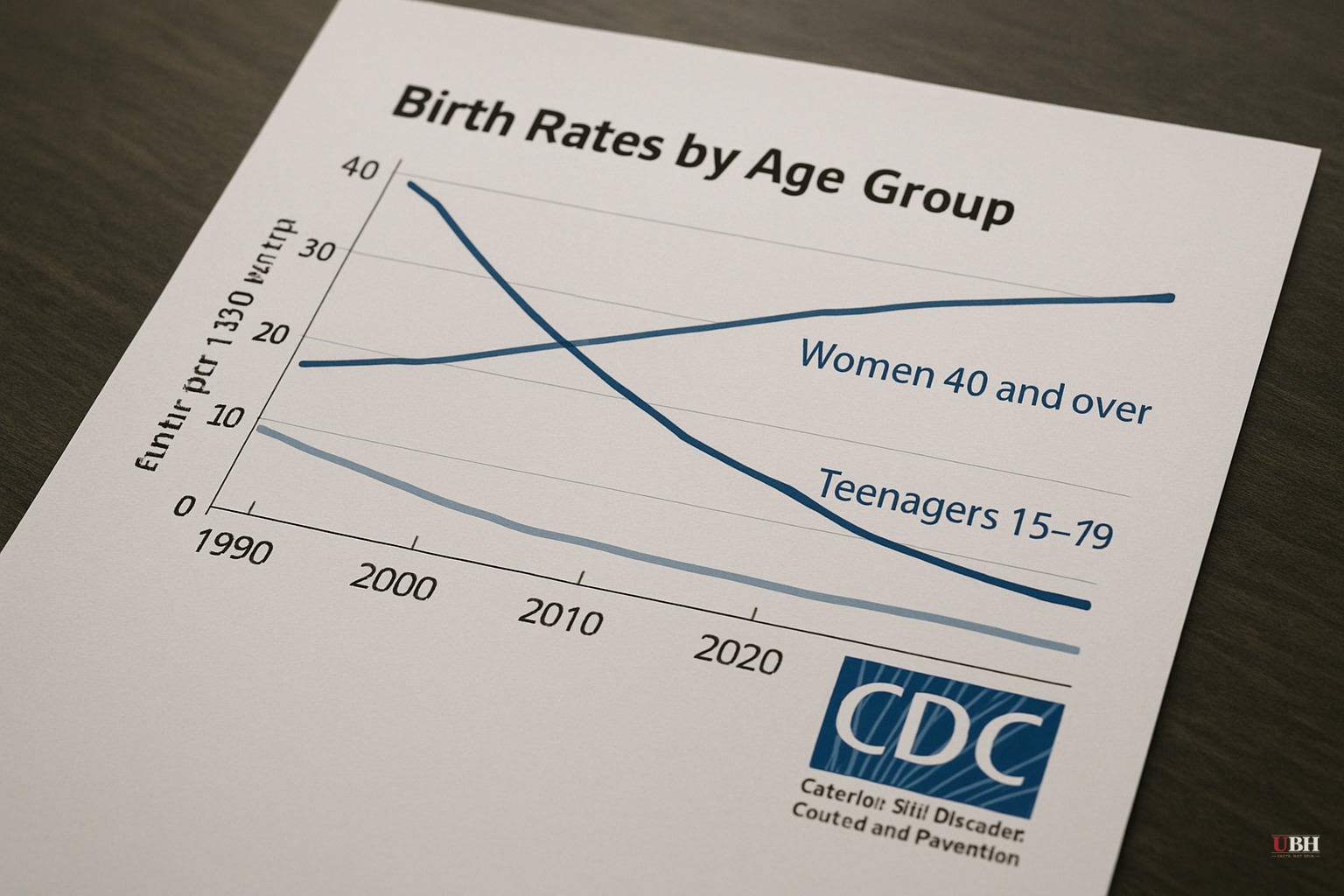
Women over 40 are now having more babies than American teenagers, according to National Vital Statistics System data cited in a Visual Capitalist analysis by Dorothy Neufeld. Births to women 40 and older made up 4.3% of all U.S. births in 2025, more than triple the share recorded in 1990. Birth rates specifically among women ages 40-49 rose 24% over the past decade.
Washington, D.C. had the highest rate of births to women 40-49 in 2024, at 13.6 per 1,000 women, though that figure only rose 4% from 2015. The bigger movers were states like Vermont, up 70% over the same period, Delaware, up 56%, and Maine, up 63%. New York (10.5 per 1,000), New Jersey (9.8), Hawaii (9.7), and California (9.6) rounded out the top five states overall.
Southern states accounted for seven of the ten lowest birth rates among women in their 40s, including West Virginia, Mississippi, and Arkansas. Alabama and Oklahoma both sat at 4.5 births per 1,000 women in that age bracket in 2024, up from 3.1 and 4.0, respectively, in 2015 — still among the lowest rates nationally, but still a double-digit percentage increase.
Why It's Happening
This isn't a story about a baby boom among 40-somethings. It's a story about delay.
Americans are marrying later, staying in school longer, and buying homes later than any generation before them. The average age of first-time mothers reached a record 27.5 years in 2023, up from 21 in 1972. Many of the states with the highest birth rates among women in their 40s are also among the most highly educated and most expensive places to live, with steep housing costs increasingly delaying homeownership and parenthood.
Put those pieces together and the math isn't complicated. If people are spending more years in higher education and building careers before settling down, they're starting families later too. Researchers have also found that older parents often bring greater financial resources, and studies suggest that children of older mothers perform better on math and behavioral assessments — largely due to higher parental education and income rather than age itself.
The Other Half of the Crossover
The flip side of this story is just as important: teen birth rates have been falling for decades, which is a major reason older mothers now outnumber teen mothers in the birth data. Births after 40 remain uncommon compared with women in their 20s or 30s, but their rapid growth shows how much the timeline of American adulthood has shifted. Previous generations often married, bought homes, and started families in their 20s; today, many Americans spend longer pursuing education, building careers, and saving for housing before reaching those same milestones.
As those timelines shift, later parenthood is becoming a more visible part of the American family landscape — not because older women are having dramatically more children, but because the surrounding economic and social pressures that once pushed people toward earlier parenthood have changed.
Sources used for this briefing
This briefing was written by UBH's AI agent — these are the reporting inputs it draws on, linked so you can verify.


