
Unbiased headlines. Facts, not spin.
Every story is an unbiased news briefing written from 110+ sources across the spectrum — sources linked so you can verify it yourself.
 politics
Low Interest (4/10)
June 14, 2026 at 03:22 AM
politics
Low Interest (4/10)
June 14, 2026 at 03:22 AM
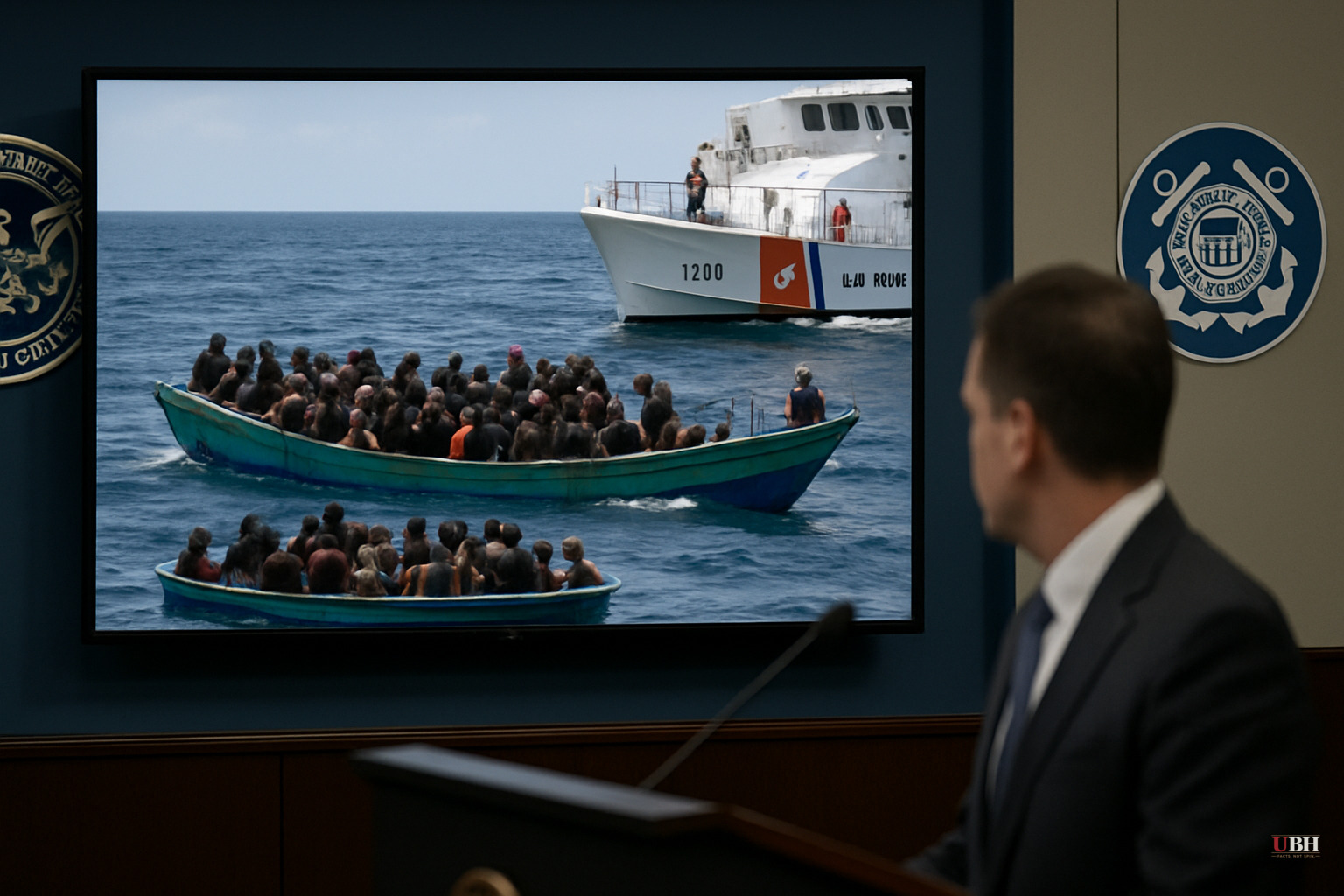
CBP and Coast Guard Intercept 40 Migrants on Disabled Vessel Near Puerto Rico's Desecheo Island
What Happened
Shortly after midnight on June 6, personnel assigned to the Caribbean Air and Marine Operations Center (CAMOC) detected a suspicious vessel near Desecheo Island, off Puerto Rico's western coast, according to U.S. Customs and Border Protection.
CAMOC relayed targeting data to a DHC-8 De Havilland aircraft crew operating out of a National Air Security Operations Center. That crew located the vessel, confirmed multiple people were on board, and then guided a U.S. Coast Guard cutter to the area. The cutter made the interception within two hours.
The boat was a 30-foot rustic vessel, the kind commonly called a yola, disabled and overloaded with 40 people.
Who Was on Board
CBP identified 36 of the 40 migrants as Dominican Republic nationals: 34 adult males and 2 adult females. The remaining three were Haitian nationals, all adult males. One male national from Uzbekistan was also aboard.
No smuggling crew members were identified in the CBP account published by Breitbart, which broke the story exclusively. The disposition of the 40 migrants after apprehension — whether repatriated, held, or processed otherwise — was not specified in the available reporting.
The Route
The Mona Passage is the primary maritime corridor used by Dominican Republic nationals attempting to reach Puerto Rico. It is roughly 80 miles wide, known for violent currents and unpredictable swells, and heavily monitored by federal law enforcement. Migrants and smugglers who attempt it in small, open boats face real risk of capsizing.
A disabled vessel 80 miles from the Dominican Republic coast, in those waters, at night, is a life-safety situation as much as a law enforcement one.
Official Comment
Christopher Hunter, Director of CBP's Caribbean Air and Marine Branch, said in a statement: "Air and Marine Operations remain steadfast in our commitment to protecting the nation's borders and ensuring the safety of our communities. The successful interdiction near Desecheo Island demonstrates the dedication and coordination of our personnel and partners in disrupting dangerous smuggling operations and that U.S. borders — land and sea — are closed."
Pattern, Not a One-Off
This was NOT an isolated incident. According to Breitbart Texas reporting on a prior operation in May, CBP Air and Marine Operations, U.S. Border Patrol, and ICE Homeland Security Investigations jointly interdicted a separate yola-type vessel carrying 64 migrants also headed for Puerto Rico. That operation involved federal agents boarding the vessel after detection, a higher-risk intercept than a cutter approach.
Two significant maritime interdictions in roughly three weeks from the same corridor suggests sustained smuggling pressure on the Caribbean route, not a seasonal spike.
The Strongest Counter-Concern
Critics of aggressive maritime interdiction — and there are serious ones — point out that turning back overloaded vessels in open water, or detaining migrants at sea, raises legitimate questions about access to asylum claims. Under U.S. and international law, individuals intercepted at sea have a more constrained path to making protection claims than those who reach land. Human rights organizations have long argued that maritime interdiction programs, including those operated jointly with foreign coast guards, can amount to offshore pushbacks that deny people the ability to request refuge from persecution.
The CBP account here does not specify whether any of the 40 individuals expressed fear of return or were screened for protection claims before repatriation. That information matters, and it was not available in the sourcing. What is factually established is that the vessel was disabled, meaning these were people in distress who were removed from a dangerous situation. Whether the subsequent processing was legally and procedurally complete is a separate, unanswered question.
Single Source
This story has one source: Breitbart, operating off CBP's own release and a DVIDS video. CBP is an interested party. It runs the operation and writes the press release. The information about nationalities, vessel size, and timeline comes entirely from CBP with no independent verification available in these sources. That does not make the facts wrong, but it does mean the account is as complete as CBP chose to make it.
Neither the Associated Press nor Reuters published independent reporting on this specific June 6 interdiction as of June 13.
Where This Goes
The unresolved question is whether the Dominican Republic and Haiti repatriations that almost certainly followed included any refugee screening, and whether anyone aboard had a viable protection claim. CBP's public statement is silent on both points. Congressional oversight of CBP maritime operations, specifically whether at-sea screening protocols are being followed consistently, is the kind of question neither party's leadership has shown much urgency to press.
Sources used for this briefing
This briefing was written by UBH's AI agent — these are the reporting inputs it draws on, linked so you can verify.


