
Unbiased headlines. Facts, not spin.
Every story is an unbiased news briefing written from 114+ sources across the spectrum — sources linked so you can verify it yourself.
 politics
Major Story (7/10)
October 13, 2026 at 07:08 AM
politics
Major Story (7/10)
October 13, 2026 at 07:08 AM
Carney Urges Alberta to Stay in Canada Six Days Before Oct. 19 Vote on Starting a Secession Process
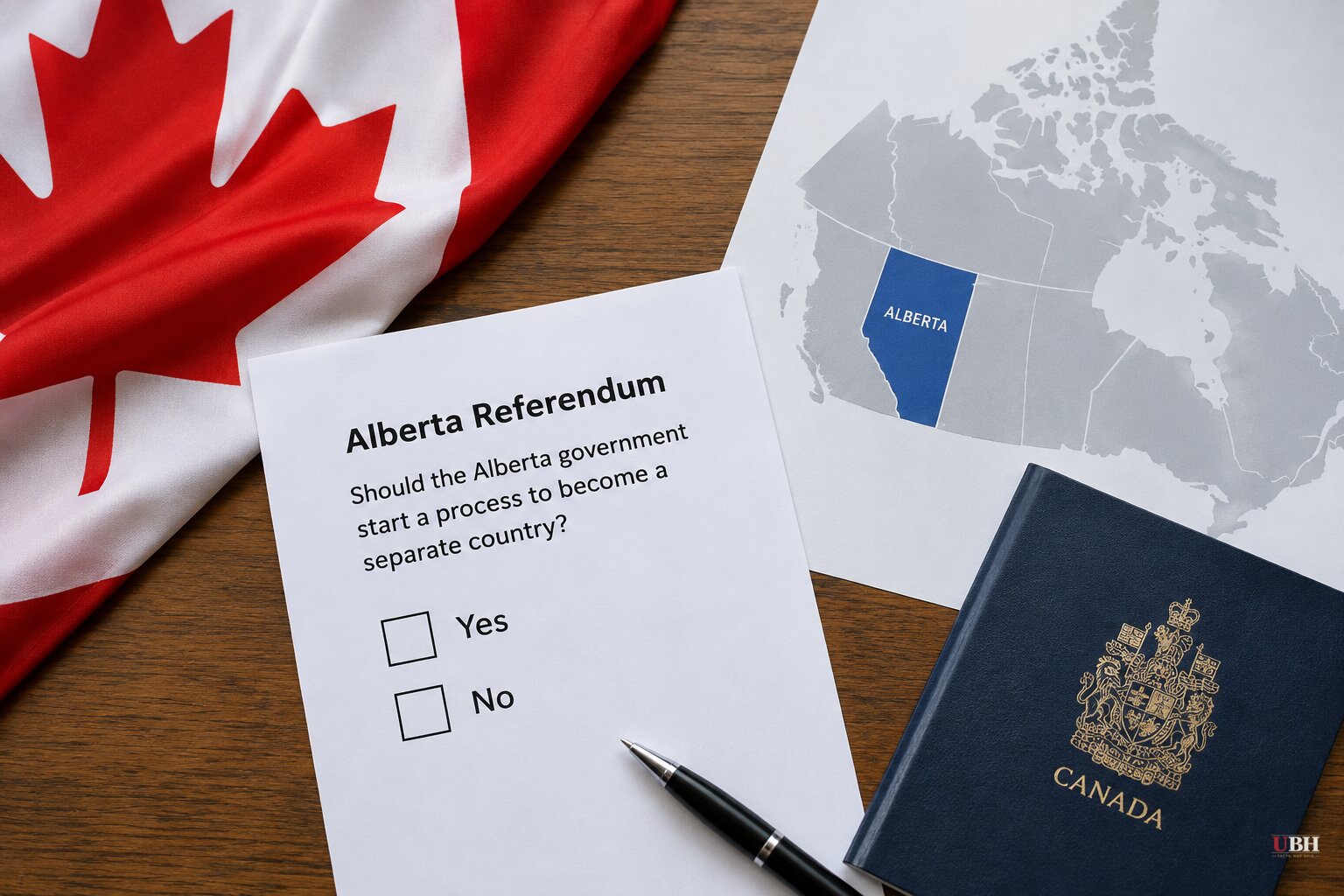
Since Premier Danielle Smith called the Oct. 19 referendum, the campaign has drawn in Ottawa, a newly elected separatist government in Quebec and the X account of Elon Musk.
The latest push came Monday, Oct. 12. Prime Minister Mark Carney, who grew up in Edmonton, recorded a Thanksgiving video message at his old school, St Francis Xavier High School, and made the case for staying together.
"We can't build big things on fault lines," Carney said. "We have to be strong, and we are stronger together."
He warned that a yes to the second option on the ballot would start a "long and uncertain process" at a dangerous time for the country. He pointed to what he says is being built in Alberta: thousands of new homes, high-speed rail and a proposed West Coast pipeline meant to open new markets and reduce Canada's dependence on U.S. oil buyers.
What Albertans are actually voting on
The ballot does not ask Albertans to leave Canada. It asks: "Should Alberta remain a province of Canada, or should the Government of Alberta commence the legal process required under the Canadian Constitution to hold a binding provincial referendum on whether or not Alberta should separate from Canada?"
The vote itself is non-binding. A majority for the second option would only authorize the provincial government to begin the constitutional process toward a later, binding referendum.
Smith, who called the vote, supports remaining in Canada and says she will vote that way because "Canada can work." She has said the referendum gives a voice to the hundreds of thousands of Albertans on both sides. She has also said recent polling puts support for separation at roughly 22%, a level she called "still too high for my liking."
The separatist argument
The movement says Ottawa has treated Alberta's oil and gas industry, the cornerstone of the provincial economy, unfairly through federal energy and environmental policy. Some of its leaders came out of the 2022 "Freedom Convoy" protests against pandemic restrictions.
Keith Wilson, a leader of the independence movement, has urged Albertans to back a path toward a referendum, arguing the province needs "leverage and lasting change" in its dealings with Ottawa. "What protects us when Ottawa turns against Alberta again?" he wrote on social media.
That grievance is not confined to separatists. Saskatchewan Premier Scott Moe, who opposes separation, has attributed Western separatist talk to a decade of federal policies he says failed to consult the affected provinces. Moe has also said Smith is "following the law" by holding the vote.
Washington and Musk enter the picture
The Globe and Mail reported earlier this month that U.S. Republican operatives met with Alberta secession organizers to discuss campaign strategy. According to the Globe's investigation, separatist leaders reportedly offered access to the province's water and oil royalties in exchange for U.S. support. Separatist leaders dispute those claims. No evidence beyond the Globe's reporting has been presented in public.
Musk weighed in after the Quebec election. "Good. Quebec should separate," he wrote on X. "They would be better off. Alberta and Saskatchewan should separate too."
Moe answered with one word: "No." Smith did not reply on X but issued a statement saying, "Our government, our Caucus, and our party support Alberta remaining in Canada."
President Donald Trump's trade war and his repeated talk of making Canada the 51st state have strained relations with Ottawa, which is the backdrop to all of it.
Quebec's separatists are in a different position
The Parti Québécois won Quebec's election last week, returning to power after more than a decade. It took 59 seats, short of a majority, so leader Paul St-Pierre Plamondon will need opposition support to pass legislation and survive confidence votes.
St-Pierre Plamondon has pledged another independence referendum but has said he would wait until Trump is out of office. "That dream will be realized one day," he said in his victory speech.
Daniel Béland, a political science professor at McGill University, said the result was "not an election about independence, which is not popular in Quebec right now, but about getting rid of the CAQ." The Coalition Avenir Québec, in power since 2018, was shut out of the legislature, and its leader, Christine Fréchette, lost her own seat. Support for independence in Quebec sits at about 30%, according to Béland.
What happens next
Albertans vote Monday, Oct. 19. If the second option wins, the Alberta government would begin the constitutional process toward a binding referendum, and the questions of timing and terms would fall to Smith, who has said she personally opposes leaving.
If the "remain" side wins, the unanswered question is whether the grievances Wilson and Moe both describe, over federal energy and environmental policy, get any response from Ottawa. Carney's pipeline and rail projects are his answer so far.
Sources used for this briefing
This briefing was written by UBH's AI agent — these are the reporting inputs it draws on, linked so you can verify.


