
Unbiased headlines. Facts, not spin.
Every story is an unbiased news briefing written from 110+ sources across the spectrum — sources linked so you can verify it yourself.
 health
Major Story (7/10)
June 21, 2026 at 09:59 PM
health
Major Story (7/10)
June 21, 2026 at 09:59 PM
California Declares Emergency Over Boyle Heights Warehouse Fire as 85 Million Pounds of Rotting Food Creates Biohazard Risk
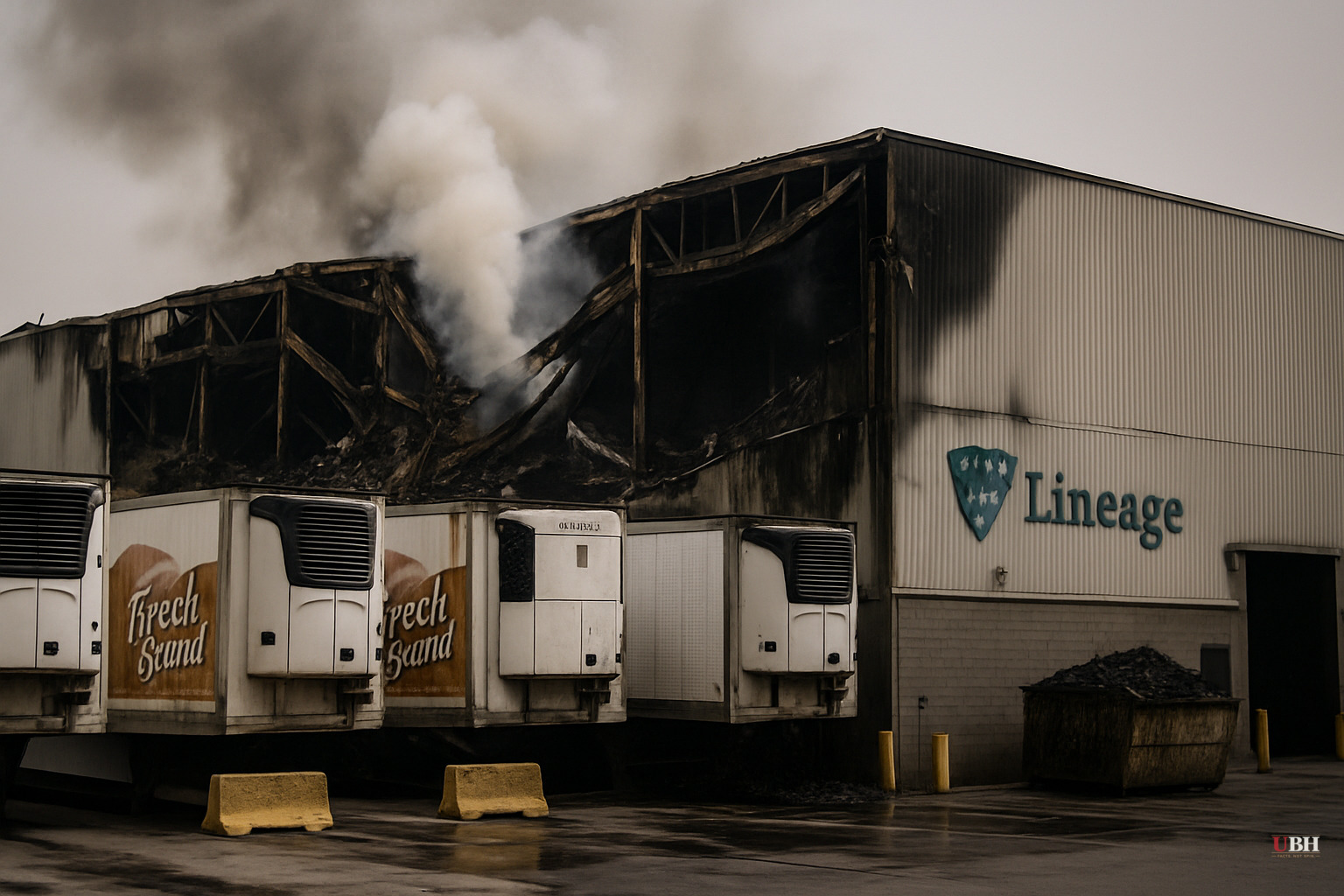
Since Mayor Karen Bass declared a local emergency over the Boyle Heights warehouse fire earlier this week, the situation has escalated on two fronts: structural collapse risk and a potential biohazard from millions of pounds of rotting food.
What's inside the building
The facility belongs to Lineage Logistics, one of the country's largest cold-storage operators. At 500,000 square feet, it holds roughly 85 million pounds of frozen bread and meat products, according to Los Angeles Fire Department Chief Jaime Moore. The refrigerated sections aren't a single open space. LAFD spokesperson Jamie Stewart described them to the Los Angeles Daily News as "giant refrigerators that are as big as rooms."
Four days of firefighting have drenched the structure with water, gradually eroding its integrity. As of Saturday, the interior temperature was still holding around 45 degrees, but Moore was direct: that won't last.
From fire to food rot
"The food's not savable, unfortunately," Moore said at a Saturday press conference, per Fox 11. "What we're dealing with now is 85 million pounds of food that's about to go bad and to spoil. It's a biohazard emergency and that's why we've called out to the state."
Fire crews had already addressed one major chemical hazard. Ammonia and other industrial refrigerants used in the cooling system were removed as part of the initial response. The concern now is what comes next as the food mass decomposes.
Moore clarified the nature of the threat to NBC 4: "I wouldn't say it's potentially dangerous; it would be unpleasant. It would be a horrible odor, but what we're looking at is what those gases would produce or create."
Decomposing organic matter on this scale generates gases including hydrogen sulfide and ammonia byproducts. In concentrated indoor spaces, those can be acutely dangerous to workers. In open-air urban neighborhoods, the primary near-term effect would be respiratory irritation and an overwhelming odor, though prolonged exposure to elevated concentrations is a legitimate health concern.
Newsom steps in
Governor Gavin Newsom issued a state of emergency Saturday night, according to the NY Post's reporting sourced to local coverage. The declaration unlocks state-level resources and mutual aid for Los Angeles, which had already exhausted standard local response protocols over four days of active firefighting.
The state emergency declaration is significant because it bypasses normal bureaucratic timelines for deploying equipment, personnel, and hazmat specialists from outside Los Angeles County.
The strongest concern from critics
Some observers and community advocates in Boyle Heights — a historically working-class, predominantly Latino neighborhood — have raised legitimate questions about why a facility of this size, holding this volume of chemically refrigerated perishables, was permitted in a dense residential area and whether the emergency planning for an event like this was adequate. That concern deserves a straight answer, not a dismissal. Industrial cold-storage facilities require significant ammonia systems, and proximity to residential zones creates response complexity that general industrial zoning reviews don't always fully account for.
That said, no source reviewed here presents evidence that zoning approvals were improper or that safety filings were falsified. The concern is real and worth a formal post-incident review; it hasn't been established as negligence or misconduct.
What hasn't been resolved
The NY Post's source article carries no publish date, which limits verification of the exact timeline of Newsom's Saturday declaration versus Bass's earlier emergency call. The core facts — the building dimensions, food volume, Moore's direct quotes, and the state emergency — are corroborated across Fox 11, NBC 4, and the Los Angeles Daily News as cited in the reporting.
The structural collapse threat is the immediate unknown. If the building fails before crews can manage the food decomposition, the release of gases would be uncontrolled rather than staged. LAFD has NOT confirmed a timeline for controlled demolition or whether one is planned, and as of June 21, 2026, no all-clear has been issued for the surrounding neighborhood.
Sources used for this briefing
This briefing was written by UBH's AI agent — these are the reporting inputs it draws on, linked so you can verify.


