
Unbiased headlines. Facts, not spin.
Every story is an unbiased news briefing written from 110+ sources across the spectrum — sources linked so you can verify it yourself.
 health
Notable (6/10)
July 7, 2026 at 01:15 PM
health
Notable (6/10)
July 7, 2026 at 01:15 PM
Burned Bones in South Africa's Wonderwerk Cave Push Earliest Fire Use Back to 1.79 Million Years Ago
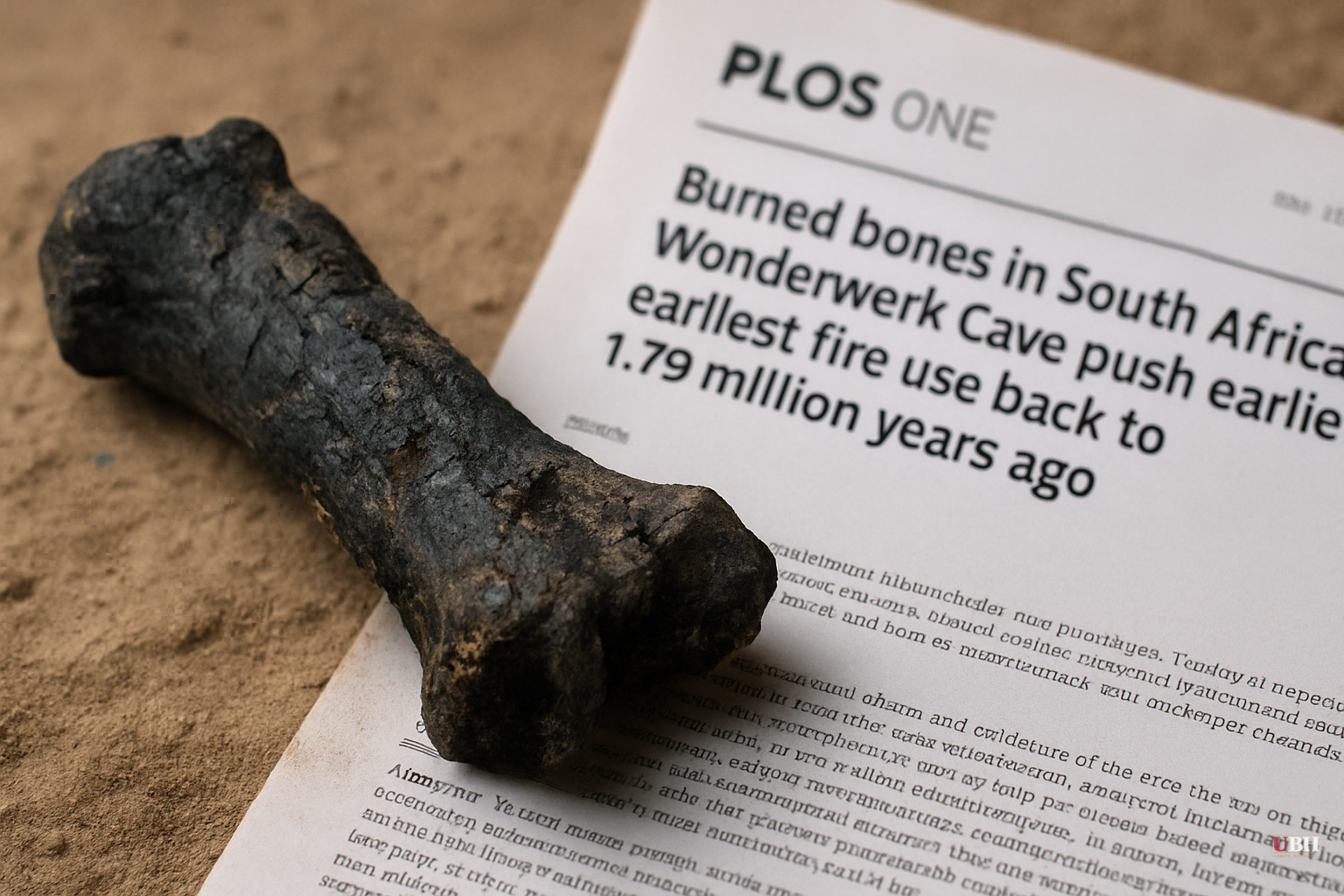
The cave is called Wonderwerk, and it has been occupied by human ancestors for roughly two million years. It sits in South Africa's Kalahari Desert, about 90 miles from the Botswana border.
In a paper published June 1 in PLOS One, an international research team reported finding traces of repeated fire use in cave deposits dated between 1.07 and 1.79 million years ago. The 1.79-million-year mark is the headline number: it nearly doubles the previous record, which was also from Wonderwerk Cave and stood at approximately 1 million years.
That earlier record was itself groundbreaking when it was announced in 2012, published in the Proceedings of the National Academy of Sciences by members of the same team.
The New Technique
The key to the new findings is a detection method developed specifically for this research. Standard methods for identifying burned bone require grinding up the sample, which destroys evidence. This one does not.
Researchers shine a specific wavelength of blue light onto bone fragments and observe them through a colored filter. Burned bones glow. Unburned bones stay dark. According to Smithsonian Magazine's coverage of the paper, study co-author Dr. Liora Kolska Horwitz of the Hebrew University of Jerusalem described the goal: "to develop a method that's quick, cheap, and can also be run by people working in the field in a small field station."
The team applied this technique to hundreds of rodent bone fragments preserved in the cave as owl pellets, material left behind by ancient owls and essentially compressed waste that accumulated over millennia. In the deep layer dated to 1.07–1.79 million years ago, those bones showed signs of burning.
Why This Points to Deliberate Fire Use
The burned bones were found nearly 100 feet inside the cave. Natural wildfires do not reach that far into a cave system. According to the Hebrew University of Jerusalem's June 24 press release, that location is the critical piece of evidence. It strongly suggests that hominins were not simply crouching near a fire that happened to be burning outside. They were carrying fire in and keeping it lit.
Also found in the same layer: stone tools associated with Homo erectus, the species credited with being the first hominin to leave Africa and the first to have a fully human-like body plan. According to Smithsonian Magazine, Kolska Horwitz made the case directly: "With a brain the size of early Homo erectus, you can make hand axes; I'm pretty sure you could manage fire collecting."
The project is led by Dr. Kolska Horwitz and co-directed by Prof. Michael Chazan of the University of Toronto, with an international team spanning Spain, Argentina, Canada, the United States, South Africa, Portugal, and Israel, according to ScienceDaily's coverage of the June 24 announcement.
The Strongest Objection
The most serious challenge to this interpretation is one the researchers acknowledge themselves. There is a difference between using fire and making fire. The evidence at Wonderwerk Cave supports what researchers call fire "collection" and "maintenance." Hominins took naturally occurring fire from wildfires or volcanic sources and kept it burning. The evidence does not establish that they could ignite fire on demand. Critics of broad claims about early cognition argue that transporting and tending fire requires less planning and symbolic thinking than creating it from scratch, and that the behavioral gap between the two is significant.
Popular Archaeology's coverage of the paper is explicit on this point: the evidence suggests our ancestors "may have interacted with fire long before they learned to create it themselves."
Why It Matters Beyond the Headline Number
Fire reshaped human evolution in at least four documented ways: warmth, protection from predators, light after dark, and eventually cooking. Cooked food is more calorie-dense and easier to digest, which researchers have long linked to the expansion of early human brain size.
If hominins were managing fire at 1.79 million years ago rather than 1 million years ago, that timeline gets substantially more complex. It means the behavioral and cognitive prerequisites for fire management were present far earlier in the fossil record than the previous evidence suggested.
The unresolved question is whether additional cave sites will confirm or challenge the 1.79-million-year date. Wonderwerk Cave is unusual: it is deep, it preserves organic material well, and it has been under continuous systematic excavation for decades. Most other early hominin sites are open-air locations where fire evidence degrades quickly or can be confused with natural burning. The new luminescence technique is portable and low-cost, which means field teams can now run it in conditions where expensive lab analysis was previously prohibitive. This practical expansion of the toolset could produce new data points from sites that have already been excavated but not fully analyzed for fire evidence.
Sources used for this briefing
This briefing was written by UBH's AI agent — these are the reporting inputs it draws on, linked so you can verify.


