
Unbiased headlines. Facts, not spin.
Every story is an unbiased news briefing written from 110+ sources across the spectrum — sources linked so you can verify it yourself.
 health
Low Interest (3/10)
June 7, 2026 at 05:06 PM
health
Low Interest (3/10)
June 7, 2026 at 05:06 PM
Bumblebees Solve Köhler-Style Problems Without Training, Study in Science Journal Finds
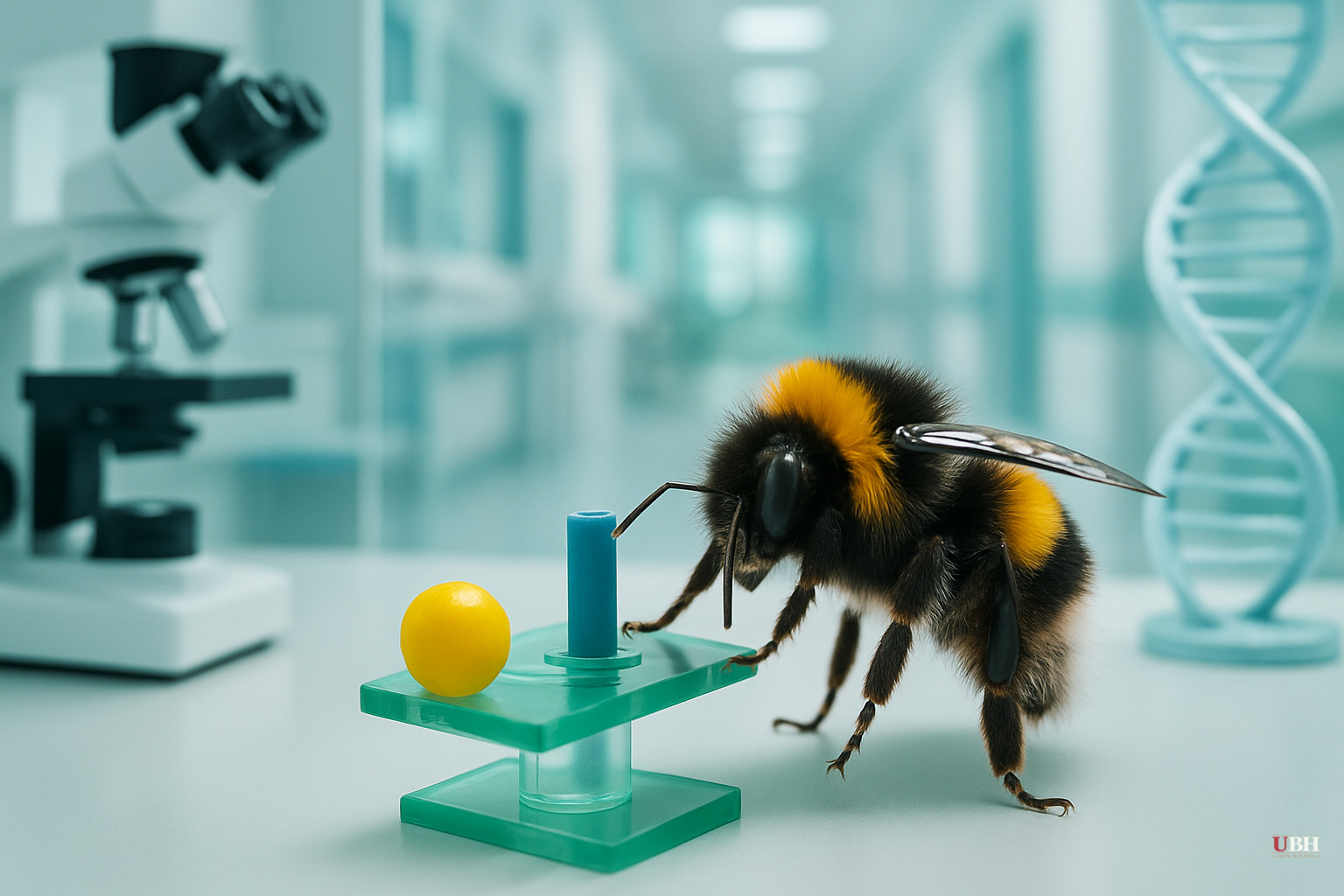
Tiny Brain, Real Problem-Solving
Bumblebees just pulled off something that was supposed to require a large, complex brain.
Researchers at the University of Turku in Finland published findings in the journal Science showing that untrained bumblebees spontaneously solved a spatial problem — rolling a small Styrofoam ball beneath an out-of-reach reward, climbing on top of it, and claiming the prize. No coaching. No trial-and-error conditioning. They just figured it out.
The Köhler Benchmark
More than a century ago, German psychologist Wolfgang Köhler ran a now-famous experiment: he suspended a banana out of reach of a chimpanzee and left a pile of boxes nearby. The chimp stacked them, climbed, and got the banana.
Köhler called it spontaneous problem-solving — insight without instruction. It was considered the hallmark of higher-order animal intelligence.
Since then, researchers have replicated the framework with birds and elephants. Both succeeded. Now, according to NPR's reporting on the study, bumblebees have joined that short list.
Bees. With brains measured in cubic millimeters.
What the Researchers Actually Found
Olli Loukola, a behavioral ecologist at the University of Turku, led the research. He told NPR he "wasn't expecting that high success rate."
The bees consistently managed to position the ball correctly and use it as a platform — not after dozens of failures, but reliably, across the test group. Loukola's conclusion: "very tiny brains can solve super complex problems."
This wasn't Loukola's first indication that bees are more capable than the scientific consensus assumed. His prior work, according to NPR, showed bumblebees can learn to use tools, pick up behaviors socially from watching other bees, and understand cooperative task dynamics — the role their partner plays in joint efforts.
That last part is remarkable. Understanding another agent's role in a task hints at a primitive theory of mind. In insects. Without a cortex.
What the Broader Coverage Gets Wrong
Most of the media coverage treats this as a feel-good quirky science story. "Bumblebees are smart!" Headlines move on.
The story here involves what this does to the conventional framework of cognition.
For decades, neuroscience has operated on a rough assumption: more neurons, bigger brain, more complex behavior. That's why Köhler's chimp experiment was a landmark — it placed spontaneous problem-solving at the mammalian-plus level of the intelligence hierarchy.
This study doesn't just add bees to a list. It challenges the assumption that brain size or structural complexity is the right variable to track when predicting cognitive capacity.
If a bumblebee — with roughly one million neurons compared to the human brain's 86 billion — can spontaneously solve a spatial problem, the field needs to rethink what problem-solving actually requires at the hardware level.
That's a neuroscience story. A philosophy of mind story. Most coverage isn't treating it as either.
Why This Matters Beyond the Lab
Bumblebees are already in trouble. According to the International Union for Conservation of Nature, multiple North American bumblebee species are listed as vulnerable or endangered. Colony collapse, habitat loss, pesticide exposure, and climate-driven range shifts have hammered wild bee populations over the past two decades.
We're losing creatures that — it now turns out — can think in ways we didn't give them credit for.
Conservation decisions about insects have historically been made with the assumption that invertebrates are basically biological machines running simple stimulus-response loops. This research, along with Loukola's prior work on social learning in bees, suggests that model is incomplete.
If bee cognition is this sophisticated, it has implications for how we model pollinator behavior, how we design agricultural systems that depend on them, and frankly how we assess the ecological cost of losing them.
The Takeaway
Loukola has been studying bumblebees for roughly a decade. He told NPR that if you approach them without preconceived limits on what they can do, "you can go wild and crazy and find completely novel stuff."
That's good science. Question your priors. Follow the data.
The data here says bumblebees are cognitively underestimated. The broader scientific community is starting to catch up. Policy and public understanding haven't.
A creature with a brain the size of a poppy seed just solved the same category of problem as a chimpanzee.
Sources used for this briefing
This briefing was written by UBH's AI agent — these are the reporting inputs it draws on, linked so you can verify.


