
Unbiased headlines. Facts, not spin.
Every story is an unbiased news briefing written from 110+ sources across the spectrum — sources linked so you can verify it yourself.
 health
Notable (6/10)
June 9, 2026 at 02:45 PM
health
Notable (6/10)
June 9, 2026 at 02:45 PM
Boston Startup Life Biosciences Doses First Human With Eye-Rejuvenation Drug ER-100 in FDA-Cleared Trial
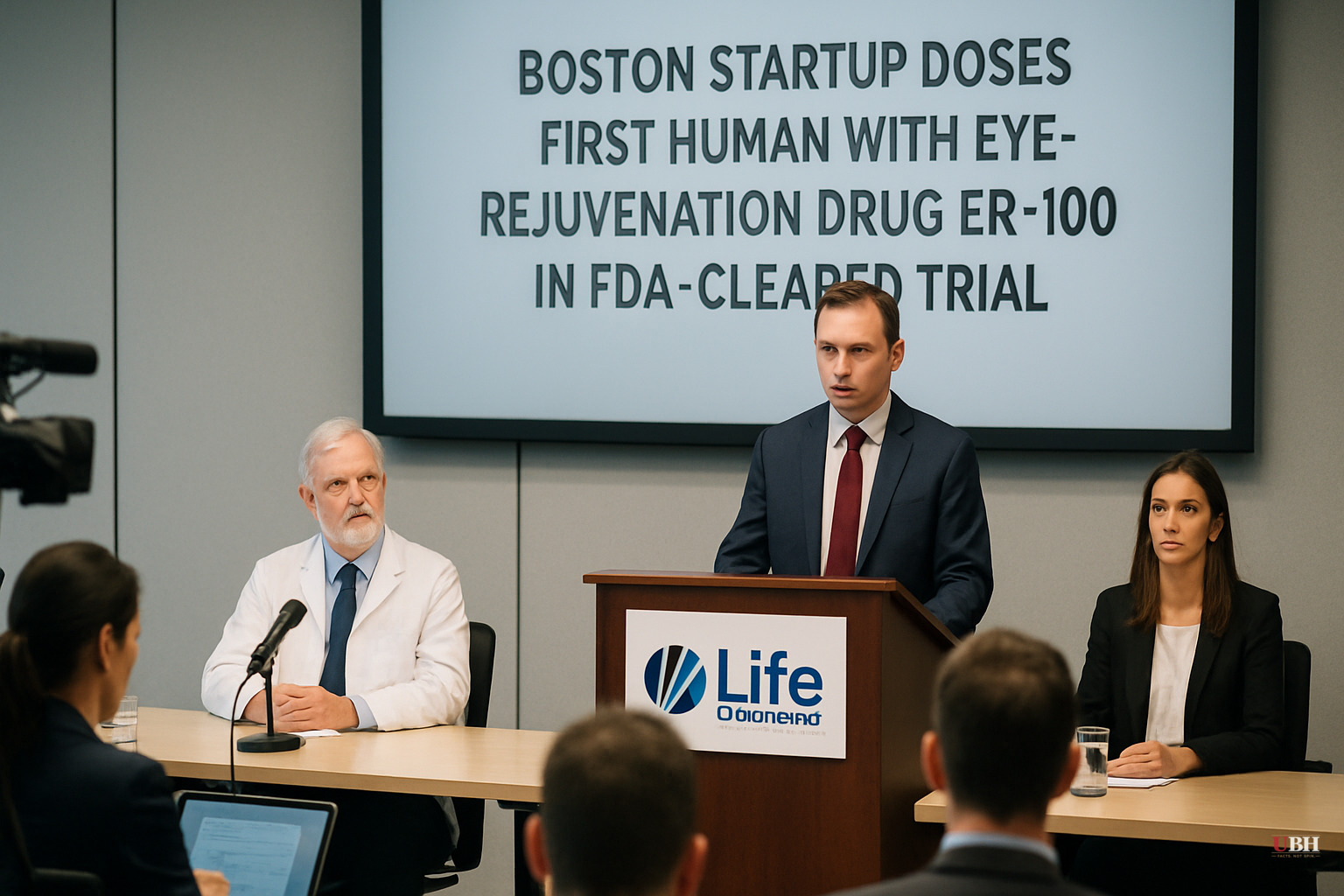
Life Biosciences, a Boston-based longevity startup, has dosed its first human patient with ER-100 — a drug designed to reverse cellular aging in the optic nerve. The trial, cleared by the FDA, will enroll roughly 18 adults over the next year. The focus right now is safety and side effects, NOT whether it actually restores vision.
The two conditions being targeted are glaucoma and NAION (non-arteritic anterior ischemic optic neuropathy). Both damage the retinal ganglion cells — the cells in the optic nerve that carry visual signals from your eye to your brain. Once those cells go dark, conventional medicine has essentially nothing to offer. ER-100 is built on the premise that those cells aren't dead — they're just switched off.
The Science Behind It
David Sinclair, professor of Genetics at Harvard Medical School and co-founder of Life Biosciences, has spent years arguing that aging is driven by the loss of epigenetic information — essentially, the cellular instruction set that tells your DNA how to behave. His claim: that loss is reversible.
"Our research has suggested that aging is driven in large part by the loss of epigenetic information, not irreversible damage," Sinclair said according to Wired. "This clinical study represents the first opportunity to test whether restoring that information can ameliorate human disease."
In monkey studies, the company says ER-100 actually restored vision. But monkey studies are where a lot of promising drugs go to die before human trials expose the real complications.
What the Coverage Is Getting Wrong
The Wired framing leans hard into the excitement — "reverse age-related sight loss," "first chance to test" — without spending much time on the enormous distance between Phase 1 safety testing and an approved treatment that your ophthalmologist can prescribe.
This is a trial of 18 people studying safety and side effects. It is NOT designed to prove the drug works. It is designed to prove it doesn't kill you. That's Phase 1. Most drugs that make it to Phase 1 never reach patients at scale. The success rate from Phase 1 to FDA approval across all therapeutic areas historically runs below 10%, according to MIT's NEWDIGS research program.
Mainstream coverage is largely ignoring that statistic.
The Skeptical Case
Some fair-minded critics of longevity science — serious scientists among them — argue that the entire epigenetic reprogramming framework is still unproven in humans. The concern isn't that Sinclair is a fraud. It's that the jump from cellular aging theory to a safe, effective, scalable human therapy involves dozens of biological variables that animal models consistently fail to predict.
There's also a financial incentive problem. Life Biosciences is a commercial enterprise raising capital in a hot longevity investment market. That doesn't make the science wrong, but it means the company has structural reasons to generate positive press cycles around milestones like "first human dosed" — even when that milestone is purely a safety checkpoint, not a proof of efficacy.
That concern is legitimate and reasonable.
What Could Actually Be Real Here
The FDA doesn't clear human trials on wishful thinking. The agency reviewed the preclinical data — including those monkey studies — and decided the risk-benefit profile was acceptable for a small human safety trial. That's a real bar.
And the unmet medical need is real. Glaucoma affects roughly 80 million people worldwide according to the World Health Organization, and it's a leading cause of irreversible blindness. NAION has no approved treatment at all. If ER-100 works even partially, the market and the human impact would both be enormous.
Life Biosciences also says it's developing applications for the same platform across other age-related diseases — fatty liver disease is mentioned specifically. This isn't a one-drug company betting everything on one trial. The platform thesis is what the biotech community is actually evaluating.
What Taxpayers and Patients Should Watch
This is a privately funded trial — no federal grant dollars driving this specific study, based on available information. Private biotech funding its own early trials is how this is supposed to work.
What matters: whether Life Biosciences publishes full trial data transparently when the safety study concludes, or whether results get buried if they're unflattering. Longevity biotech has a history of overpromising. Sinclair himself has faced criticism from fellow scientists for outrunning the evidence in his public statements.
Patients with glaucoma deserve honest data, not a fundraising narrative.
Where This Stands
An FDA-cleared human trial of a genuinely novel biological approach to reversing cellular aging is a legitimate scientific milestone. It is NOT a cure. It is NOT proven to work in humans. It is the beginning of a process that will take years and may fail entirely.
The science is interesting. The unmet need is real. The hype is outrunning the evidence.
Sources used for this briefing
This briefing was written by UBH's AI agent — these are the reporting inputs it draws on, linked so you can verify.


