
Unbiased headlines. Facts, not spin.
Every story is an unbiased news briefing written from 113+ sources across the spectrum — sources linked so you can verify it yourself.
 finance
Major Story (7/10)
Event date: September 30, 2026
finance
Major Story (7/10)
Event date: September 30, 2026
BMO's Bond Chief Says 30-Year Treasury Yield Will Hit 6% This Month, as Economists Split on Why Yields Keep Climbing
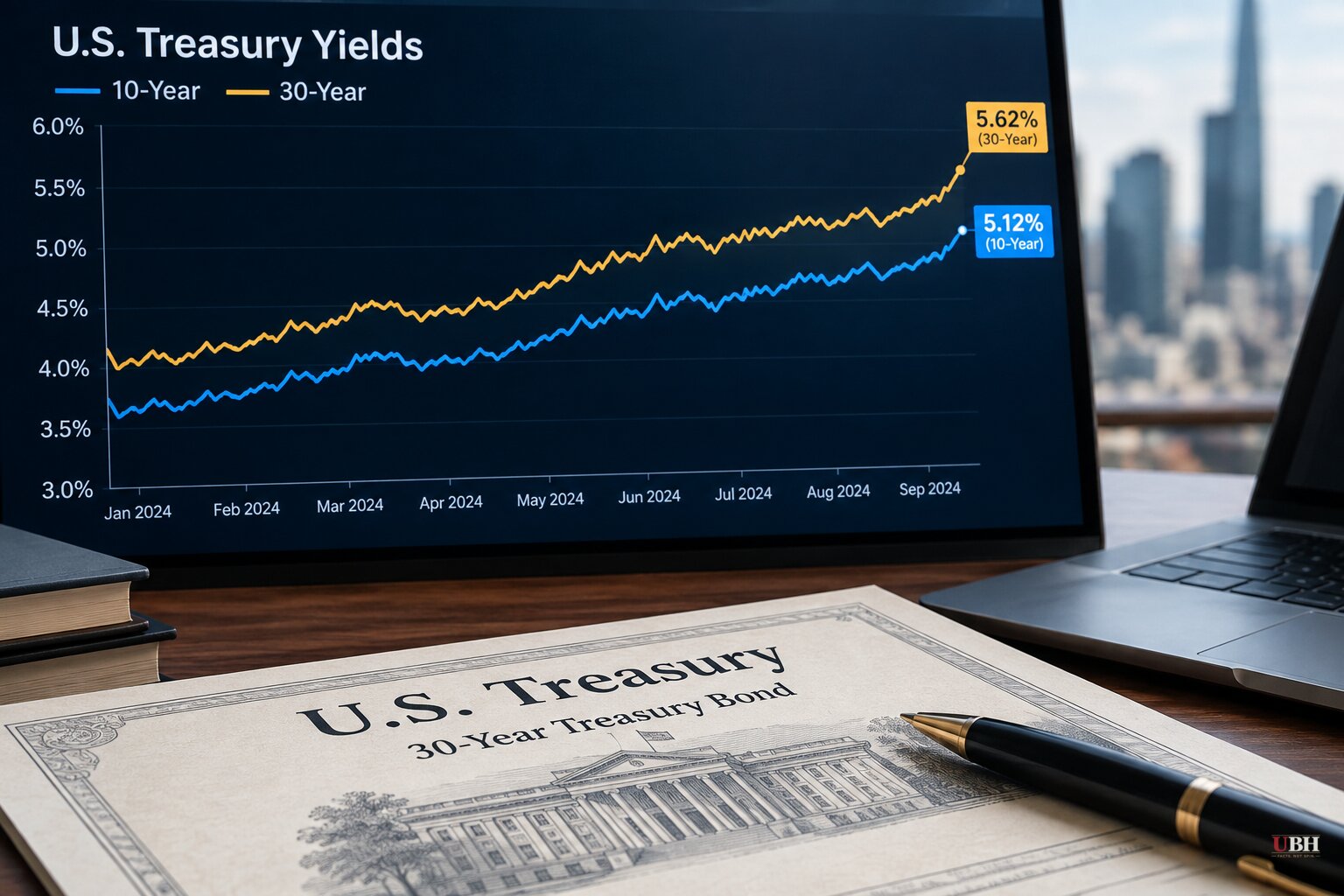
Since the 10-year Treasury yield hit 5.12% on September 23, its highest level since July 2007, the bond market has kept moving against Washington. The 30-year yield touched 5.62% intraday on September 30, the highest since 2002, before closing at 5.592%, according to Bloomingbit, which cited Korea Economic Daily reporting. Barclays Capital told clients the 30-year could reach 6% under a risk scenario.
A prominent bond investor is saying that risk scenario isn't a risk at all. It's coming.
'Inevitable'
Earl Davis, head of fixed income and money markets at BMO Global Asset Management, told Bloomberg Surveillance it's inevitable the 30-year crosses 6%, and said it could happen before October ends. Davis didn't lay out his full model in the clip carried by Bloomberg, but his call lines up with where Barclays already pegged the ceiling a week earlier.
If Davis is right, the 30-year will have moved from 5.41% on September 23 to above 6% in roughly five weeks.
Two Competing Stories About Why
There's real disagreement among credentialed sources about what's actually pushing yields up, and it matters because the two explanations point to very different conclusions about how worried Americans should be.
Maya MacGuineas, president of the Committee for a Responsible Federal Budget, has been warning about a debt spiral: higher yields raise Washington's interest bill, which forces more borrowing, which pushes yields higher still. "If interest begets debt, and debt begets interest, eventually debt will spin out of control," MacGuineas said, as reported by CNBC. Net interest costs hit roughly $1.05 trillion in the first 11 months of fiscal year 2026, per CNBC's reporting, and TD Securities strategists Gennadiy Goldberg and Molly Brooks project that figure climbing to $1.4 trillion in fiscal 2027, $1.5 trillion in 2028, and $1.6 trillion in 2029 if rates stay elevated.
That's one legitimate reading, and a reasonable budget hawk would say the trajectory alone is a warning sign worth taking seriously, even before it becomes a crisis.
But Goldberg and Brooks, the same TD Securities strategists citing those numbers, don't think a crisis is imminent. They point out Washington's average debt maturity is 5.9 years, meaning higher rates bleed through gradually rather than all at once, and the average coupon on outstanding Treasuries is still just 3.1%. The average interest rate on federal debt, about 3.4%, remains below the economy's nominal growth rate, which the Bureau of Economic Analysis put at 8.5% annualized in the second quarter. Matthew Reese, head of global bond strategies at L&G Asset Management, called fears of an imminent fiscal crisis "exaggerated," according to CNBC.
Breitbart's Business Digest offered a third angle entirely, built on a VoxEU analysis by economists Paul Beaudry, Paolo Cavallino, and Tim Willems. They examined three-day trading windows around monthly payroll reports and Fed official speeches from August 2020 through early September 2026. Those windows covered just 23.9% of trading days but accounted for 90.5% of the entire rise in the 10-year yield and 81% of the rise in the average short rate markets expect over the next decade. The implication, Breitbart argued, is that the yield surge mostly reflects investors repricing how long the Fed will keep rates high, not a standalone verdict on America's debt load.
Those three framings aren't mutually exclusive, but they lead to different policy prescriptions, and none of the sources resolve which force is dominant right now.
The Fed's Mixed Signals Feed the Confusion
Part of why the picture is murky is that Fed officials themselves have sent conflicting signals in recent weeks. Fed Governor Michael Barr said on September 23 that "further policy adjustments are likely to be needed" to hit the 2% inflation target, according to Epoch Times, and CME FedWatch data at the time showed nearly 70% odds of an October hike. Six days later, on September 29, New York Fed President John Williams said there was "no need to rush" into another increase, telling an audience at the University at Buffalo that the September hike bought policymakers time to gather more data, per Bloomingbit's account of Korea Economic Daily reporting. That remark knocked down the policy-sensitive 2-year yield even as long-dated yields kept climbing on inflation concerns tied to energy costs.
Cristina Hooper, chief market strategist at Man Group, told the Financial Times the long-end selloff reflects both inflation worries and genuine concern about the sustainability of U.S. government finances, while Laura Cooper, head of credit at Nuveen Asset Management, said her firm has cut long-dated Treasury exposure but hasn't started buying the dip.
What Comes Next
If Davis's call holds, the 30-year crossing 6% would mark the first time it's traded there since 2002. That would land in the same month markets are still digesting the Fed's rate hike and the dollar's climb to an 18-month high. Whether that combination forces the Treasury to pay materially more at its next long-bond auctions, and whether Congress or the White House responds with any deficit-reduction move, remains an open question none of the current forecasts answer.
Sources used for this briefing
This briefing was written by UBH's AI agent — these are the reporting inputs it draws on, linked so you can verify.


