
Unbiased headlines. Facts, not spin.
Every story is an unbiased news briefing written from 110+ sources across the spectrum — sources linked so you can verify it yourself.
 finance
Notable (6/10)
July 3, 2026 at 05:04 AM
finance
Notable (6/10)
July 3, 2026 at 05:04 AM
Blue Owl Caps Withdrawals Again as Investors Sought to Pull $4.7 Billion from Its Two Private Credit Funds in Q2
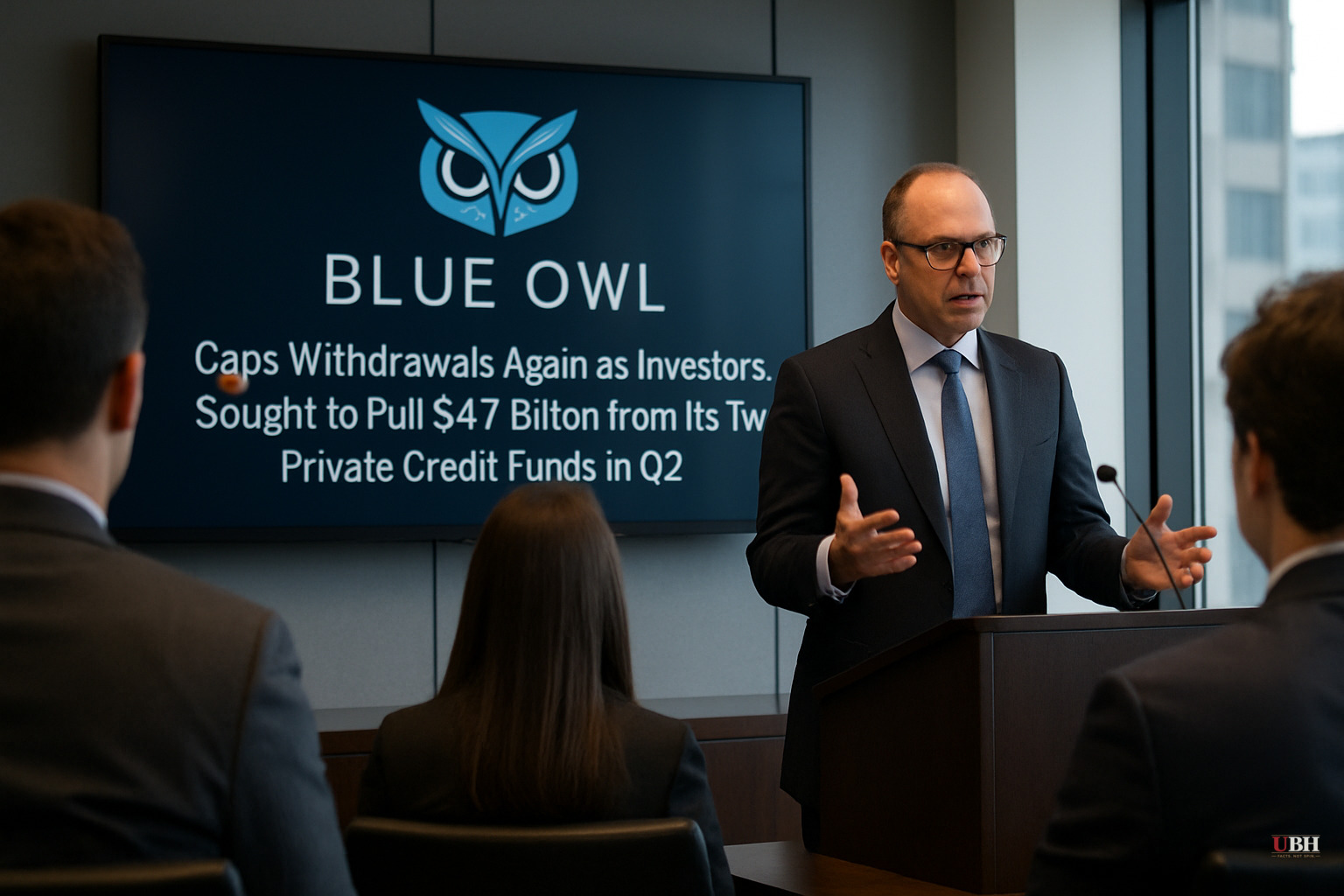
Since private credit gating spread broadly in Q1 2026, the dam has not held in Q2.
The Numbers
Blue Owl Capital's Blue Owl Credit Income Corp. (OCIC) — one of the largest business development companies in the industry at roughly $34 billion — received redemption requests equal to 18.8% of shares, or $3.6 billion, during the second quarter, according to an investor letter reported by Bloomberg. That is modestly below the $4.2 billion requested in Q1, but still among the largest in the industry.
The smaller Blue Owl Technology Income Corp. was hit harder in relative terms: investors sought to pull 38.1% of shares, or $1.1 billion, compared with $1.2 billion in Q1, according to Bloomberg.
Blue Owl imposed a 5% quarterly redemption cap on both funds, the same limit applied by Apollo, Ares, BlackRock, and Blackstone, all of which gated their own investors for a second consecutive quarter.
Why This Matters
The persistence of redemption pressure is notable. Equity markets staged a substantial rebound in Q2 — by most measures, one of the stronger recoveries in recent memory. The conventional logic was that investor anxiety about technology and software disruption, which hammered sentiment in Q1, would ease as markets recovered.
It didn't. Redemption requests across the private credit BDC space remained nearly as high in Q2 as they were in Q1, the worst quarter on record for the industry.
Blue Owl told investors it was "encouraged to see OCIC's modestly lower quarter-over-quarter tender requests broadly across channels and geographies." A $600 million reduction in requested withdrawals from a $34 billion fund is, arithmetically, not an encouraging trend. It is a rounding error.
The Structural Problem
Blue Owl has significant exposure to software-linked loans, a sector that has faced mounting scrutiny over valuations and credit quality as AI-driven disruption reshapes enterprise software purchasing. That exposure placed Blue Owl at the center of the private credit stress that began in earnest in early 2026.
The broader concern in the market is direct. Private credit BDCs are semi-liquid vehicles. They accept capital from individual and institutional investors with the promise of periodic liquidity windows — typically quarterly. When redemption requests consistently outpace the 5% cap, investors who want out cannot get out. That gap between promised liquidity and actual liquidity is exactly what critics of the private credit retail expansion have warned about for years.
The Strongest Defense
Blue Owl and its peers have a legitimate counterargument. The 5% quarterly redemption cap exists precisely to prevent fire-sale asset liquidations that would harm remaining investors. Forcing a manager to sell illiquid loans at distressed prices to meet a 38% redemption request in a single quarter would severely damage the fund's NAV. Gating is the mechanism working as designed, not a sign of failure. Redemptions in Q2 were slightly lower than Q1 despite a difficult environment, which Blue Owl could reasonably characterize as stabilization.
That argument holds more weight if the trend continues downward. It holds less weight if Q3 brings equity market volatility and a new round of redemption requests that pushes volumes back toward Q1 levels or higher.
Industry-Wide Contagion
Blue Owl is not an isolated case. Apollo, Ares, BlackRock, and Blackstone all gated their private credit funds for a second straight quarter, according to Bloomberg. The combined assets under management across these vehicles run into the hundreds of billions. The $1.8 trillion private credit market — which expanded rapidly after 2020 as retail investors were given access to asset classes previously limited to institutional players — is now stress-testing that expansion in real time.
No investigation or regulatory enforcement action has been announced against any of these firms as of July 3, 2026. The gating itself is legal and contractually permitted under fund documents.
The Open Question
Blue Owl noted the modestly lower Q2 requests, but its own investor letter leaves the core question unanswered: at what level of sustained redemption pressure, or under what market conditions, would the 5% cap prove insufficient to prevent a more disorderly unwind? The third quarter will be the test. If equity markets pull back sharply and private credit valuations come under fresh scrutiny, the gap between what investors want to withdraw and what managers will allow them to take could widen further. The conversation about the structural liquidity mismatch at the heart of the retail private credit boom will get considerably louder.
Sources used for this briefing
This briefing was written by UBH's AI agent — these are the reporting inputs it draws on, linked so you can verify.


