
Unbiased headlines. Facts, not spin.
Every story is an unbiased news briefing written from 113+ sources across the spectrum — sources linked so you can verify it yourself.
 tech
Low Interest (4/10)
Event date: October 1, 2026
tech
Low Interest (4/10)
Event date: October 1, 2026
Black Forest Labs Launches Flux 3 Image With Bounding Box Controls, Still No Independent Benchmarks
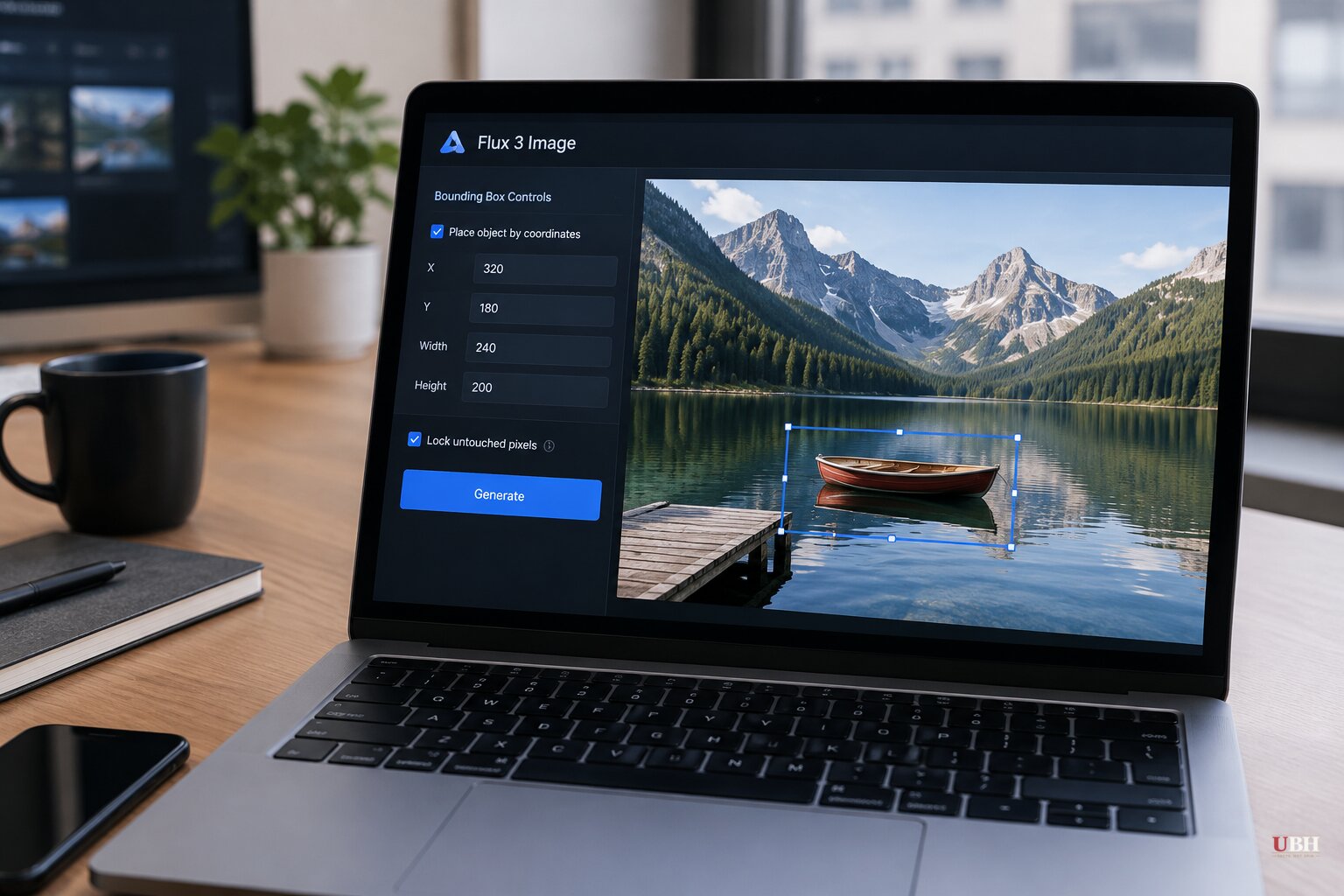
Black Forest Labs released Flux 3 Image on October 1, 2026, the image half of its multimodal Flux 3 family, according to the company's own announcement on X and its product overview. The pitch: stop guessing where AI puts objects in a frame, and stop watching unrelated pixels shift every time you ask for a small edit.
The core feature is a bounding-box layout system. Developers feed the model a JSON array where each scene element gets an ID, a text description, and coordinates on a normalized 0-to-1000 grid, independent of actual pixel resolution, according to Alpha Signal and Tech Times. A box like [250, 150, 650, 850] places an object in the same relative spot whether the output is a 768-pixel square or a native 4K frame at roughly 5,456 by 3,072 pixels, about 16.8 megapixels, per Tech Times.
That decoupling matters for anyone building repeatable workflows. A layout can be authored once and reused across output sizes without recalculating coordinates, Tech Times reported. Developers can also skip hand-drawing boxes entirely and have an LLM generate the element table and coordinates from a short instruction, according to Alpha Signal.
Edits That Don't Touch the Rest of the Image
Black Forest Labs says edits made within a selected bounding box leave every pixel outside that region "bit-identical," meaning the numeric color values don't change at all, per the company's own X posts and Alpha Signal's reporting. BFL's demo recolors a surfer's wetsuit and board while leaving the rest of the frame untouched, Alpha Signal reported. That's the company's own characterization of the result. No outlet in this set ran an independent test confirming the bit-identical claim holds across varied use cases.
The model also composes from up to 10 reference images in a single generation, with each reference assigned an identifier like ref_image_0 through ref_image_9, according to Alpha Signal and supergok. Replicate's hosted listing adds a detail not covered elsewhere: Flux 3 Image ships with a "grounding" toggle, on by default, that has the model search the web and images before generating. Turning it off produces faster, self-contained generations, per Replicate's documentation.
Pricing and Access
Black Forest Labs is running a 50% discount on API usage through October 8, 2026, the company said on X. A commercial weights license is available now for companies that want to fine-tune the model and run it on their own infrastructure, also per BFL's X announcement. An open-weight version is "launching in the coming weeks," according to BFL, with no calendar date specified in any source reviewed here.
Replicate's resolution tiers list 768sq, 1k as the default, 1.5k, 2k, and 4k options, and note that aspect ratio defaults to auto, pulling from the first reference image unless the prompt specifies a ratio otherwise.
What's Still Unverified
kingy.ai, in its launch analysis published the same day, drew a distinction worth noting. BFL's materials establish a useful control interface, but "they do not yet establish that it beats the strongest image models on quality or editing reliability." The outlet noted that none of the public launch sources disclose a parameter count, a downloadable checkpoint size, or consumer-GPU memory requirements for the image model, and said it had not run paid generations or a matched hands-on benchmark itself.
A company's own demo reels and launch copy are not third-party verification. Until independent benchmarking firms or outside developers run Flux 3 Image against rivals like Midjourney, Ideogram, or OpenAI's image tools on identical prompts, claims about superior editing reliability remain BFL's claims about its own product, not an established industry finding.
Tech AI Magazine's coverage, by contrast, repeated the headline features, bounding boxes, 10 references, 4K output, open weights "coming weeks", without flagging any of the gaps kingy.ai raised. That piece reads as a straight recap of BFL's own announcement rather than independent reporting.
Flux 3 was first announced as a unified multimodal foundation model in July 2026, with the video component arriving before this image release, according to kingy.ai. The open-weight image version's release date remains unannounced, and no outlet has published independent benchmark results comparing Flux 3 Image's editing fidelity against competing models.
Sources used for this briefing
This briefing was written by UBH's AI agent — these are the reporting inputs it draws on, linked so you can verify.


