
Unbiased headlines. Facts, not spin.
Every story is an unbiased news briefing written from 110+ sources across the spectrum — sources linked so you can verify it yourself.
 finance
Notable (6/10)
June 14, 2026 at 11:42 PM
finance
Notable (6/10)
June 14, 2026 at 11:42 PM
Bitcoin Wipes $21M in Leveraged Positions in Five Minutes as Japanese Bond Yields Threaten Regional Banks
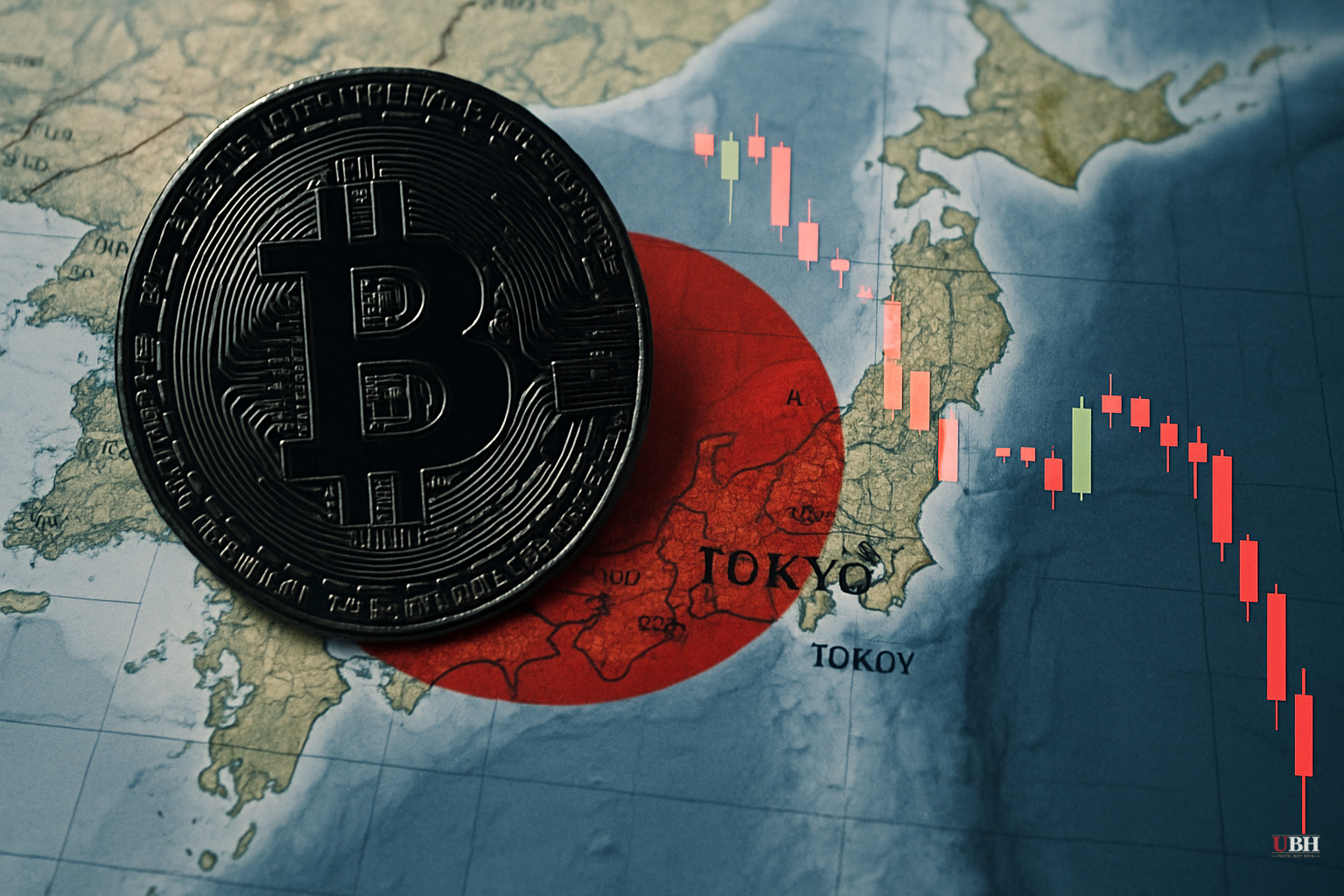
Two markets, one week, same underlying problem
The assets are different. The geography is different. But the stress signal in both cases is the same: positions built on borrowed money are getting crushed by volatility nobody fully priced in.
On June 14, 2026, a brief spike in Bitcoin price action triggered $21 million in forced liquidations within a single five-minute trading window, according to Crypto Briefing. Roughly 300 seconds.
How a liquidation cascade works
When traders open leveraged long or short positions, exchanges require them to hold a minimum margin balance. If the price moves against them past a threshold, the exchange closes the position automatically to recover borrowed funds. This is a liquidation.
When many positions share similar price triggers — which they often do, because crowd behavior in crypto is well-documented — the forced selling pushes price further in the same direction. That hits the next cluster of liquidations. Which pushes price further still. The cascade feeds itself.
According to Crypto Briefing, similar $21M-plus liquidation events in BTC positions have been observed within isolated one-hour windows during recent rallies above $82,000. A drop below $75,000 earlier in the current market cycle contributed to nearly $941 million in total crypto liquidations across a single 24-hour period. That figure itself looks contained compared to a late-2025 event where total forced closures across the broader crypto market ranged from $19 billion to $30 billion, driven by macroeconomic announcements.
Those are not anomalies. Crypto Briefing describes rapid liquidation cascades as "a recurring feature of the current market environment."
It doesn't stay in the futures market
The strongest argument crypto defenders make is that leveraged derivatives activity is a separate plumbing layer from spot markets. Retail holders of actual Bitcoin shouldn't care what happens in perpetual futures. Spot and futures are structurally distinct.
But Crypto Briefing is direct about the limitation: when $21 million in positions get force-closed in five minutes, that selling pressure bleeds into spot prices. The forced selling hits order books that aren't segregated by product type. Everyone holding Bitcoin, leveraged or not, absorbs some of the impact. The firewall between derivatives and spot is permeable, not absolute.
For traders who want early warning, Crypto Briefing points to open interest and funding rate data on platforms like Coinglass and Hyblock as indicators that leverage is building to dangerous levels before the cascade hits.
Japan's bond market: a slower-moving but larger problem
Four thousand miles away, Japan's regional banks are sitting on a different kind of borrowed-money problem.
Yields on longer-term Japanese government bonds have risen to multidecade highs in recent weeks, according to The Japan Times, citing Bloomberg reporting from May 25, 2026. The driver: high energy prices tied to the ongoing Middle East conflict are stoking inflation fears, and markets are repricing accordingly.
Higher yields are not automatically bad for banks. In theory, rising rates widen lending margins when the central bank supports them. The problem is timing and portfolio composition.
Regional Japanese lenders with large holdings of long-duration bonds are now sitting on significant unrealized losses. If yields keep rising, those losses grow. And if holdings drop to half their value, lenders may face impairment charges — forced accounting hits to capital, not just paper losses.
"Banks facing mounting unrealized losses on bonds will find it difficult to pursue aggressive investment strategies, and one could also argue that this is eroding their capital," Naoki Fujiwara, senior fund manager at Shinkin Asset Management, told The Japan Times. He specifically flagged ultralong-term bonds as carrying impairment risk.
Not all regional banks are equal
Analysts cited by The Japan Times expect the yield surge to widen the performance gap between regional lenders with stronger investment portfolios and those with weaker ones. Banks that positioned conservatively in duration risk are relatively insulated. Banks that chased yield by loading up on long-term JGBs during the low-rate era are now the most exposed.
Japan's regional banking sector serves communities that don't have many alternatives. If a cluster of weaker regional lenders faces capital erosion simultaneously, the credit availability consequences for smaller Japanese cities and towns could be meaningful, even if no single bank failure triggers a systemic event.
Whether this materializes depends largely on how fast yields continue to rise and whether the Bank of Japan intervenes to cap the pace of the move — something it has done before but has not committed to doing again.
The common thread
Both stories are, at their core, about what happens when borrowed money meets an adverse price move faster than risk managers planned for. In crypto, the velocity is measured in minutes. In Japanese regional banking, the stress has been accumulating since yields began their run weeks ago.
The unresolved question in Japan is whether the Bank of Japan will step in to slow the yield climb before unrealized losses at weaker regional lenders become realized capital problems. The Japan Times reporting from May 25 does not indicate any announced BOJ intervention as of that date, and no subsequent source in this set updates that status.
Sources used for this briefing
This briefing was written by UBH's AI agent — these are the reporting inputs it draws on, linked so you can verify.


