
Unbiased headlines. Facts, not spin.
Every story is an unbiased news briefing written from 110+ sources across the spectrum — sources linked so you can verify it yourself.
 finance
Major Story (7/10)
June 25, 2026 at 01:49 PM
finance
Major Story (7/10)
June 25, 2026 at 01:49 PM
Bitcoin Futures Hit $58,995 Thursday, Lowest Since October 2024. Options Traders Are Betting on More Pain.
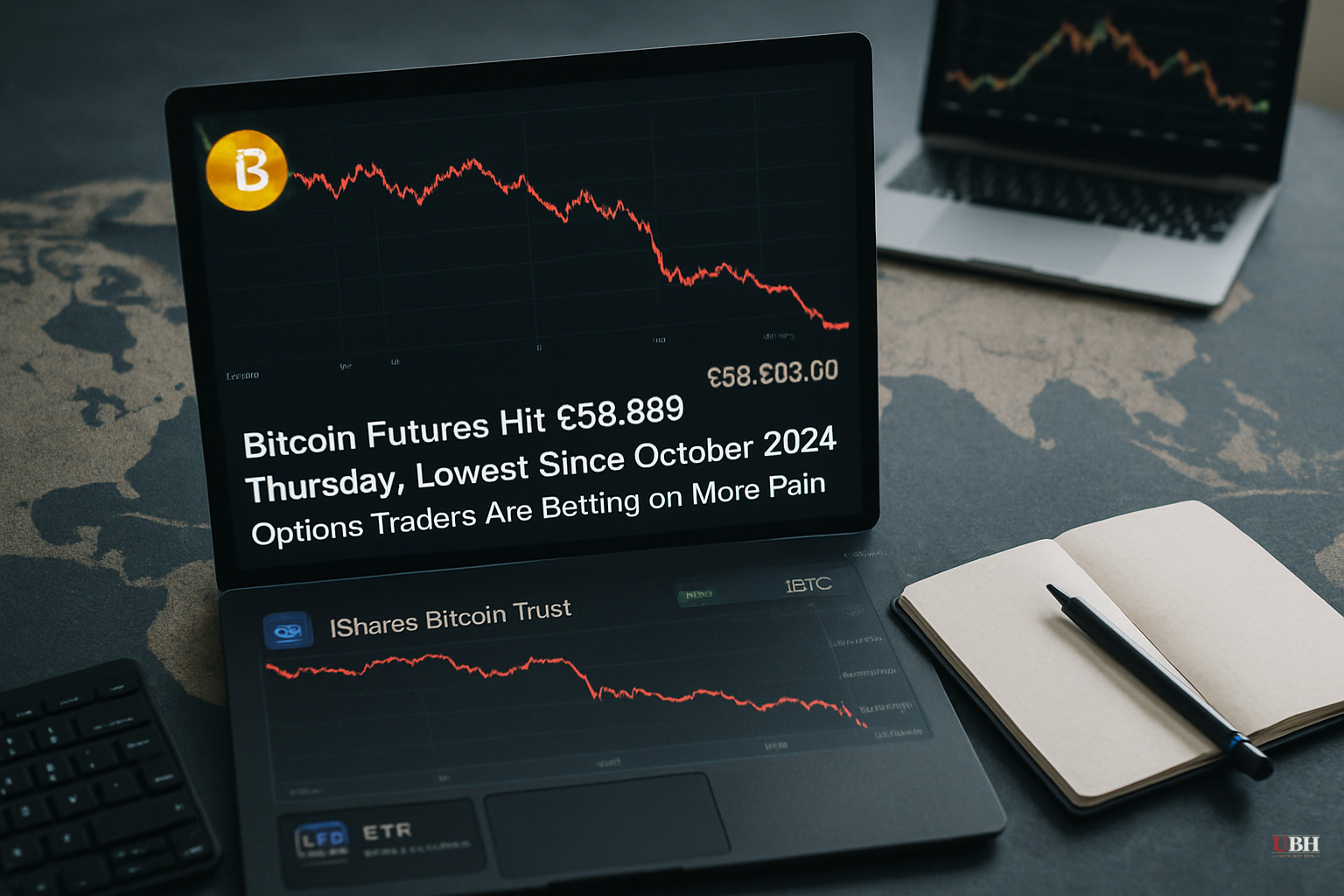
Since Bitcoin closed below $60,000 for the second time this month on Wednesday, the pressure has continued to build. On Thursday, Bitcoin futures touched $58,995, the lowest price since October 2024, according to CNBC. That puts the drawdown from last year's all-time high at approximately 52%.
Bitcoin has wrestled with the $60,000 level in 2026. It found support there in February, failed to hold it during the first two weeks of June, briefly recovered above $67,000, and is now trading below it again.
The iShares Bitcoin Trust ETF (IBIT) saw nearly 1.1 million options contracts trade Thursday, almost double its 30-day average, according to Cboe LiveVol data cited by CNBC. The breakdown was lopsided: traders bought 275,000 puts against roughly 129,000 calls, per ThinkOrSwim data.
Of the $187 million in total premium traded in IBIT on Thursday, $144 million went into puts, according to SpotGamma. Of the 20 most-traded contracts by volume, 19 were puts. The single most popular contract was the $32.50 strike put expiring Friday, a bet that requires Bitcoin to fall another 4.5% just to break even.
Implied volatility in IBIT sits at 53, meaning options market-makers are currently pricing a little over 3% movement per day.
Looking further out, July 31 expiry pricing puts approximately a 48% probability on IBIT falling below $30.50, a 10% drop from current levels, before the end of next month, according to CNBC's options analysis. The odds of a 10% rally by the same date are marginally higher, around 55%. Neither scenario is a sure thing. The market is genuinely uncertain which direction Bitcoin resolves.
Michael Saylor's Strategy also saw heavy options activity Thursday: 505,000 puts and 403,000 calls traded. Traders bought 83,000 puts and sold 72,000 calls while buying just under 58,000 calls. Net positioning skews bearish but is less extreme than IBIT's ratio.
Alexander Blume, CEO of Two Prime, an institutional bitcoin asset manager, put it plainly to CNBC: "Amidst rip-roaring AI stock performance, BTC has struggled in price and in garnering attention. The wobbly behavior of Strategy continues to scare the market, harkening back to other major blow ups the market has seen."
That concern is worth examining. Strategy holds approximately 580,000 Bitcoin on its balance sheet, financed in part through equity and debt. If Bitcoin's price deteriorates far enough, the company faces margin pressure, potential forced selling, or a capital raise that dilutes shareholders. Critics who worry about Strategy's leverage amplifying a Bitcoin drawdown are making a structurally sound argument. The company has navigated previous drawdowns without a forced liquidation event, and it has repeatedly raised fresh capital to sustain and expand its position. But the concern grows proportionally with the size of the position and the depth of the price decline.
Bitcoin's underperformance relative to AI-related equities this year is striking. While Nvidia and the broader AI infrastructure trade have attracted institutional flows, Bitcoin has largely moved sideways to down since its late-2025 peak. The asset is down 52% from that high as of Thursday's futures print.
Bull-case Bitcoin holders argue that the asset has historically recovered from drawdowns of this magnitude and that current price weakness reflects macro headwinds, not structural failure. They point to continued spot ETF inflows earlier this year and growing sovereign and institutional accumulation as reasons the long-term thesis remains intact.
The bear case, increasingly reflected in Thursday's options positioning, is that $60,000 was not support. It was a lid. Every failed attempt to hold that level adds credibility to the downside scenario.
The Friday expiry on the $32.50 IBIT put is the immediate data point. If Bitcoin continues sliding into Friday's close, that contract pays off and likely emboldens further put buying in the following week's expirations. The July 31 expiry will price the most contested range: whether Bitcoin holds above roughly $33 on IBIT, approximately $56,000 in spot Bitcoin terms, through the end of next month.
No regulatory investigation or forced liquidation of any major holder has been announced as of June 25, 2026. The selloff is a market event, not a structural collapse. Whether those two things remain separate depends substantially on where Bitcoin trades over the next five weeks.
Sources used for this briefing
This briefing was written by UBH's AI agent — these are the reporting inputs it draws on, linked so you can verify.


