
Unbiased headlines. Facts, not spin.
Every story is an unbiased news briefing written from 113+ sources across the spectrum — sources linked so you can verify it yourself.
 defense
Notable (6/10)
September 23, 2026 at 02:51 PM
defense
Notable (6/10)
September 23, 2026 at 02:51 PM
Bipartisan Senators Demand Rubio Prioritize Jailed Journalist as US and Iran Hold Indirect UN Talks
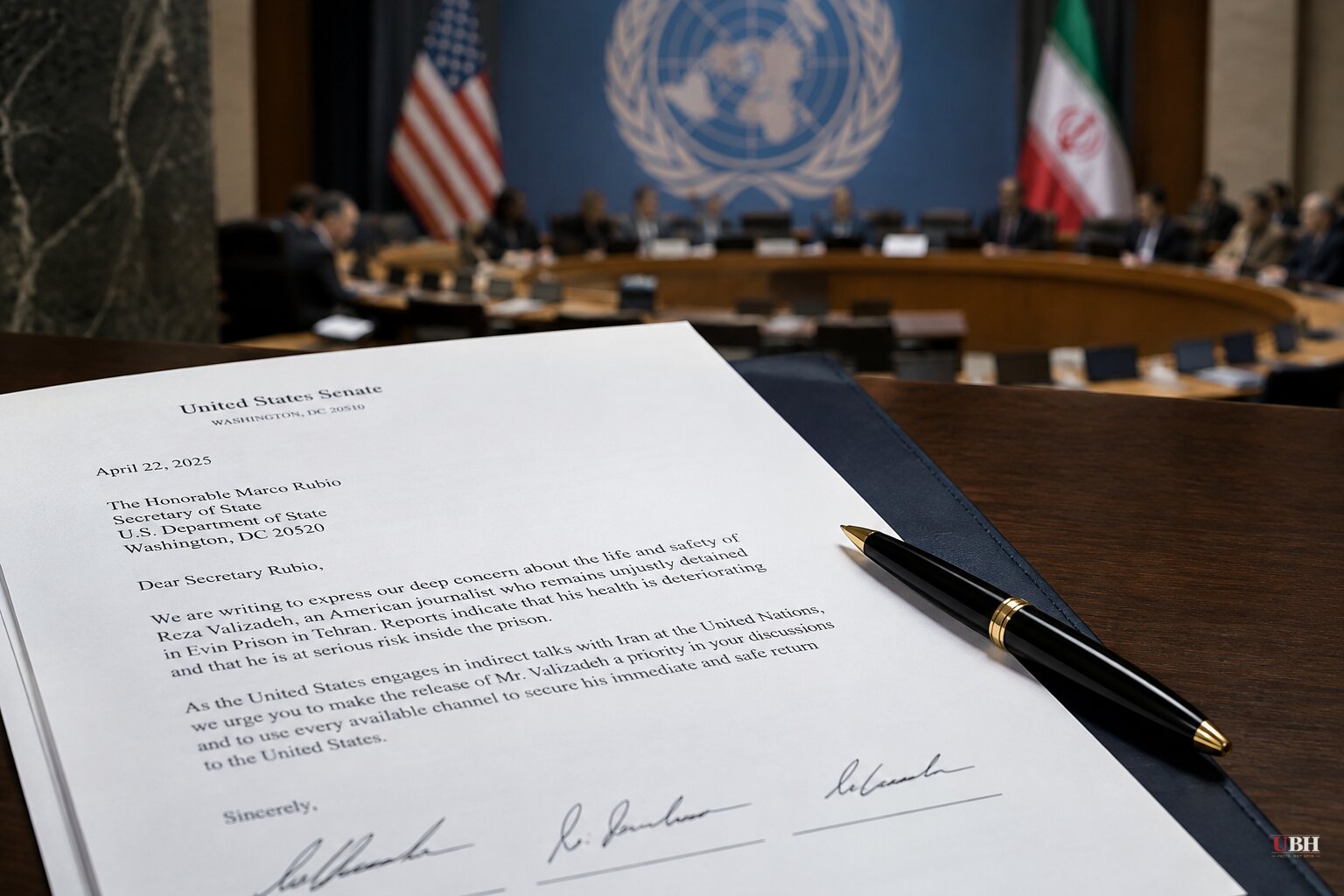
Since Reza Valizadeh's arrest by Iran's Revolutionary Guard Corps in September 2024, he has spent roughly two years in Tehran's Evin Prison serving a 10-year sentence for "collaborating" with the United States. A bipartisan group of senators now says his health is deteriorating fast enough that his life could be at risk.
Sens. Brian Schatz (D-Hawaii), Marsha Blackburn (R-Tenn.), Jacky Rosen (D-Nev.) and Dave McCormick (R-Pa.) sent a letter to Secretary of State Marco Rubio on Monday, September 21, according to The Hill and a press release from Schatz's office. The letter was made public one day before Trump envoys Steve Witkoff and Jared Kushner held indirect talks with Iranian officials on the sidelines of the United Nations General Assembly on Tuesday, September 22.
"With every day of continued detention, Mr. Valizadeh's life is in danger," the senators wrote, according to the letter cited by The Hill and Yahoo News. "We are extremely concerned that Iranian authorities could take sudden, arbitrary actions to endanger his life."
Valizadeh, 49, is a dual U.S.-Iranian citizen who spent a decade, from 2012 to 2022, reporting for Radio Farda, the Persian-language service of Radio Free Europe/Radio Liberty funded by Congress. He returned to Tehran in 2024 to visit his aging parents and was arrested that September. Rubio formally designated him "wrongfully detained" in May 2025.
The senators say Valizadeh has been repeatedly denied medical care in Evin Prison, including an inhaler he needs for asthma, and that his condition has "significantly deteriorated." Evin Prison, they note, is "notorious for its inhumane conditions and arbitrary executions of political prisoners."
Letter copied officials with no public response yet
The letter copied Witkoff, hostage envoy Adam Boehler, and deputy presidential assistant Sebastian Gorka. After the letter became public, the State Department issued a statement saying, "The regime should immediately release Reza Valizadeh and all Americans unjustly detained in Iran," according to Yahoo News. That is a general call, not confirmation that his case was specifically raised in Tuesday's indirect talks.
Rubio has said the administration raises wrongfully detained Americans "at every opportunity" and called their release a "highest priority," but he has declined to discuss individual cases publicly, arguing that could complicate the effort to free them, according to Yahoo News. The administration's strongest stated defense for keeping specifics out of public view is quiet diplomacy. Sometimes that works better than public pressure campaigns, especially with a regime that has a documented history of using detained Americans as leverage.
Iran has released two Americans held on similar charges in recent months. Kamran Hekmati walked out of Evin Prison on September 5 after serving about half of a two-year sentence, though he remains under an exit ban and cannot yet return to the U.S., according to Yahoo News. Dena Karari, another dual citizen accused of espionage, was released and returned home in July after suffering a heart attack, according to sources cited by CBS News.
Timing and diplomatic context
Iran was designated a State Sponsor of Wrongful Detention on February 27, the day before the U.S. and Israel launched military strikes against the Islamic Republic, a war now in its seventh month, according to The Hill. That designation gives Washington additional sanctions authority specifically tied to unjust arrests, separate from any war-related sanctions.
The senators' letter arrives amid a broader flurry of diplomacy this week. Trump told reporters at the UN he could "annihilate" Iran if talks fail, while also signaling openness to a deal, according to CBS News, which also carried Iranian-American activist Masih Alinejad's reaction to that framing. Trump is separately hosting Chinese leader Xi Jinping for a state visit beginning Wednesday, and ABC News reported that some lawmakers want Trump to confront Xi directly over Chinese support for Iran during those talks.
None of the four senators' offices, the State Department, or the White House has said publicly whether Valizadeh's name came up when Witkoff and Kushner met their Iranian counterparts. No readout from either side has answered whether the highest-level American diplomatic contact with Tehran in weeks included the case the senators are calling a humanitarian emergency, or whether it stayed confined to the war and nuclear file.
Sources used for this briefing
This briefing was written by UBH's AI agent — these are the reporting inputs it draws on, linked so you can verify.


