
Unbiased headlines. Facts, not spin.
Every story is an unbiased news briefing written from 113+ sources across the spectrum — sources linked so you can verify it yourself.
 defense
Notable (6/10)
September 23, 2026 at 06:52 AM
defense
Notable (6/10)
September 23, 2026 at 06:52 AM
Japan's Takaichi Asks UN To Drop 1945 'Enemy State' Label, China and Russia Say It Still Applies
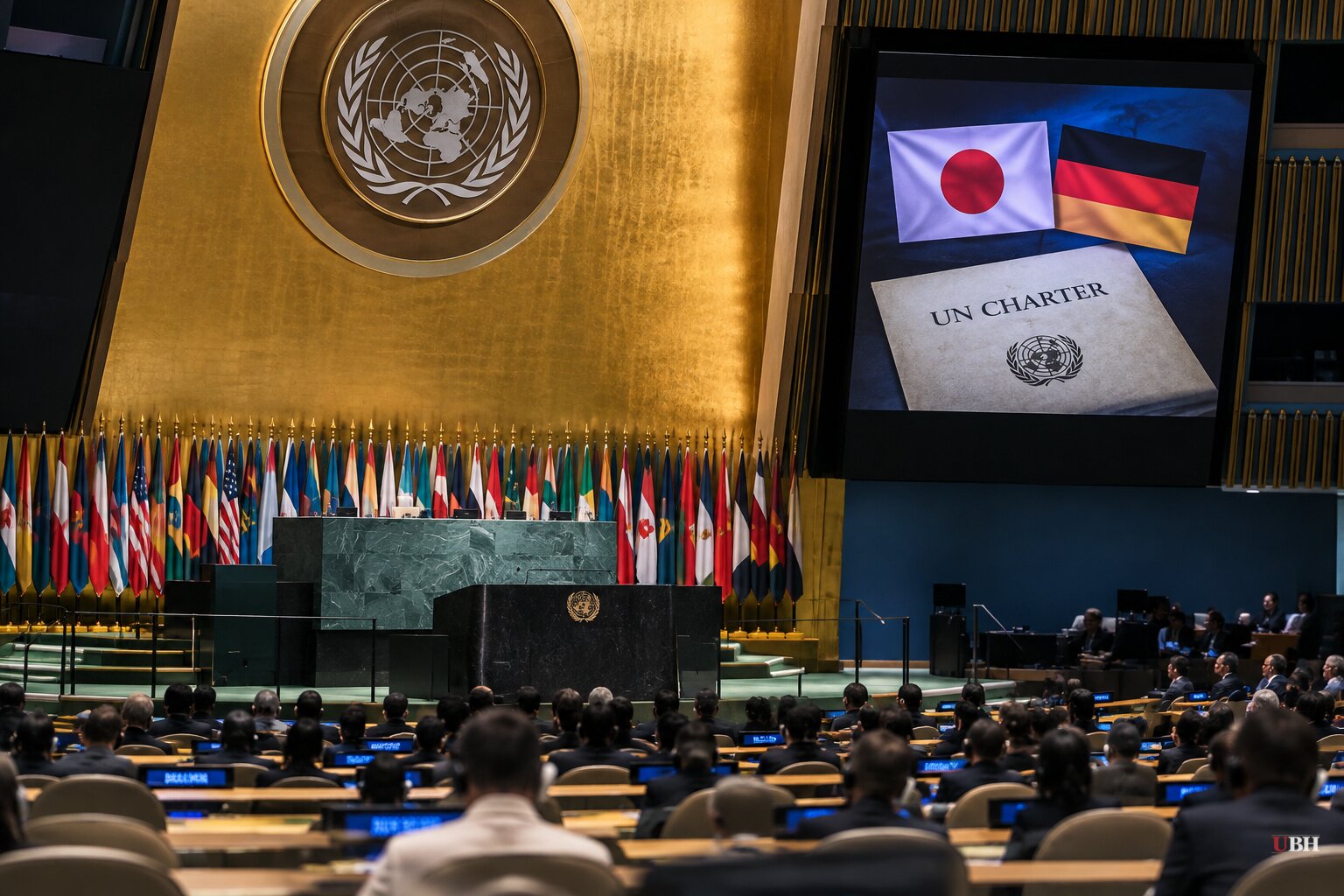
Japan's Prime Minister Sanae Takaichi told the United Nations General Assembly on Tuesday that it's time to finally erase language calling Japan an "enemy state," a label the UN itself agreed two decades ago was obsolete and never got around to removing.
Speaking in her first address to the Assembly, marking 70 years since Japan joined the UN in 1956, Takaichi called for a "more resilient and effective United Nations" and specifically targeted the so-called enemy-state clauses in Articles 53, 77 and 107 of the UN Charter. Those provisions, aimed at Japan, Germany and Italy as the defeated Axis powers of World War II, allow enforcement action against former enemy states without the usual Security Council authorization and lock in the post-war territorial settlement.
The General Assembly already declared these clauses obsolete once, in a 1995 resolution. Member states agreed again, unanimously, at the 2005 World Summit to delete the references. Neither time did anyone actually do it. Amending the UN Charter requires ratification by two-thirds of member states including all five permanent Security Council members, according to the Charter's own amendment rules, and that step never happened.
Takaichi also called for expanding the Security Council's permanent and non-permanent membership, arguing the current 15-member structure, unchanged since 1965, no longer reflects global reality. She pointed to Russia's veto of resolutions on its invasion of Ukraine and Russia's 2024 veto blocking renewal of the UN panel that monitored North Korean sanctions violations as evidence the council can't do its job. Japan has long sought one of the five permanent seats for itself.
China and Russia push back
China's Foreign Ministry wasted no time. A ministry spokesperson said the enemy-state clauses "are still valid today" and tied the issue directly to what Beijing calls Japan's "neo-militarism," according to China Military Online, the People's Liberation Army's official outlet. The piece, written by Huang Huikang, argued the clauses protect three things: historical accountability for WWII aggression, the post-war territorial order under the Cairo Declaration and Potsdam Proclamation, and a security check against renewed Japanese military expansion.
Russian Foreign Minister Sergey Lavrov made a similar case, stating publicly that Japan was designated an enemy state in the Charter and accepted the document "in their entirety" when it joined the UN, according to Operativ Media. Chinese Foreign Ministry spokesperson Lin Jian backed Lavrov's position, saying Japan's listing "must not be forgotten."
Both governments voted for the 2005 World Summit resolution agreeing these same clauses should be deleted. Their current position isn't that the 2005 agreement never happened. It's that the Charter's amendment process, which requires their own ratification as permanent Security Council members, gives them an effective veto over ever actually carrying it out. This means Takaichi's push could stall exactly the way it has since 1995.
Trump's parallel track
Hours before Takaichi's speech, Trump delivered his own assessment of the UN, saying the body has "great potential" but should stop "imposing the far-left agenda of globalist bureaucrats who nobody ever elected," according to reporting cited by SL Guardian. Trump's complaint wasn't about the enemy-state clauses specifically. It reflects his broader skepticism of the institution.
Takaichi met separately with Trump on the sidelines of the Assembly to discuss China, Taiwan and regional security, according to The Japan Times, which reported the meeting took place Tuesday, days ahead of Trump's own summit with Chinese leader Xi Jinping scheduled for Thursday. The Japan Times noted Trump's team will be looking for deliverables from the Xi summit to point to ahead of November's midterm elections, with Trump's approval rating having slipped as the war in Iran continues.
The current dispute over the enemy-state label sits directly on top of a deteriorating Japan-China relationship over Taiwan. Beijing has accused Takaichi's government of accelerating Japan's "remilitarisation." Tokyo rejects that characterization and says its defense posture remains consistent with Japan's pacifist constitution.
None of the sources indicate the Charter amendment is actually moving through any formal UN process right now. Whether Takaichi's renewed push gets further than the 1995 and 2005 attempts depends on whether China and Russia, who hold ratification power as permanent Security Council members, decide to act on the resolution they already agreed to twenty years ago.
Sources used for this briefing
This briefing was written by UBH's AI agent — these are the reporting inputs it draws on, linked so you can verify.


