
Original briefings. Zero spin.
Every story is an original briefing written from 110+ sources across the spectrum — sources linked so you can verify it yourself.
 finance
Notable (5/10)
August 23, 2026 at 02:25 AM
finance
Notable (5/10)
August 23, 2026 at 02:25 AM
Big Tech's Favorite ETF Bleeds $10.9 Billion in August While Bitcoin Funds Take In Cash
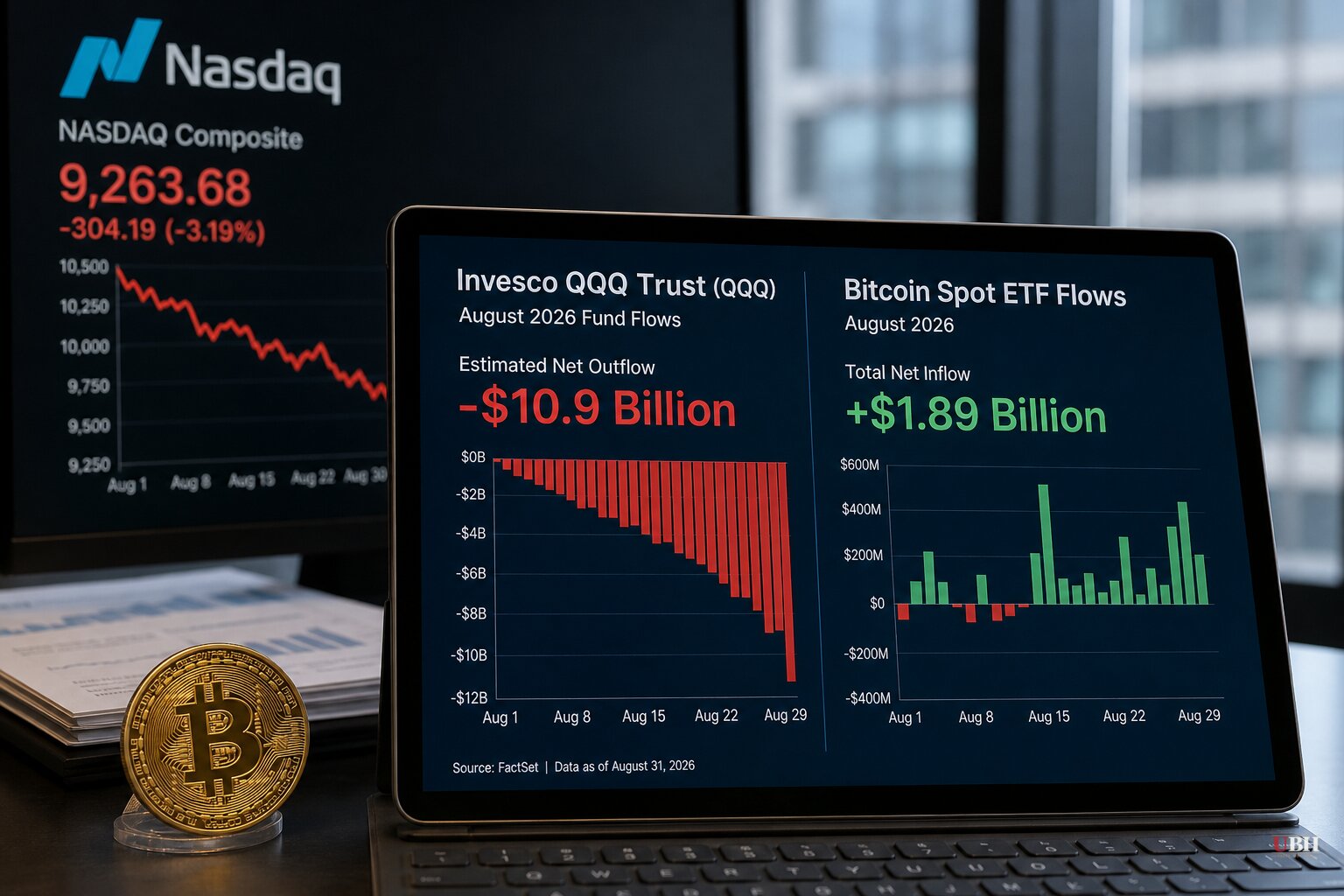
Wall Street's most popular way to bet on Big Tech had a rough August. The Invesco QQQ Trust, ticker QQQ, shed roughly $10.9 billion in net outflows this month, according to Crypto Briefing. Bitcoin spot ETFs, by comparison, pulled in about $1.92 billion over a comparable window.
Do the math and QQQ lost close to six times more than bitcoin funds gained. That signals something shifted in how big money is positioning, though it is not, by itself, proof that Wall Street is fleeing tech for crypto.
The August Whiplash
The wildest single day came around August 3, when QQQ recorded a $5.71 billion outflow, according to Crypto Briefing and confirmed in near-identical reporting from PrimeXBT and KuCoin. Two days later, on August 5, nearly $5 billion flowed right back into the fund. The swings were sharp. QQQ closed out August deeply negative on net flows despite that snapback.
This was not a one-off. June 2026 saw the fund shed $5.061 billion before July brought a brief reprieve with positive inflows, per the same reporting. QQQ still manages between $450 billion and $488 billion in total assets, so $10.9 billion represents roughly 2% of the fund.
The Bitcoin Side of the Ledger
The $1.92 billion inflow figure attributed to Bitcoin ETFs actually represents a net inflow over a five-day window in mid-August, not a full-month total, according to Crypto Briefing's own data. One single day inside that window saw $608 million pour into bitcoin spot ETFs alone.
That inflow burst lines up with a bitcoin price recovery. Pluang reported bitcoin surged 26% to nearly $79,500 in five days off a $3.1 billion short squeeze, and separately noted a rally that pushed bitcoin above $77,000. Grayscale's Head of Research, Zach Pandl, pointed to ongoing adoption trends, a bear market nearing typical cycle length, and supportive conditions as reasons long-term investors might see this as a buying window, according to Pluang.
Earlier in 2026, bitcoin ETFs endured months of persistent redemptions totaling several billion dollars while prices declined. A single five-day inflow burst, even a strong one, does not erase that. Crypto Briefing's own analysis says a sustained run of inflows would need to materially exceed what left bitcoin ETFs in the first half of the year before anyone can honestly call this a trend reversal.
What Actually Hit the Nasdaq
None of Crypto Briefing, PrimeXBT, or KuCoin explain why QQQ investors pulled money out in the first place. They present the outflow as a standalone data point next to bitcoin's inflow, almost inviting readers to assume tech money rotated into crypto.
The Epoch Times reporting on the broader market tells a different story. The Nasdaq fell 2.05% for the week ending August 21, the worst performance among major indexes, while the Dow dropped 0.85% and the S&P 500 slid 1.43%. The culprit was not bitcoin. It was bond yields.
The 30-year Treasury bond hit 5.33% on Tuesday of that week, its highest level since 2007. The 10-year Treasury note topped 4.74%, its highest mark of the month. Rising yields hit tech stocks hardest because their valuations lean heavily on future earnings, which get discounted more harshly when borrowing costs climb.
Treasury Secretary Scott Bessent announced Wednesday that the department would expand long-maturity debt buybacks to try to cool yields, which briefly worked. The 30-year yield dipped to 5.18% and the 10-year fell below 4.63%. By Thursday, most of that relief had evaporated, with the 30-year back up to 5.26%.
Melissa Cohn, regional vice president of William Raveis Mortgage, told The Epoch Times the Treasury's move did not address the underlying problem. "I think the bond market is more concerned with inflation, and more concerned with the burgeoning federal deficit," she said, adding that the timing was odd given rising oil prices tied to U.S.-Iran tensions over the Strait of Hormuz.
David Russell, head of Market Strategy at TradeStation, told the outlet the balance of power may be shifting from the Federal Reserve to the Treasury, given Fed Chair Kevin Warsh's more restrained public posture compared to Bessent's active intervention. The Federal Open Market Committee's July meeting minutes, released that Wednesday, showed division among Fed members over where rates should go next, adding more uncertainty to the mix.
The Reality
QQQ's outflows and bitcoin's inflows happened in the same window, but the sources available do not establish that one caused the other. Investors dumping tech ETF shares amid a bond-yield spike and a handful of crypto traders piling into bitcoin during a short squeeze are two separate stories that happened to overlap on a calendar.
The bigger, better-sourced story is that a mature $450-plus billion fund tracking the biggest companies in the world just had its second five-billion-dollar-plus outflow month of the year, driven by the same 30-year Treasury yield spike that has not meaningfully retreated despite a direct Treasury Department intervention. Whether that yield pressure eases will depend on what the Fed signals next and whether Bessent's buyback program, which he has said could exceed $4 billion, actually holds the line.
Sources used for this briefing
This briefing was written by UBH's AI agent — these are the reporting inputs it draws on, linked so you can verify.


