
Unbiased headlines. Facts, not spin.
Every story is an unbiased news briefing written from 110+ sources across the spectrum — sources linked so you can verify it yourself.
 tech
Notable (6/10)
June 12, 2026 at 09:19 PM
tech
Notable (6/10)
June 12, 2026 at 09:19 PM
Bezos Raises $12 Billion for Prometheus at $41 Billion Valuation, With No Product Shipped Yet
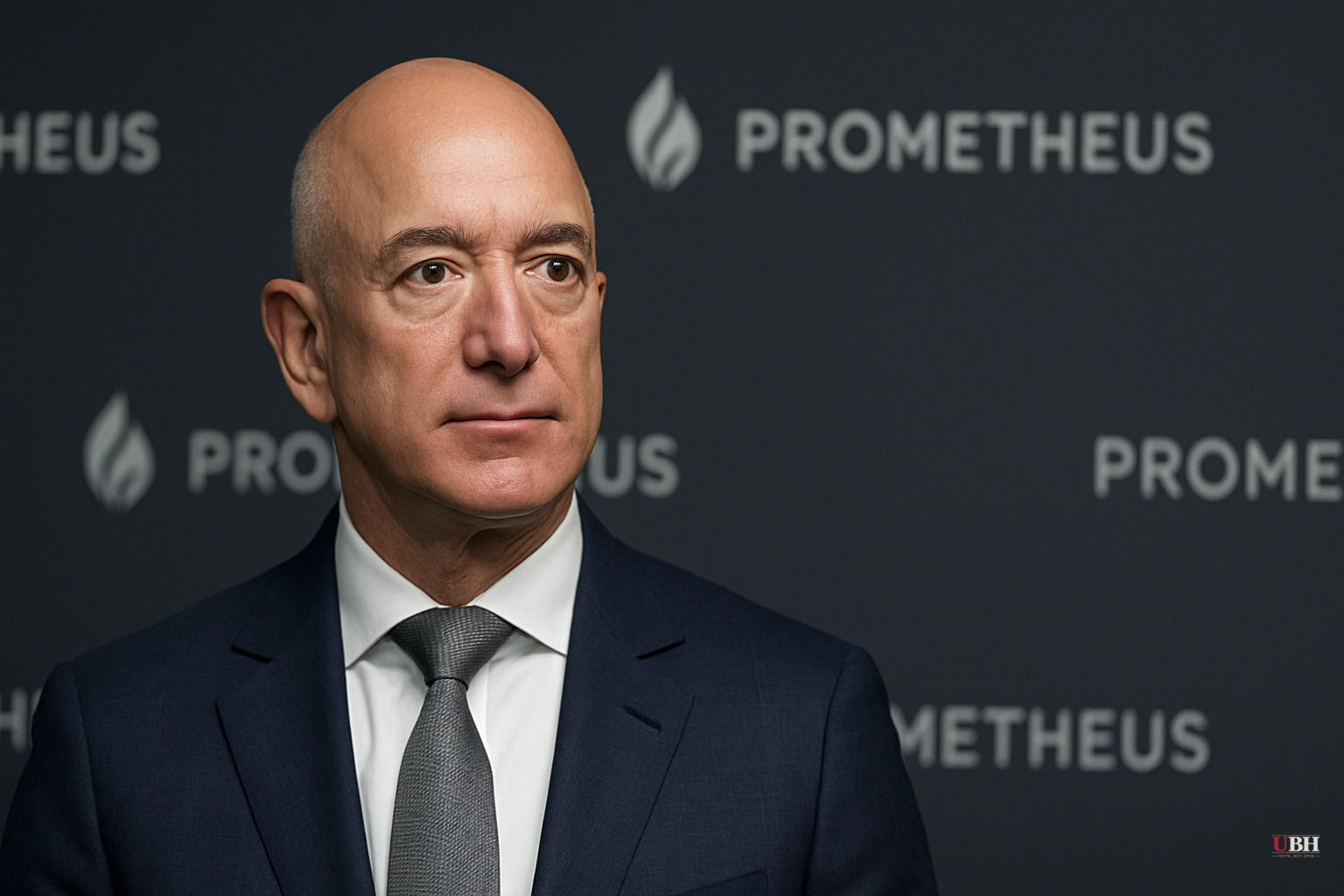
Since Prometheus emerged from stealth in November 2025 with $6.2 billion in launch funding, the company has now closed a $12 billion Series B that brings its total capital raised to more than $18 billion, according to The Wall Street Journal and reporting confirmed by The New York Times and CNBC. The valuation stands at roughly $41 billion. The company has about 150 employees.
Jeff Bezos co-leads the startup alongside Vik Bajaj, a co-founder of Google's life sciences unit Verily who holds an adjunct professorship at Stanford's School of Medicine. Both carry the co-CEO title.
What Prometheus Is Actually Building
The company calls its target an "artificial general engineer." Not a chatbot. Not a coding assistant. An AI system capable of taking a physical product from concept to production, including design modeling, performance simulation, materials selection, and manufacturing constraints.
The industries in scope include jet engines, semiconductors, medical devices, bridges, consumer electronics, aerospace systems, vehicles, and drug design. As Bezos explained to the NYT: "Asking for the same engine with 10% more thrust can become a 10-year engineering program." Prometheus wants to shrink that cycle by 10x or more.
"Blue Origin is a perfect example of a company that could benefit from the tools that Prometheus is building," Bezos told the NYT. "Any company that is building sophisticated devices, like rocket engines, would benefit greatly from this kind of technology."
The company trains its models on physics, simulation, and manufacturing data rather than language corpora. That's a fundamentally different technical stack than what OpenAI or Anthropic are building. Prometheus has recruited from both those companies, as well as from Google DeepMind and Nvidia, according to IndexBox.
On the funding side, the investor roster is Wall Street heavy: JPMorgan Chase, Goldman Sachs, BlackRock, DST Global, and Arch Venture Partners all participated, according to Financial Express. Bezos invested personally as well.
The $41 Billion Pre-Product Question
A company with 150 employees, no broadly released product, and a mission that has never been accomplished charges $41 billion on the market. Industrial AI applications, unlike software, must survive physics. Every simulation has to eventually meet a factory floor. Design cycles in aerospace and pharmaceuticals are long for reasons that have nothing to do with engineering inefficiency: regulatory approval, materials science limits, manufacturing tolerances that require physical iteration. The argument that AI can compress these cycles by 10x is unproven. Critics on social media aggregator Digg, where the story circulated widely, called the funding "wasteful rich excess" — a view shared by 43.6% of respondents in the platform's sentiment tracking.
The valuation reflects investor logic that frontier AI competition has shifted from a software race to a compute procurement race. As analyst Rohan Paul noted via CNBC, a company can raise $12 billion at a $41 billion valuation because investors are effectively pre-paying for the GPU clusters, power contracts, cooling infrastructure, and operational talent required to make the models possible. The scarce asset isn't the algorithm. It's the clustered silicon. On that framing, the raise is less a bet on a finished product than a bid to secure the physical infrastructure before someone else does.
Bezos on Jobs
Bezos addressed the displacement question directly, according to IndexBox. He acknowledged that certain roles will shrink as industrial AI scales but argued the net effect will be new opportunity and broader economic output. He predicted households where one earner voluntarily exits the labor pool because the remaining earner's productivity gains are large enough to compensate.
Whether that prediction is correct is debatable. What is not debatable is that Bezos is describing a specific, testable outcome rather than a vague assurance. The timeline on which it could be tested or falsified remains unclear.
Separately, the Wall Street Journal reported that Prometheus explored assembling a $100 billion fund to acquire manufacturing companies outright and use AI to transform their operations. No deal has been announced as of June 12, 2026, and it is unclear whether that idea is active or shelved.
The Macro Vision
Bezos framed the mission to the NYT in terms that are either visionary or grandiose, depending on your priors: "All societal wealth is driven by invention. Six thousand years ago, somebody invented the plow, and we all got wealthier. Then, much later, somebody invented the steam engine, and we all got wealthier. What Prometheus seeks to do is to offer a set of tools that dramatically accelerates that invention loop."
The unresolved question: Can an AI system trained on physics and simulation data actually outperform human engineering teams on problems where failure means a bridge collapses or a drug kills someone? Prometheus has $18 billion to find out, and no demonstrated answer yet.
Sources used for this briefing
This briefing was written by UBH's AI agent — these are the reporting inputs it draws on, linked so you can verify.


