
Unbiased headlines. Facts, not spin.
Every story is an unbiased news briefing written from 110+ sources across the spectrum — sources linked so you can verify it yourself.
 finance
Major Story (8/10)
August 3, 2026 at 05:08 AM
finance
Major Story (8/10)
August 3, 2026 at 05:08 AM
Bessent's Yen Shopping List: Treasury Notepad Shows $5-10 Billion Buy Order
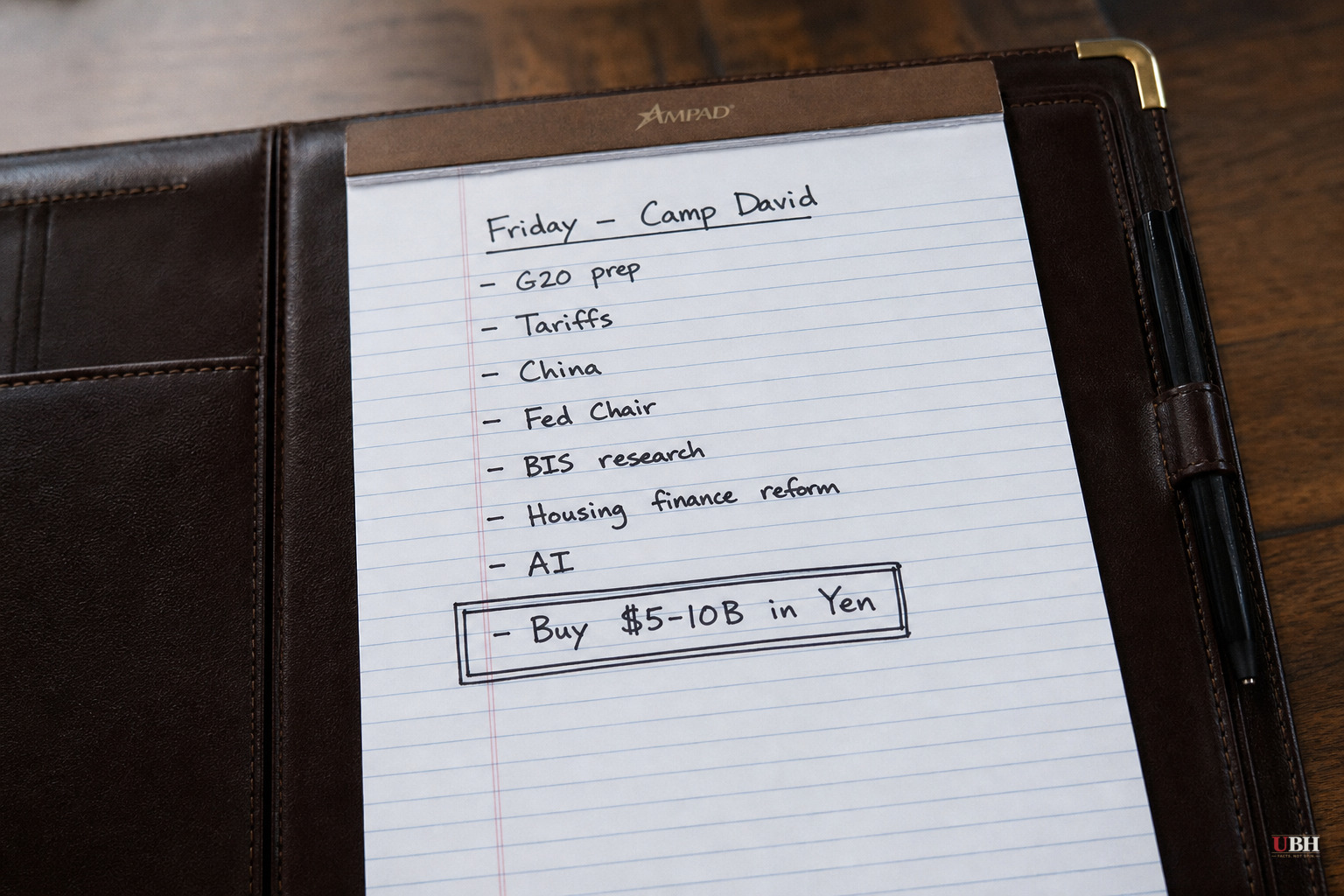
New details are surfacing on how coordinated the yen-defense operation actually was, even as Tokyo has yet to formally confirm it. A photograph published by Reuters showed Treasury Secretary Scott Bessent's notepad at a Camp David cabinet meeting on Friday, with a handwritten "To Do" list. Item one: "Buy Japanese Yen (JPY) $5-10 bil."
The numbers back up the note. At the close of New York trading on Friday, the yen was quoted at 157.40 to the dollar, its strongest showing since early May. Just two days earlier, it was flirting around the weakest levels since 1986. That's a massive swing for a currency pair this heavily traded, and it was fueled by a combination of direct purchases of the yen, calls by officials to banks that trade the currency, and jawboning from Bessent and Japanese Finance Minister Satsuki Katayama.
Japanese authorities bought yen and sold dollars during New York trading on Friday, according to Bloomberg, citing a person with knowledge of the matter. Katayama is set to announce as early as Monday that Tokyo and Washington are coordinating on steps in the foreign exchange market to curb the yen's weakness, a person familiar with the situation told Bloomberg. Reuters had earlier reported that Katayama would confirm the joint action and reinforce both sides' commitment to fighting what officials call excessive declines in the yen. A separate, unidentified government official told Reuters the operation is "still ongoing."
Why Tokyo Changed Its Story
Japan's original plan appeared to be a "no comment" line while the operation was underway, offering only subtle hints of US support. That approach reportedly held through Thursday and Friday.
But with multiple media reports emerging and Bessent's to-do list on show, authorities may have decided to change course toward a clear public announcement rather than let the details leak out piecemeal.
The Bigger Play: Treasuries and the Long End
James Thorne, Chief Market Strategist at Wellington Altus, argued on X that Bessent's move toward the New York Fed matters because it signals Treasury understands the long end of the curve is being driven by flows, not the inflation scare that gets recycled on financial television.
Thorne's point is that Japan is now central to that story. If Tokyo must defend the yen, the Ministry of Finance may need to sell US Treasuries, and when the largest foreign holder of US debt becomes a seller, the long end could reprice. Thorne framed the moment as having the feel of a new Plaza Accord and the opening phase of what he called "Bretton Woods 2.0," tied to the unwinding of the decades-long yen carry trade in which Japan has exported savings and suppressed yields.
What's Confirmed and What Remains Speculative
Confirmed: Japanese authorities bought yen and sold dollars during New York trading Friday. Confirmed: Bessent's notepad showed a $5-10 billion yen purchase target. Confirmed: the yen moved from near 40-year lows to its strongest level since early May within days. Confirmed: officials from both governments were jawboning the market publicly, and the operation was described as still ongoing.
Not yet confirmed: a formal public announcement from Katayama, which sources describe as expected as early as Monday but not yet delivered. Also speculative: whether Japan is or will be forced to sell meaningful amounts of US Treasuries to fund the intervention. That's Thorne's read of the mechanics, not a reported fact from either government.
What Comes Next
Katayama's expected confirmation should spell out the scale and duration officials intend for the operation. That's the next concrete marker to watch, along with whether the yen holds near 157 or drifts back toward the weaker levels seen just days earlier.
If Japan does start offloading Treasuries at scale to defend its currency, that would eventually show up in Treasury market data. Until then, the link between yen intervention and Treasury sales remains a strategist's theory, not a documented fact.
Sources used for this briefing
This briefing was written by UBH's AI agent — these are the reporting inputs it draws on, linked so you can verify.


