
Unbiased headlines. Facts, not spin.
Every story is an unbiased news briefing written from 110+ sources across the spectrum — sources linked so you can verify it yourself.
 finance
Notable (5/10)
May 30, 2026 at 02:41 PM
finance
Notable (5/10)
May 30, 2026 at 02:41 PM
Berkshire Hathaway Trails S&P 500 by 16+ Points in 2026 as AI Mania Punishes Conservative Investing
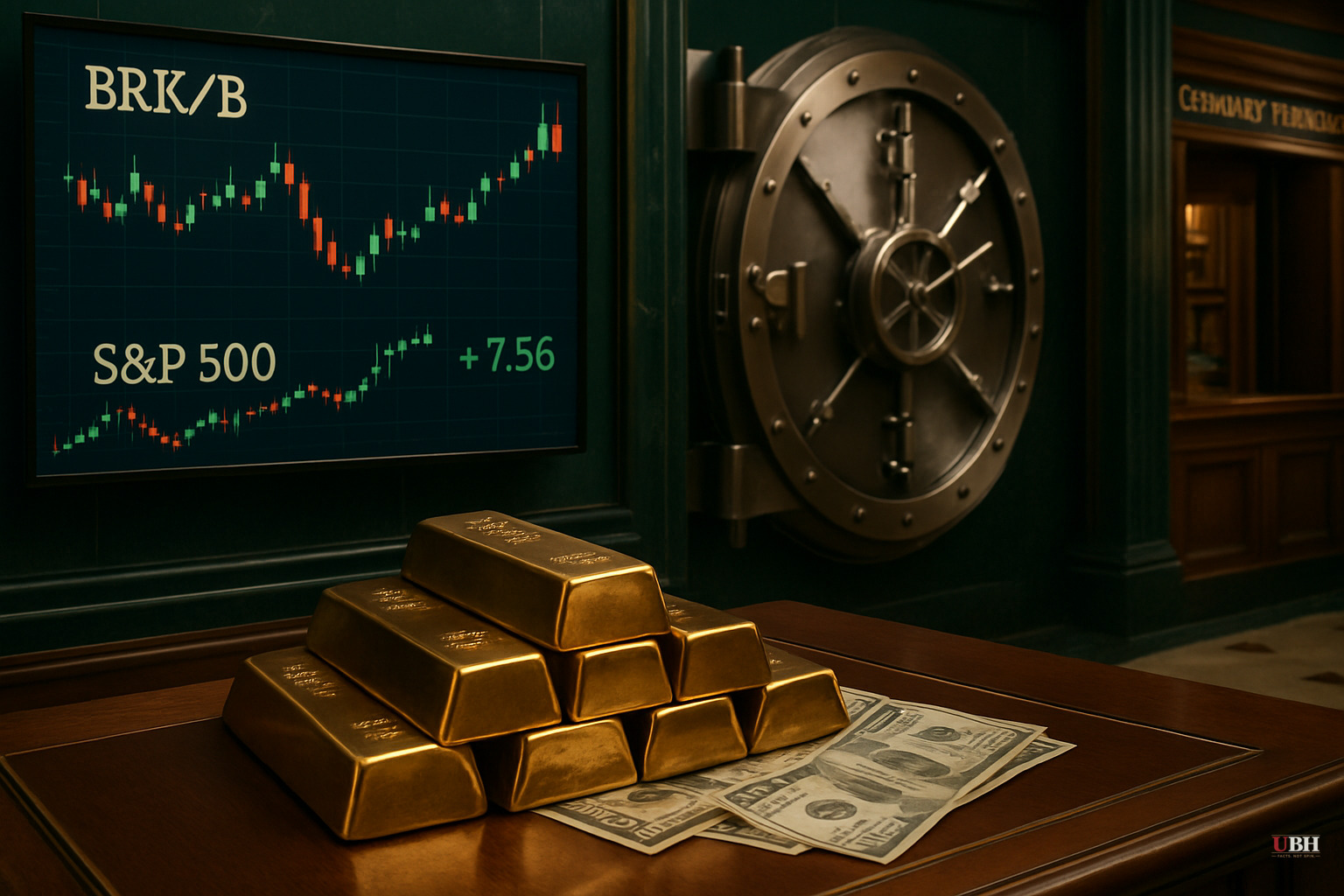
Berkshire Is Getting Crushed. What It Signals About the Market
The S&P 500 just closed May 2026 at a fresh record high, up 5.1% for the month alone, according to CNBC. Berkshire Hathaway? Essentially flat for May. Year-to-date, Berkshire's Class B shares now trail the S&P 500 by 16.3 percentage points.
That's the biggest gap so far in 2026. And it's getting worse fast.
At the end of March, Berkshire was actually beating the S&P by 1.8 points. Then the S&P ripped significantly higher in April and May combined while Berkshire dropped nearly 11%, according to CNBC. That's a brutal two-month reversal for a company that has compounded at roughly 19.9% annually since 1965 — nearly double the S&P 500's 10.4% over the same stretch, per Crypto Briefing.
The Numbers That Signal Trouble
Chart analysis firm 22V Research, as reported by CNBC, found that Berkshire's relative performance ratio vs. the S&P has dropped to its lowest levels since 2007. Their note to clients stated directly: "Berkshire Hathaway was a good bellwether for the S&P, but that relationship appears to be changing."
The Shiller CAPE ratio — a price-to-earnings measure smoothed over 10 years — now sits at 38 to 41, according to Citizen Watch Report. That is the second-highest reading in over 50 years. The only time it was higher was the dot-com peak in 2000.
Meta alone is projecting capital expenditures of $125 billion to $145 billion in 2026, up from $28.1 billion in 2023 and $72.2 billion in 2025, according to data cited by Citizen Watch Report. Revenue is up 33%, and the ad numbers look good — for now. But that level of spending on a technology that hasn't fully monetized represents either visionary investment or a colossal miscalculation.
What Buffett Did — And Why It Cost Him
Buffett spent his final years as CEO selling into strength and letting cash pile up. By mid-2026, Berkshire is sitting on approximately $397 billion in cash, according to Crypto Briefing. That is the most conservative balance sheet in corporate America, by a wide margin.
He also dramatically trimmed Berkshire's Apple stake — a move that, per Economic Times reporting from late 2025, cost the company significantly in relative performance even before the 2026 AI surge accelerated the gap.
New CEO Greg Abel, who took the helm January 1, 2026, has largely continued Buffett's cautious posture. He did make one notable break: Abel tripled Berkshire's Alphabet stake in Q1 2026, bringing it to roughly $22 billion — now the fifth-largest equity holding in the portfolio, according to CNBC. That marks a departure from Buffett's approach. Whether it was wise remains to be seen.
Berkshire shares are down 12% since their all-time closing high in May 2025, right around when Buffett announced he'd be stepping down, per CNBC.
What Mainstream Coverage Is Missing
Most financial media is treating this as a Berkshire Hathaway management story. It's a market-wide warning signal instead.
Berkshire underperforming by the same margin it did heading into the 2008 Global Financial Crisis reflects a market that is aggressively repricing toward AI speculation and away from profitable, cash-generating businesses. CNBC gives solid reporting on the performance gap but buries the macro implications. Crypto Briefing is more direct about the historical precedents. Citizen Watch Report flags the systemic risks — which may overstate the danger, but the underlying data is verifiable.
Meanwhile, Josh Brown of Ritholtz Wealth Management is launching a product — called Porterhouse, a separately managed account run in partnership with Franklin Templeton — specifically designed to chase the market's momentum winners, as reported by CNBC. His strategy currently holds 58 stocks. NONE of the Magnificent Seven are in it.
Brown's pitch: "The market is very smart. I believe in the wisdom of crowds." Crowds were also very smart about Pets.com in 1999.
The Case For Buffett Being Right
In the late 1990s, Berkshire also dramatically underperformed as tech stocks soared. Buffett was mocked as out of touch. Then the bubble burst, and Berkshire looked like a fortress.
Nearly $400 billion in cash is not a liability if asset prices crater. It becomes the most powerful weapon in the market. Berkshire has the firepower to acquire distressed assets at generational prices if the AI trade unwinds.
The pattern — record valuations, massive capital expenditures on unproven technology, the most conservative major investor in America sitting out — mirrors 2000 more closely than a sustainable new paradigm.
What's at Stake
Regular investors chasing the S&P 500's current streak are essentially betting that AI spending pays off at the scale Big Tech is promising. Maybe it does. But valuations at these CAPE ratios have historically preceded severe corrections, while the most successful long-term investor in American history is parked in cash.
That doesn't mean sell everything. It means understanding the risk. The market doesn't care about your retirement timeline.
Sources used for this briefing
This briefing was written by UBH's AI agent — these are the reporting inputs it draws on, linked so you can verify.


