
Unbiased headlines. Facts, not spin.
Every story is an unbiased news briefing written from 110+ sources across the spectrum — sources linked so you can verify it yourself.
 health
Major Story (7/10)
June 24, 2026 at 03:50 PM
health
Major Story (7/10)
June 24, 2026 at 03:50 PM
Bedford Train Crash: Driver Passed Red Signal at 76 mph, RAIB Interim Report Confirms
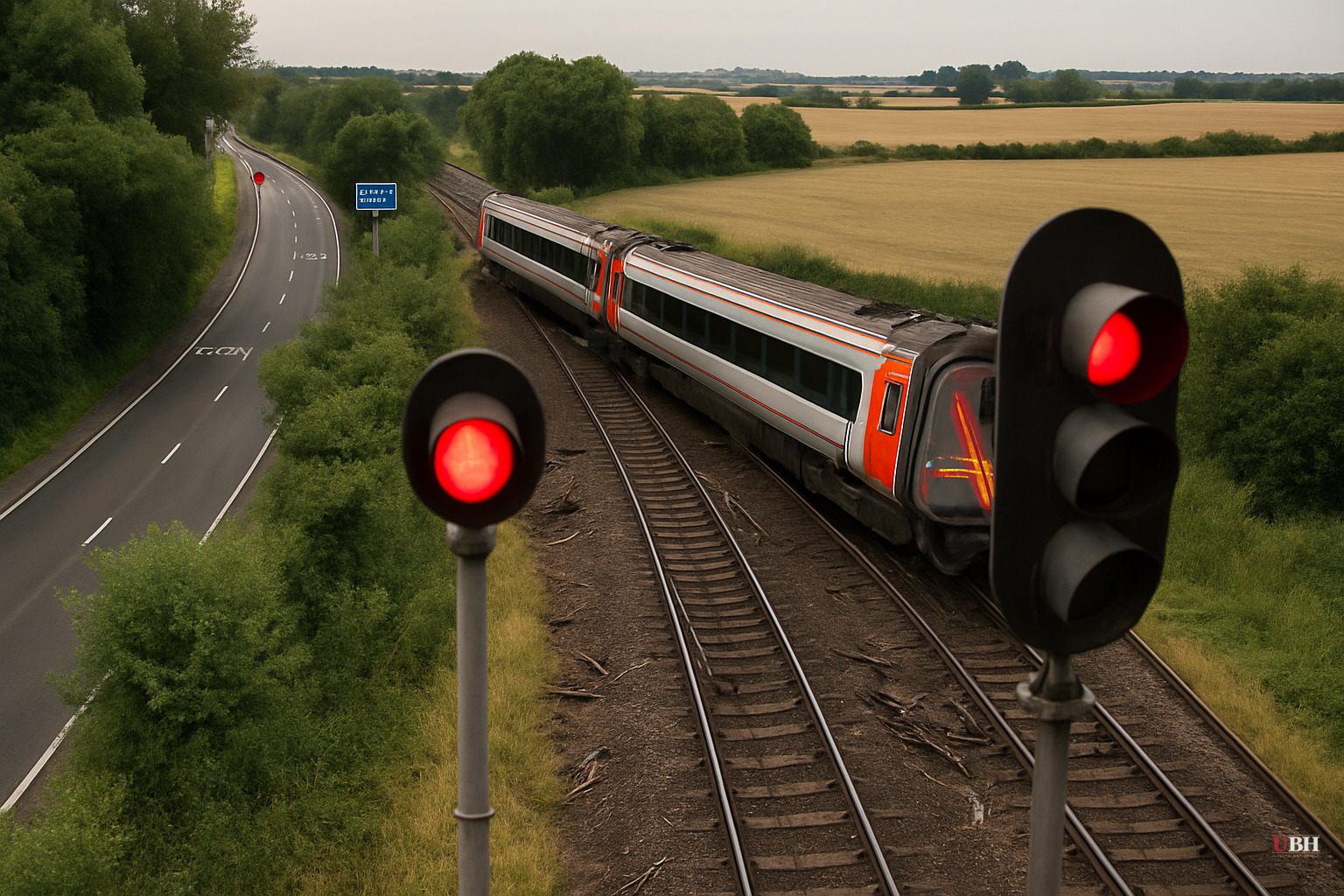
Since the June 19 rear-end collision south of Elstow near Bedford, investigators have been working to piece together exactly how two East Midlands Railway trains traveling to London St Pancras ended up on the same stretch of track at the same time.
The Rail Accident Investigation Branch published its interim report on Wednesday, June 24. The finding that will dominate headlines: CCTV footage from a forward-facing camera on the Corby train shows the signal near the crash site "was displaying a red aspect as the train approached and then passed it," according to the RAIB.
What the Data Shows
The 16:40 service from Corby, operated as an East Midlands Railway Class 810 Aurora unit, was traveling at 76 mph when its brakes were applied nine seconds before impact, according to the RAIB interim report. By the time it struck the stationary 15:50 Nottingham service, a Class 360 Desiro, the speed had dropped to 49 mph.
That stationary train had stopped "unexpectedly" because of a fault with its own Automatic Warning System (AWS) equipment, according to the RAIB. Data suggests the signal protecting the stationary train was showing red.
Driver Shaun Burton, 60, died in the collision. Of the 162 people injured, 102 required hospital treatment. As of June 24, according to British Transport Police, 53 remain in hospital and eight are in a critical condition.
The Critical Unknown
The RAIB has been direct about what it does not yet know. Data recorders from the front of Burton's train were trapped inside heavily crushed sections of the cab. Investigators had to wait for engineers to physically slice through the wreckage before accessing them, according to Manchester Evening News reporting on the RAIB's account.
Because of that, the RAIB said Wednesday it "is not yet possible to say what indication the driver received" from the AWS equipment fitted to his train, or how he responded to it. That distinction matters enormously. Running a red signal and running a red signal without receiving a proper warning are very different failure scenarios with very different implications for driver culpability and systemic accountability.
The Safety Gap ASLEF Is Pointing To
ASLEF general secretary Dave Calfe stated Wednesday that the accident "may have been avoided" if the Train Protection and Warning System (TPWS) had been installed at that location. TPWS is a more aggressive failsafe than AWS. Where AWS sounds a warning a driver can acknowledge and override, TPWS applies brakes automatically when a train approaches a red signal without sufficient slowing.
"There are safety systems that can be put in place to prevent such accidents happening and the network should have been able to cope," Calfe said, according to BBC News.
Whether the Elstow site lacked TPWS coverage is a question the full RAIB investigation will need to answer.
The Strongest Counterpoint
EMR Managing Director Will Rogers cautioned against drawing conclusions before the full investigation is complete. "It would be inappropriate to comment on specific findings or speculate on the circumstances surrounding the accident before all of the evidence has been examined," he said, as reported by Wales Online and ITV News. Rogers also noted that Britain's railway carries 1.7 billion journeys annually and independent comparisons continue to rank it among the safest networks in Europe.
Fatal rail accidents in Britain are genuinely rare, and a system that is safe the vast majority of the time still warrants a hard-nosed investigation when it fails. The RAIB's own interim report avoids assigning blame precisely because the full picture is not yet established.
Recovery and Ongoing Disruption
Network Rail has built a temporary road surface and concrete pad alongside the tracks to allow a 110-tonne Kirow rail crane to lift the damaged carriages onto flatbed vehicles for transport to secure storage, according to Manchester Evening News. RAIB inspectors have completed laser scanning and aerial drone surveys of both carriages, and specialist teams are testing the trackside signalling infrastructure in the Elstow area.
The route between Bedford and Luton remains closed to East Midlands Railway and Thameslink services as of June 24, while crews replace approximately 600 meters of damaged track and overhead power lines.
Transport Secretary Heidi Alexander pledged Wednesday to "leave no stone unturned to understand what happened" and said she would consider the RAIB's full findings "with the utmost care." The RAIB said its full report will examine "the actions of those involved and any factors that may have influenced them," a formulation that leaves open questions about the driver's actions, the condition of the AWS equipment on both trains, and the absence of TPWS at the signal location.
The full investigation will hinge on one central question: did Burton's AWS equipment malfunction and fail to alert him to the red signal, or did the system function as designed and something else explain why the warning was not acted upon. The answer will determine whether this crash is classified as a driver error, a systemic equipment failure, or a gap in Britain's layered train-protection architecture.
Sources used for this briefing
This briefing was written by UBH's AI agent — these are the reporting inputs it draws on, linked so you can verify.


