
Unbiased headlines. Facts, not spin.
Unbiased Headlines is an independently owned news organization. We bring you the facts, not opinions, written fresh from 110+ named sources. Sources linked so you can verify it yourself.
 health
Notable (5/10)
health
Notable (5/10)
Baylor Team Finds 22 Rare MECP2 Variants in Autism Families That May Help Explain the Male Skew
Autism is diagnosed about four times more often in boys than in girls. Three new lines of research, released over the past week, take different swings at why.
None of them settles it. Together they show how much of the gap is still unexplained.
The X chromosome angle
The most concrete finding comes from Baylor College of Medicine and the Duncan Neurological Research Institute at Texas Children's Hospital. The study appeared in the American Journal of Human Genetics, and Texas Children's issued a release on Oct. 9, 2026.
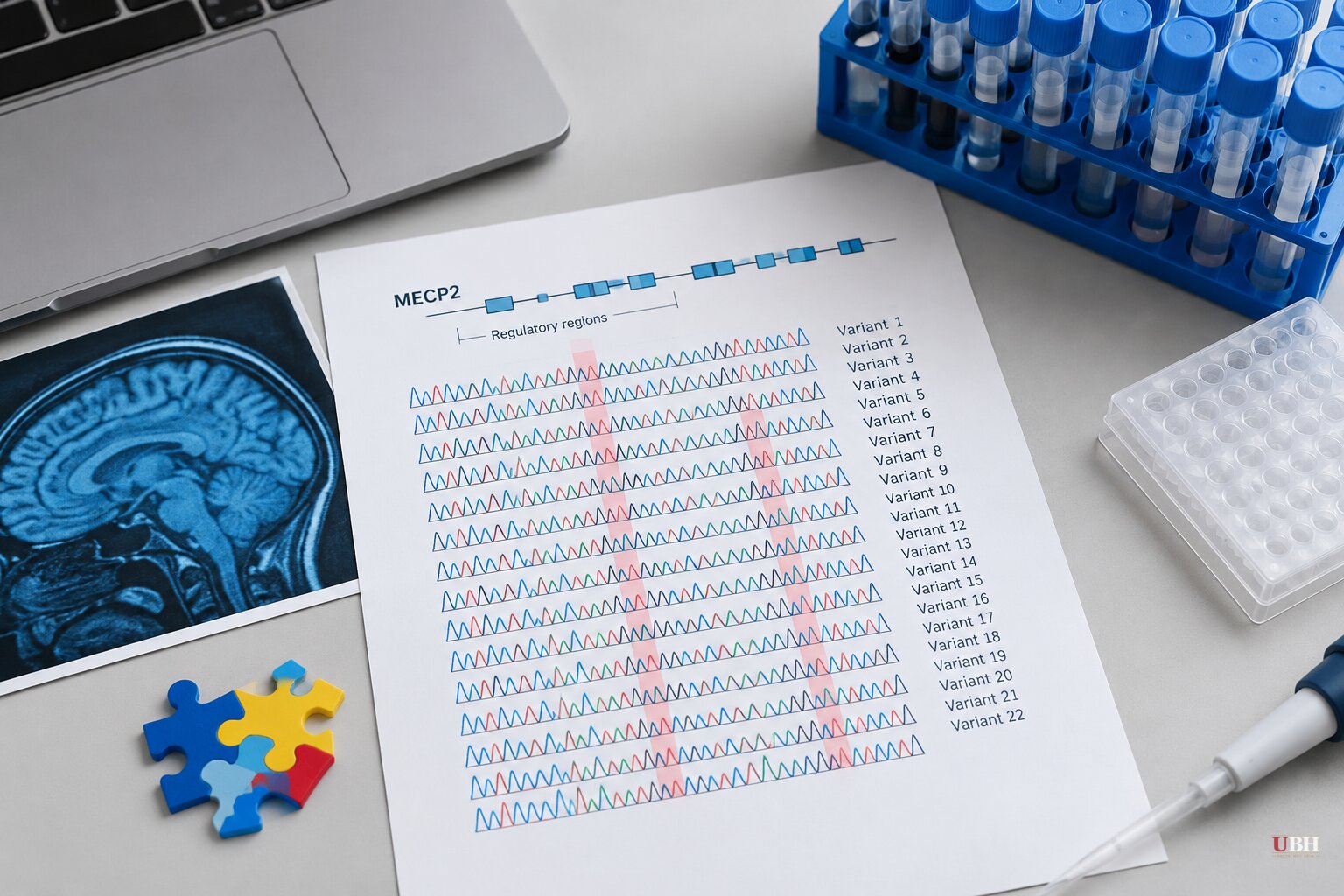
The team analyzed genetic data from 8,245 families, including 9,437 autistic individuals. They identified 22 rare candidate variants in the regulatory regions of MECP2, a gene on the X chromosome.
Regulatory regions work like dials, said first author Dr. Rebecca Meyer-Schuman, a postdoctoral associate in the lab of Dr. Huda Zoghbi. They control whether a gene is expressed and by how much.
The logic runs through biology that is not controversial. Females have two X chromosomes. Males have one.
"Females might be protected from such a mild mutation because of their second X chromosome, but males, who have only one copy, would be more vulnerable," Meyer-Schuman said.
Zoghbi, the corresponding author and a Howard Hughes Medical Institute investigator, told Newsweek that some of the differences the team found were inherited from a healthy mother by a son with autism. "We think cases like this could help explain why more males are diagnosed with autism than females," she said.
Why MECP2
The Zoghbi lab has worked on MECP2 for years. The gene is a "Goldilocks" gene, in the lab's description: brain health depends on getting the protein level just right.
About 50% or less of normal levels leads to Rett syndrome. Double the normal level causes MECP2 duplication syndrome.
Milder shifts appear to do something different. Earlier mouse studies from the lab and others found that cutting expression by 30% or raising it by 50% did not produce seizures or motor problems. It did produce autism-like behaviors, Meyer-Schuman said.
The team screened MECP2's regulatory regions with a laboratory tool called a Massively Parallel Reporter Assay to find variants that alter how much of the gene is expressed.
The limits, from an outside scientist
Clinical psychologist Karen Sheridan, who was not involved in the research, called the findings promising. She told Newsweek they should not be applied too broadly.
"Autism is a highly heterogeneous neurodevelopmental condition, and one genetic mechanism cannot explain autism in all boys," Sheridan said.
She also noted that showing a variant changes gene expression in laboratory-grown neurons does not prove it caused any individual's autism.
Sheridan went further on the headline number. She cautioned against attributing the four-to-one disparity primarily to genetics. Autism research and diagnostic expectations, she said, have historically centered on male presentations. Girls and women may show less conspicuous repetitive behaviors or use camouflaging strategies that make autistic traits less apparent.
Zoghbi's team frames the claim modestly. The release says the MECP2 changes "might help explain part of this difference."
A separate pathway: the mother's immune system
On Oct. 15, 2026, the Brain & Behavior Research Foundation highlighted mouse research from Lucas Cheadle, an associate professor at Cold Spring Harbor Laboratory and a 2021 foundation Young Investigator grantee.
According to the foundation's summary, the work points to an immune conflict between mother and fetus that can follow activation of the pregnant mother's immune system, for example by a viral infection. In the mouse experiments, that conflict produced pathology in male fetuses but not female ones.
The foundation describes this as a possible contributor to some of the male skew. It is mouse work, and the summary does not claim it explains autism in humans broadly.
Timing of diagnosis
A third study, in the journal Behavior Genetics, looked at the diagnosis side. Boys tend to be diagnosed earlier than girls, a pattern shown in a 2012 study. A 2025 study found that early-diagnosed and late-diagnosed autism have distinct genetic profiles and concluded that sex differences were unlikely to explain the split.
Lead author Sophie Breunig, a PhD candidate at the University of Colorado Boulder, set out to test that conclusion directly. Her team used genomic structural equation modeling on genome-wide association data divided into early-diagnosed, late-diagnosed, male and female categories.
The genetic signal for early-diagnosed autism carried links to educational and cognitive traits that sex could not explain. For late-diagnosed autism, the stronger ties to conditions like depression could not be sorted into diagnosis timing versus sex.
"If certain interpersonal, cognitive, and behavioral traits are more typical of autism in females, that knowledge could eventually help clinicians recognize autism in girls sooner and get them support earlier," Breunig told PsyPost.
What comes next
Zoghbi said she hopes genetic testing will eventually play a role in diagnosing both boys and girls. She said the MECP2 work helps illustrate that the genetic causes of autism in boys and girls might differ, which "could ultimately help improve diagnosis for girls."
That is a hope, not a clinical tool. It remains unclear how much of the four-to-one ratio reflects real biological differences and how much reflects girls being identified later or missed. Breunig's team could not yet separate the two.
Sources used for this briefing
7 links from 5 independent newsrooms (syndicated copies of the same report count once)
These are the sources it draws on, linked so you can verify.


