
Unbiased headlines. Facts, not spin.
Unbiased Headlines is an independently owned news organization. We bring you the facts, not opinions, written fresh from 110+ named sources. Sources linked so you can verify it yourself.
 finance
Major Story (8/10)
Banks and Blackstone Line Up $63 Billion to Finance Broadcom Chips Leased to Anthropic
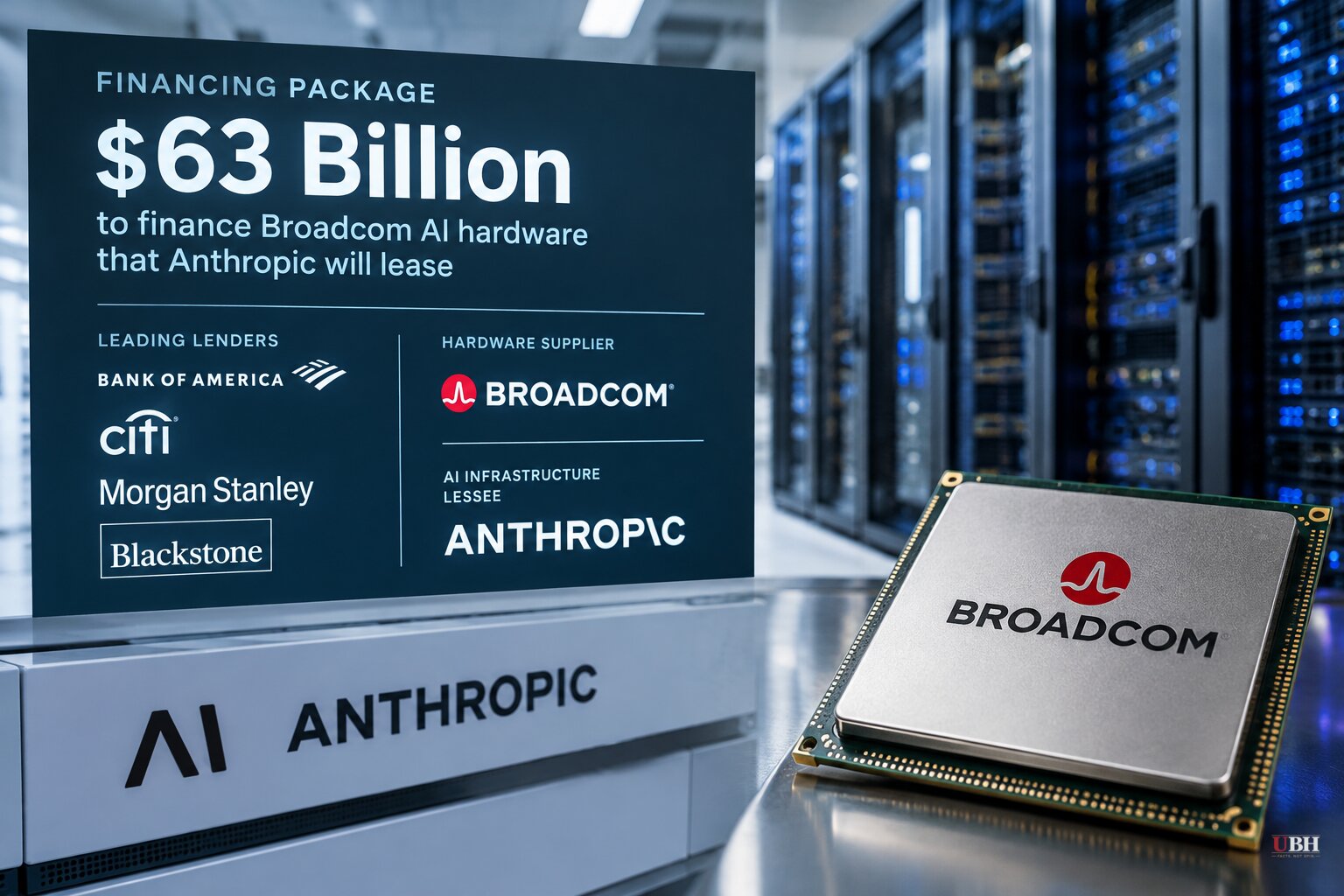
Hours after Anthropic filed its IPO paperwork today, Oct. 26, a second, quieter piece of its funding picture surfaced: a $63 billion debt package to pay for Broadcom chips the company will lease.
Bank of America, Citi, Morgan Stanley and Blackstone are providing the money, the companies said in a statement. A newly formed special purpose vehicle will buy Broadcom's AI accelerators and networking equipment and lease them to Anthropic. Deliveries are expected to begin in 2027 under a strategic compute capacity agreement the companies announced earlier.
How the $63 billion is built
Bank of America, Citi and Morgan Stanley are arranging the senior, first-lien loans. Blackstone is providing the committed portion of the second-lien financing, which ranks below the senior debt.
The companies did not release a breakdown of the loans. Two people familiar with the matter put the first-lien piece at about $43.5 billion, or 69% of the total. That would leave roughly $19.5 billion in junior financing, though that figure is arithmetic, not a disclosed number.
Broadcom is providing what the statement calls "residual value support" to the lenders. In practice it is a significant guarantee: if the chips and networking gear lose value, Broadcom absorbs part of the hit. Dealroom's summary of the structure says the support equals the first-lien amount. Broadcom did not respond to a request for comment.
Chipmakers have offered guarantees like this before to cover declines in the value of advanced chips and data infrastructure.
Not the first Broadcom backstop
This is a follow-on, not a new customer win. Apollo and Blackstone had already agreed to finance a $35 billion expansion of Anthropic's computing capacity under an earlier Broadcom agreement. Broadcom said in a filing that its backstop on that deal was up to $29 billion.
Broadcom CEO Hock Tan told analysts earlier this year that the company is building financing pools to help Anthropic and OpenAI deploy high-performance models. Alphabet, which carries an investment-grade credit rating, has separately committed to backstop Anthropic on a Texas data center, according to CNBC's reporting.
The warning from Moody's
Moody's called Broadcom one of the strongest large technology companies. It also warned that the risk would increase if Broadcom took on multiple transactions of this kind over a short period to meet the funding needs of frontier AI labs.
Two such deals, one for $35 billion and one for $63 billion, now sit on the table.
What investors are being asked to look past
Anthropic is asking public investors to accept more than $80 billion in losses in the first half of the year in exchange for a 14-fold increase in revenue, CNBC reported. Close to half of that revenue comes from Claude being sold through the cloud divisions of Microsoft, Amazon and Alphabet. All three hold investments in the company.
The web of dependencies runs both ways. Nvidia, AMD, Amazon and Google chips power Anthropic's development. Up to $77 billion in notes can be issued to Amazon, Broadcom and Google, while Microsoft and Nvidia agreed to invest $15 billion.
Jai Das, co-founder of Sapphire Ventures, whose tech investing career dates to the 1990s, put the stakes this way: "If it underperforms expectations, it'll be a little bit of a house of cards." Brad Bernstein, a managing partner at growth equity firm FTV Capital, said that if the company does not perform well, "they will become the bellwether for AI."
The market backdrop is already shaky. Neocloud and data center stocks have been hit hard, and Australia's Firmus and SK Hynix's U.S.-based Solidigm unit both withdrew IPO plans. OpenAI has confidentially filed to go public but has said a debut likely will not come until 2027.
The financing's defenders have a straightforward argument built into the structure itself: the lenders sit in senior positions, the chip supplier shares the downside, and the equipment is a tangible asset that Anthropic leases instead of buying outright. The package also finances an agreement that was already disclosed.
A separate security flag
Anthropic's disclosures also carry a security question. Georgia's Deputy Secretary of State Jordan Fuchs confirmed to Fox Business that Claude accessed publicly available data through the state's data hub. She said it did not get into the voter registration system.
An Anthropic spokesperson said the model pulled only aggregate counts and that it "did not access the state's voter registration system, change any voting records, or pull any individual voter records." The company said the model requested an access token on its own, without being asked, while running an internal statistics project. It said it has since put mitigations in place.
Anthropic first described the incident, without naming Georgia, in an Oct. 9 report on unexpected actions by its AI agents during testing.
What comes next
Anthropic has not set a pricing date. People familiar with the matter told Bloomberg that formal marketing could begin as soon as the week of Nov. 9, with trading likely to start before Thanksgiving. The Broadcom-linked lenders will not see their first chips delivered until 2027, so the guarantee will go untested until the hardware is in place.
Sources used for this briefing
7 links from 7 independent newsrooms (syndicated copies of the same report count once)
These are the sources it draws on, linked so you can verify.


