
Unbiased headlines. Facts, not spin.
Unbiased Headlines is an independently owned news organization. We bring you the facts, not opinions, written fresh from 110+ named sources. Sources linked so you can verify it yourself.
 finance
Major Story (7/10)
SpaceX Filing Shows $40 Billion Apollo GPU Deal Is a Binding Commitment, With the Lease Still to Be Signed
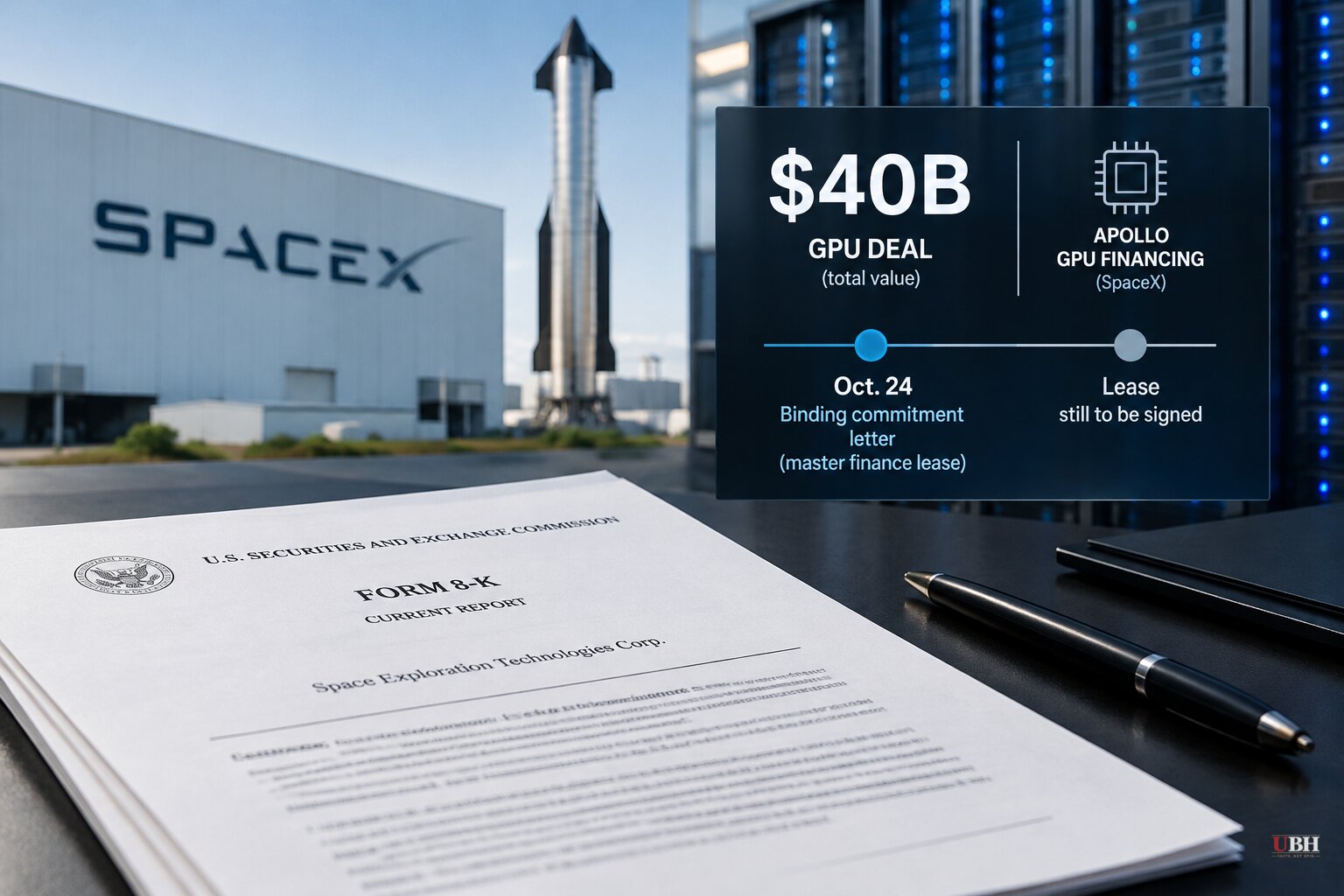
Since Elon Musk announced on X on Sunday, Oct. 25, that SpaceX had closed $40 billion in financing for GPUs, the company has put the terms in writing. A Form 8-K filed Monday, Oct. 26, describes a binding commitment, not a signed lease.
SpaceX entered the commitment letter on Oct. 24. Under it, an entity managed by Apollo Global Management will buy GPU pods and related data-center equipment and lease them to SpaceX for use at sites the company picks. SpaceX called it the "largest committed GPU financing."
The master finance lease itself has not been signed. SpaceX said it expects to finalize it before the end of the year, subject to closing conditions.
How the lease is built
Equipment arrives in tranches, and each tranche gets its own lease schedule of roughly five to five and a quarter years. Individual leases are expected to begin in the first half of 2027 as hardware is delivered.
Rent is paid quarterly in advance. Each payment generally covers one-twentieth of the financed cost of the tranche, interest at a fixed annual rate on the outstanding balance, and certain ongoing costs and expenses.
SpaceX expects aggregate principal payments of about $40 billion, excluding interest and other expenses. The interest rate has not been determined. The filing says it will be set at a pricing that occurs before SpaceX enters the master lease.
Who is putting up the money
The financing parties are led by Apollo and Goldman Sachs, with Goldman as sole structuring agent. Funds and accounts managed by BlackRock and Goldman Sachs Asset Management, plus capital accounts advised by KKR, made anchor commitments.
Apollo said the money will help deliver Nvidia's next-generation Vera Rubin chips for SpaceX's "terrestrial compute buildout."
Bloomberg reported earlier, citing people familiar with the talks, that the plan was to use a special purpose vehicle to keep the debt off SpaceX's balance sheet and protect its investment-grade ratings. The filing describes a lease with an Apollo-managed lessor.
The company's case
CFO Bret Johnsen said SpaceX is seeing "less than one-year payback periods" on its super intelligence infrastructure investments. He said the lease "diversifies our funding sources and addresses a notable portion of the funding required to deliver on our growth plans," including powering Grok for enterprises and consumers and serving cloud customers.
The numbers behind the spending are large. SpaceX reported third-quarter revenue of $14.6 billion, up 161% from a year earlier. Its Super Intelligence segment, which includes Grok, the Cursor coding tool and cloud compute, brought in $7.56 billion, up from $813 million a year earlier. That is more than Starlink and launch combined.
Capital expenditures hit nearly $20 billion in the quarter, against $6.9 billion a year earlier. On the Oct. 20 earnings call, Johnsen said SpaceX expects to spend $35 billion to $40 billion in the fourth quarter alone.
Musk's neocloud prediction
In his posts, Musk said debt markets have "almost entirely shut off access to money for any company that doesn't have substantial revenue independent of AI data centers." He added: "But we're investment grade and have Starlink & launch revenue."
He predicted the 200-plus neocloud companies built to rent out GPUs will "see guppy-level death and consolidation. Some will make it through, but not many." In a follow-up post he described the financing as primarily callable debt arriving in the first and second quarters of 2027.
The prediction is Musk's own. The filing says nothing about other companies' access to credit.
Market reaction
SPCX shares were down 0.6% in Monday trading. Bernstein raised its price target on SpaceX to $267 from $248 and kept an Outperform rating, citing stronger prospects for the terrestrial AI buildout. The firm put the target at roughly 80% above the current price.
The open items are concrete. The fixed rate has to be priced, the master lease has to be signed by year-end, and the first leases are due to start in the first half of 2027, as the first GPU deliveries arrive.
Sources used for this briefing
7 links from 7 independent newsrooms (syndicated copies of the same report count once)
These are the sources it draws on, linked so you can verify.


