
Unbiased headlines. Facts, not spin.
Every story is an unbiased news briefing written from 110+ sources across the spectrum — sources linked so you can verify it yourself.
 finance
Low Interest (4/10)
May 28, 2026 at 07:57 AM
finance
Low Interest (4/10)
May 28, 2026 at 07:57 AM
Bank of Korea Holds at 2.50% But Signals Rate Hikes Are Coming — New Governor's Hawkish Debut
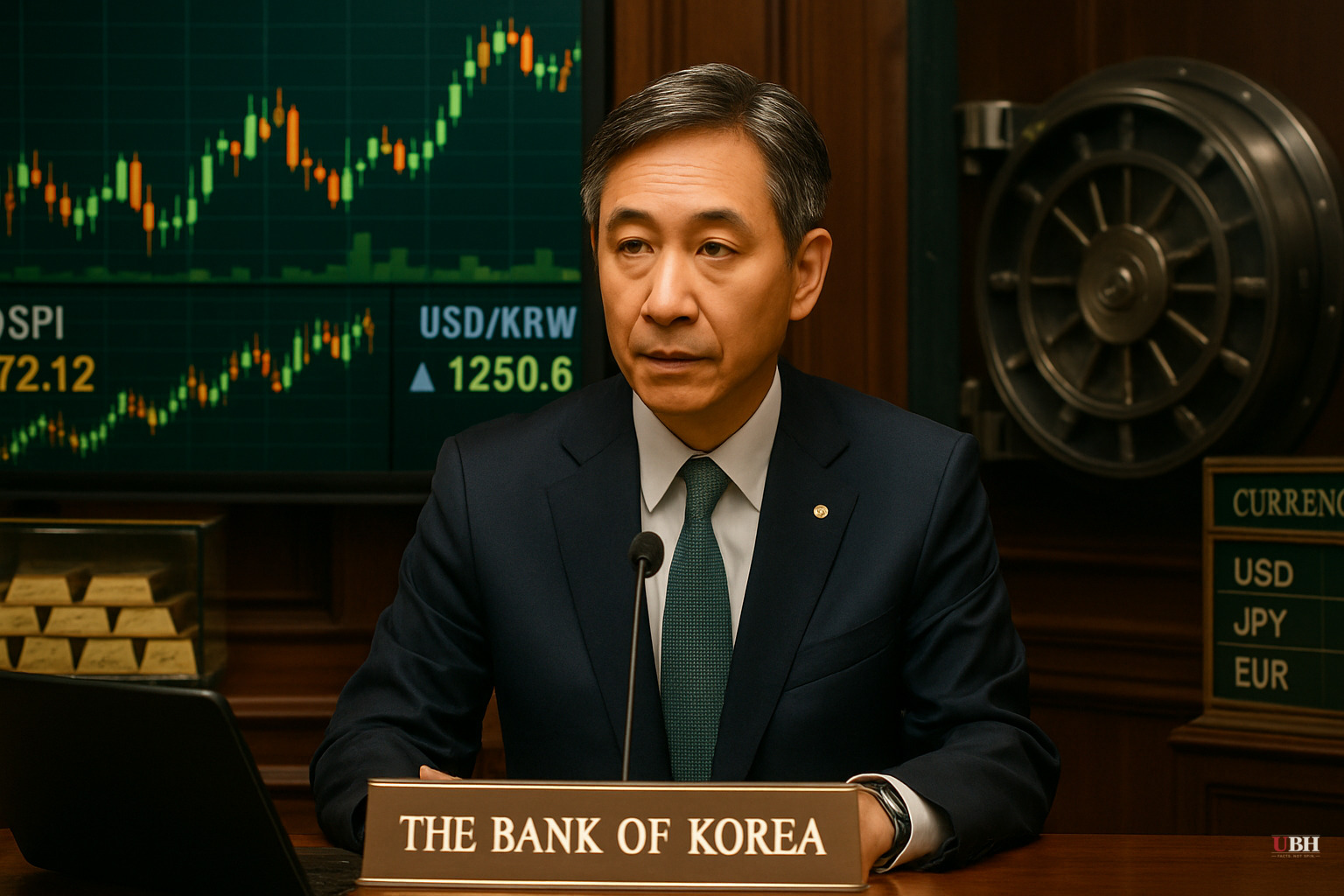
The Headline Says 'Hold.' The Data Says 'Not For Long.'
The Bank of Korea voted 5-2 to keep its benchmark interest rate at 2.50% on Thursday, May 28, 2026. The market expected it — 30 of 32 economists polled by Reuters forecast no change.
The rest of the decision signaled tightening ahead.
Two Dissents. Nineteen of Twenty-One Dots Pointing Up.
Board members Ryoo Sang-dai and Chang Yong-sung voted for an immediate rate increase — the first dissenting votes of the current policy cycle, according to investingLive.
The dot plot showed a clearer picture. Of 21 policy rate projections submitted by board members for the next six months:
- 10 projected 3.00%
- 7 projected 2.75%
- 2 projected 3.25%
- Only 2 projected staying at 2.50%
19 of 21 board members see higher rates coming. The disagreement is over when, not whether.
Why the Pressure to Hike?
Inflation. The BOK revised its 2026 inflation forecast to 2.7%, up from 2.2%, according to CNBC. The revision tracks rising oil prices tied to the Iran war.
April headline inflation came in at 2.6% — the fastest pace in nearly two years, and above the BOK's 2% target. The won has dropped 4.5% this year, adding imported inflation pressure.
GDP growth was revised upward to 2.6% for 2026, from 2.0%, reflecting a first-quarter expansion of 1.7% — the fastest in nearly six years, per CNBC. Strong growth combined with rising inflation leaves less room for policy inaction.
New Governor, New Direction
This was the policy debut of Governor Shin Hyun Song, who chaired his first monetary policy board meeting Thursday. His press conference was scheduled for 0210 GMT.
Analysts expect Shin to be more hawkish than his predecessor, Rhee Chang-yong, with greater emphasis on price stability and currency defense, according to CNBC.
The "hold" on Thursday resembles a preliminary step before committing to a shift that appears already determined.
What the Market Said
Bond traders moved quickly. South Korea's policy-sensitive three-year treasury bond futures turned sharply lower after the dot plot and policy statement, erasing early gains, according to CNBC.
A hold paired with this much hawkish signaling amounts to advance notice of rate increases.
What Comes Next, According to Analysts
Stephen Lee, economist at Meritz Securities in Seoul, projected a hike to 2.75% at the July meeting, followed by another increase in October, pushing rates to 3.00% by year-end.
Lee cited a positive output gap, rising inflation expectations, and accelerating housing prices. Not runaway inflation, but sufficient momentum to make inaction riskier than moving forward, per CNBC.
A Nomura analyst flagged that the timing of any BOK hike remains uncertain given Iran-related geopolitical risk, according to Bloomberg's Asia Trade coverage. That regional uncertainty adds complexity for Seoul's policymakers.
What Mainstream Coverage Is Missing
Two dissents on a seven-member board is significant — nearly 29% voting for an immediate increase. Combined with the dot plot, where only 2 of 21 projections see no change, the central bank has effectively previewed its next move without formally committing.
The focus on the "hold" headline misses the substance.
Also underreported: household debt and housing market conditions constrain how aggressively the BOK can move. The board explicitly flagged these, per investingLive. Aggressive hikes risk damaging overleveraged Korean homeowners. The tension exists — and received little coverage.
What This Means for Regular People
Korean households carrying mortgages or consumer debt face likely rate increases. The BOK signaled this as clearly as a central bank typically does.
For global markets, South Korea is another data point showing the post-COVID rate-cutting cycle is not a straight decline. Geopolitical shocks, currency pressure, and inflation are forcing central banks to reverse course or hold tighter for longer.
The BOK held Thursday. It almost certainly won't in July.
Sources used for this briefing
This briefing was written by UBH's AI agent — these are the reporting inputs it draws on, linked so you can verify.


