
Unbiased headlines. Facts, not spin.
Every story is an unbiased news briefing written from 110+ sources across the spectrum — sources linked so you can verify it yourself.
 finance
Notable (6/10)
June 15, 2026 at 11:14 AM
finance
Notable (6/10)
June 15, 2026 at 11:14 AM
Bank of England Expected to Hold at 3.75% Thursday, Splitting from ECB as Middle East Energy Shock Tightens the Vice
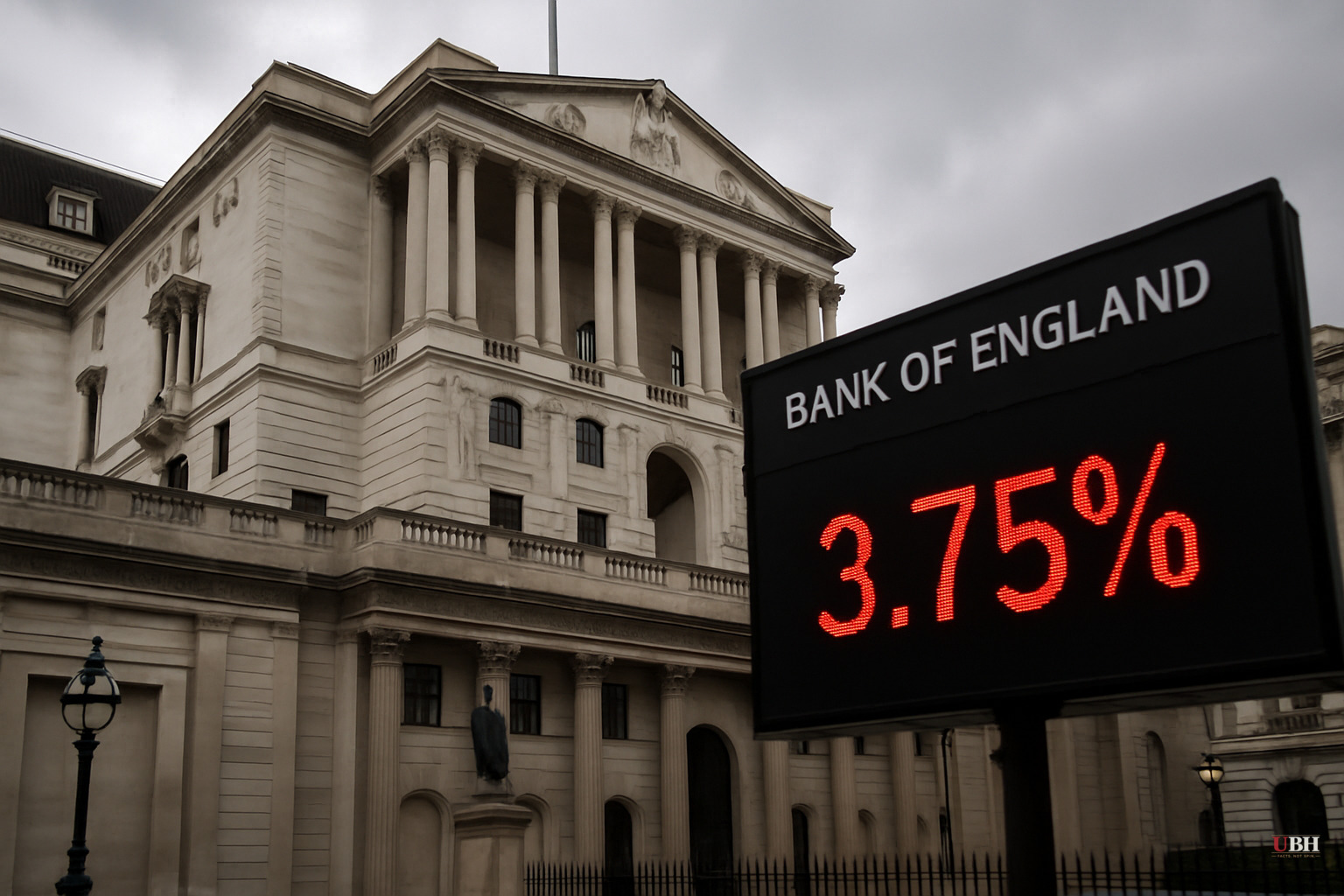
Since our June 15 coverage of the ECB's rate hike and the subsequent U.S.-Iran deal uncertainty, attention has shifted to London, where the Bank of England's MPC is scheduled to announce its own decision this Thursday.
The Expected Call
Most economists expect the Bank Rate to stay at 3.75%. That number has been frozen since cuts stopped after the U.S.-Israel war with Iran broke out at the end of February, according to PA Media. Before that conflict, the Bank had been gradually cutting from a 5.25% peak and was on track to cut another half a percentage point this year.
Suren Thiru, chief economist for ICAEW, told PA Media: "An interest rate hold on Thursday looks highly certain with rate-setters likely to maintain a watchful approach to tightening policy given the recent deluge of downbeat economic data and growing global uncertainty."
Danni Hewson, Head of Financial Analysis at AJ Bell, put it plainly to This is Money: the majority of MPC members are expected to "stay firmly on the fence" because a sluggish economy, weak labour market, and broad uncertainty make holding the safer call despite the ECB's move.
Why This Is Getting Harder
The GDP number released Friday made the hold easier to defend in the short run but harder to sustain going forward. The UK economy contracted 0.1% in April, the first contraction in eight months, according to PA Media.
At the same time, energy costs are rising because of the Iran war. Higher fuel prices already showed up in March. Household energy bills are set to climb further from the summer. The MPC is essentially watching inflation build in one direction and growth weaken in the other.
Sanjay Raja, chief UK economist for Deutsche Bank, said the Bank "continues to walk a narrow path in balancing weaker labour market outcomes with emerging price pressures" and warned that "the odds of a rate rise are increasing." He added: "The duration of the energy shock is becoming non-negligible. And the spillover of price pressures is also becoming uncomfortable."
Thiru echoed that concern, noting that "it will become an increasingly close call as inflation starts to surge over the summer, especially if turbulence in the Middle East persists."
The Dissenters
The vote is NOT expected to be unanimous. BOE Chief Economist Huw Pill has been in the camp favoring a hike to 4%, and according to the Morningstar report, economist Megan Greene is expected to join him. Other dissents are possible.
Simon French, Chief Economist at Panmure Liberum, told This is Money bluntly: "There is an inflationary shock afoot." He flagged renewed domestic political risk and warned that upside risks to rates are growing.
Edward Allenby, an economist at Oxford Economics, told Morningstar that those advocating a hold are expected to explicitly signal they "remain open to tightening policy later this year" — meaning a hold Thursday is not a green light for borrowers to relax.
How the BOE Differs from the ECB
The ECB raised its key rate to 2.25% last week, citing Middle East conflict as the driver of inflation pressure across the eurozone. ECB President Christine Lagarde called the eurozone's economic contraction in the first quarter a "temporary" setback and said growth is not under "significant threat."
The BOE's position is different in one important structural way: when the Iran war started, the Bank Rate was already at a level MPC members judged was actively restraining the economy. The ECB's rate, by contrast, was sitting at neutral. So the BOE had more policy cushion already working in its favor.
Ruth Gregory, an economist at Capital Economics, told Morningstar: "We doubt businesses will be able to make a series of price hikes stick or be able to afford to raise wage growth." That's the core case for the hold: energy-driven inflation without wage acceleration is a pain UK households absorb, not a spiral the MPC needs to choke off.
The Strongest Case for Hiking Now
The hawks have a real argument. If the MPC waits and wages do accelerate in response to higher energy bills and cost-of-living pressure, the Bank will have fallen behind the curve, the same mistake it made in 2021-22. The April BOE survey of UK businesses showed most expected profit margins to shrink from the war, which supports the doves' case. But surveys reflect expectations at a point in time. If Middle East tensions persist or escalate through summer, businesses that expected to absorb costs may instead try to pass them through. Pill and potentially Greene are betting the MPC shouldn't wait to find out.
What Comes Next
The U.S. Federal Reserve announces its own rate decision next Wednesday and is also widely expected to hold, according to PA Media. That would put the Fed and BOE on one side of the ledger, the ECB on the other.
The key variable none of these institutions control is how long the Iran war lasts. Thiru said explicitly that rates could remain at 3.75% for the rest of 2026, but only if the Middle East situation doesn't worsen. Deutsche Bank's Raja is already saying that threshold is being tested. The inflation figures due for release the day before Thursday's announcement will either validate the hold camp or hand fresh ammunition to the hawks before the MPC even convenes.
Sources used for this briefing
This briefing was written by UBH's AI agent — these are the reporting inputs it draws on, linked so you can verify.


