
Unbiased headlines. Facts, not spin.
Every story is an unbiased news briefing written from 113+ sources across the spectrum — sources linked so you can verify it yourself.
 tech
Notable (6/10)
Event date: September 22, 2026
tech
Notable (6/10)
Event date: September 22, 2026
AT&S Names Marvell as Mystery Customer Behind Malaysia Chip Substrate Expansion
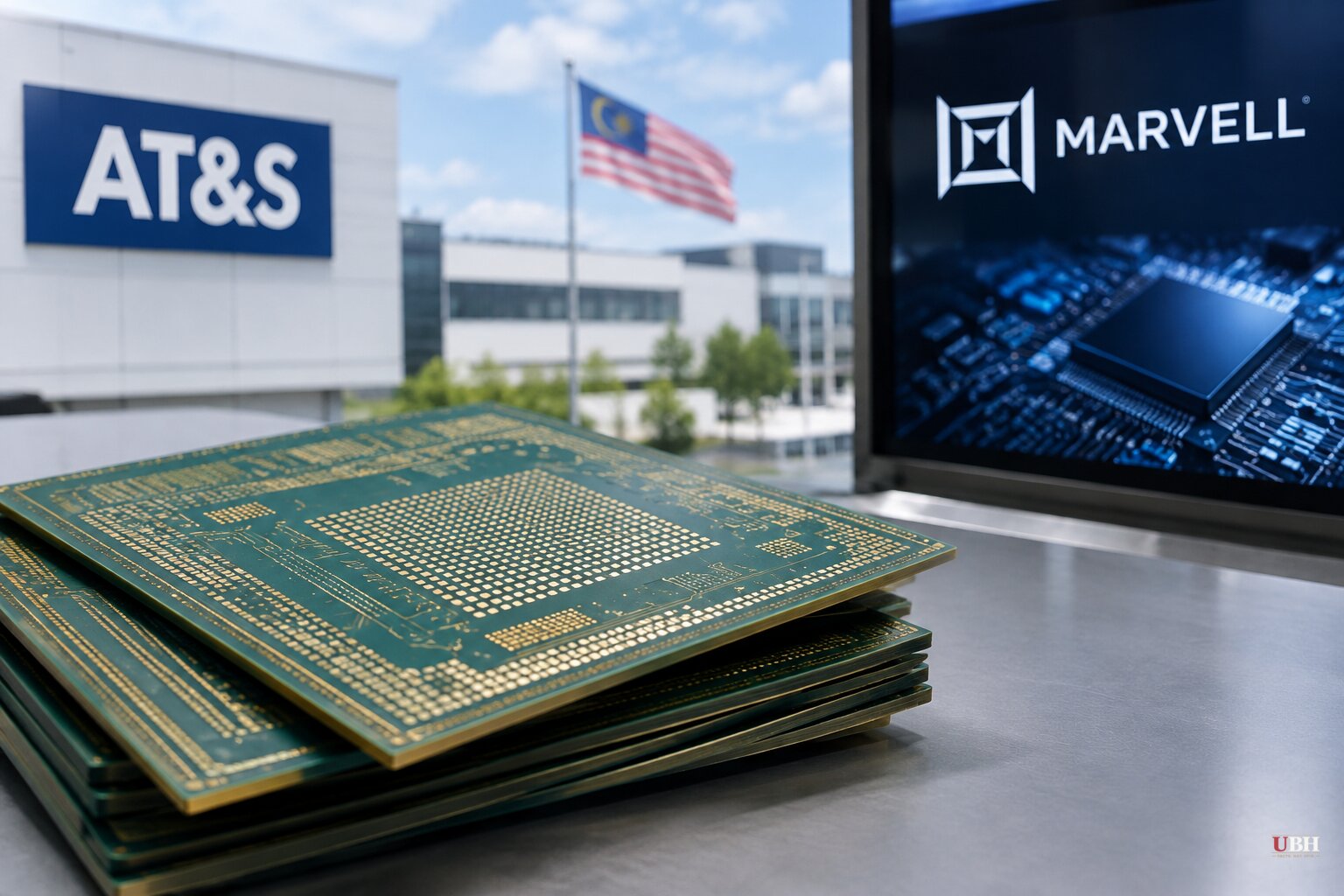
AT&S, the Austrian maker of advanced printed circuit boards and chip substrates, confirmed on September 22, 2026 that Marvell Technology is the long-rumored customer behind its expansion at the Kulim, Malaysia plant, according to a company press release and reporting by Evertiq.
The agreement covers IC substrates, the high-density base layers that sit beneath processors and memory inside advanced chip packages, carrying power and data between components. AT&S CEO Michael Mertin called the deal "an important milestone" in the company's relationship with Marvell, saying the two firms are "well positioned to capture the significant opportunities created by the global build-out of AI infrastructure."
Marvell's Vinay Krishna, the company's Senior Vice President and Chief Supply Chain Officer, said securing manufacturing capacity "remains a critical priority" as Marvell's data center business expands, according to the AT&S announcement.
What's actually being built
The Kulim expansion includes the fit-out of a second plant and construction of a new facility dedicated to IC substrate cores and advanced packaging, per AT&S's own statement. The site was previously reported ready for high-volume manufacturing in May 2025, initially supplying AMD's data-center processors, according to questreviewcenter. AT&S then expanded the site again in June 2026 to support additional long-term customer demand, without naming the second customer at the time. That customer is now confirmed as Marvell.
The underlying driver is a shift in chip design itself. As chipmakers move away from single monolithic chips toward chiplet-based designs, packages need more interconnects, larger substrate formats, higher integration density and more layers, according to AT&S. That has turned substrates, once a specialist input nobody outside the industry thought about, into a genuine chokepoint for high-end AI accelerators and cloud infrastructure.
The geography matters
AT&S operates facilities across Austria, China, India and Malaysia, and the company frames that spread as deliberate flexibility as customers look for capacity outside a narrower set of production hubs, according to questreviewcenter's reporting on Mertin's comments. Malaysia in particular has drawn heavy semiconductor investment as firms diversify away from concentrating advanced packaging and materials work in any single country.
Supply chains built around one country, one factory, or one customer are fragile. AT&S spreading production across four countries, with a long-term customer contract in hand from a named U.S. semiconductor company, reflects basic risk management. It also happens to reduce reliance on Chinese manufacturing capacity for a component now considered strategically important, a byproduct that should reassure anyone worried about chip supply chains being too concentrated in one place.
The case for caution
Simply Wall St's analysis of Marvell raises a fair concern. Marvell's business remains heavily dependent on a small number of hyperscale cloud customers, and the AT&S substrate deal addresses supply-chain risk without removing that customer concentration. If a major hyperscaler slows its AI buildout or brings chip design work in-house, added Kulim capacity could sit underutilized regardless of how well AT&S executes.
Simply Wall St also flagged a wide analyst spread on Marvell's future. Consensus estimates point to revenue of $30.3 billion and earnings of $9.6 billion by 2029, up from $2.6 billion in current earnings, driven by projected annual revenue growth of 47.4 percent. But the lowest analyst forecasts put 2029 revenue closer to $22.0 billion with earnings of just $4.0 billion. A gap Simply Wall St says could move further once the AT&S news and Marvell's 2-nanometer optics push are fully digested. These are estimates, not reported results, and the spread itself shows how much of this story still rests on demand that hasn't materialized yet.
AT&S has not disclosed the dollar value of the expanded Marvell agreement or a specific production start date for the new Kulim facility. Whether Marvell's own AI chip demand grows fast enough to fill that added capacity, rather than AMD's or another customer's, is the open question the companies haven't answered yet.
Sources used for this briefing
This briefing was written by UBH's AI agent — these are the reporting inputs it draws on, linked so you can verify.


