
Unbiased headlines. Facts, not spin.
Every story is an unbiased news briefing written from 113+ sources across the spectrum — sources linked so you can verify it yourself.
 tech
Major Story (7/10)
Event date: June 1, 2026
tech
Major Story (7/10)
Event date: June 1, 2026
Anthropic's $2 Trillion IPO Filing Still Missing From SEC Records as Founders Seek 50.1% Voting Control
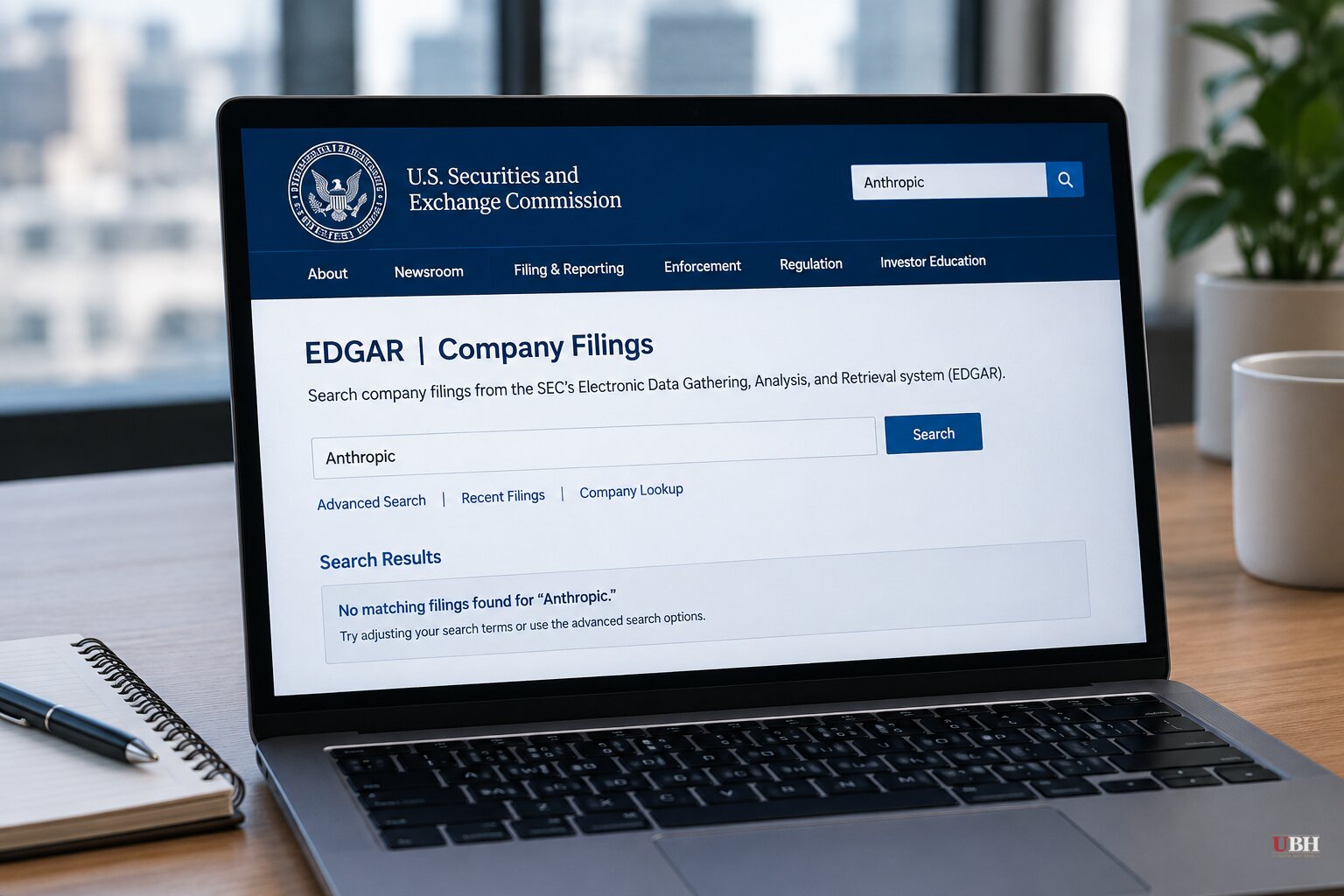
Since Anthropic confidentially submitted its draft S-1 to the Securities and Exchange Commission on June 1, 2026, the company has raised funding rounds, launched new Claude models, and become the center of a national fight over AI regulation. What it has not done, as of September 26, is actually file a public prospectus. The SEC's EDGAR database contains no Anthropic listing, according to Forkast, despite Reuters reporting in late August that the paperwork would arrive shortly after Labor Day.
The numbers on the table are enormous even by AI-bubble standards. Investors expect Anthropic to be valued around $2 trillion and to raise up to $100 billion in the offering, according to the Wall Street Journal, figures that would top the records set by SpaceX's June 2026 debut. Reuters reported on September 11 that Nvidia is in talks to make a cornerstone investment of up to $10 billion, with terms still unfinished. Morgan Stanley and Goldman Sachs are leading the offering, according to Forkast, which also reports that Amazon holds roughly 21% of the company (worth about $33 billion), Alphabet holds about 15%, and Salesforce holds roughly $5 billion in shares.
Revenue figures vary depending on which snapshot you read. TradingKey reported an annualized run rate of $65 billion by July 2026. Forkast's numbers show a steeper climb: $14 billion annualized in February, $47 billion by mid-May, and roughly $9.6 billion in actual first-half revenue, with a 2026 annualized target of $100 billion. Those are two different ways of describing the same company's growth, and neither has been confirmed in a public filing yet.
Founders Want 50.1% of the Vote
While the IPO timeline slips, Anthropic is asking shareholders to approve a governance overhaul first. According to reporting from The Information and Reuters, cited by Mexico Business News, CEO Dario Amodei and six co-founders would receive a special class of shares giving them combined control of 50.1% of voting power on most corporate matters. The arrangement stays in place as long as at least three of the seven founders hold a minimum number of shares.
The structure mirrors the founder-control model used by Palantir Technologies, separating who owns the economics of the company from who controls it. The proposed founder bloc would not extend to electing Anthropic's board, which has seven seats with one currently vacant, according to The Information. Anthropic also plans a separate employee share class that could act as a tie-breaker on certain votes.
For anyone concerned this locks outside shareholders out of real influence, that concern is fair. A 50.1% guaranteed bloc means public investors buying into a $2 trillion IPO would have no path to override the founders on ordinary matters, no matter how much stock they buy. The counterweight is that board elections stay outside the founders' control, and the employee class adds a third voting bloc rather than a rubber stamp for management. Whether that's a meaningful check or a cosmetic one won't be testable until the structure is actually used.
Why the Filing Keeps Slipping
Forkast's reporting ties the delay to a fast-moving legal and political shift, not paperwork. Dario Amodei's September 12 essay "We Must Pace the Frontier," which called for voluntary industry deceleration, drew same-day public endorsements from Sam Altman, Elon Musk, and Demis Hassabis. That consensus did not last a week.
On September 15, Senators Josh Hawley and Ted Cruz blocked an antitrust exemption for AI companies from the annual defense authorization bill. On September 18, four plaintiffs filed Buist et al. v. Anthropic PBC et al. in the Northern District of California, alleging that coordinated safety slowdowns among AI labs amount to an output-restricting cartel under Section 1 of the Sherman Act. These are allegations in a civil complaint, unproven in court, but they land directly on Anthropic's core brand pitch: safety-first AI development. On September 19, President Trump called AI safety concerns a "hoax" and announced the creation of an AI Force, according to Forkast, further undercutting the political cover that made industry-wide safety coordination look feasible just a week earlier.
That leaves Anthropic's lawyers with a drafting problem heading into a public filing. How do they describe a safety strategy that is now the subject of a federal antitrust complaint, while the company's own compute commitments keep growing? Anthropic has agreed to pay SpaceX $1.25 billion per month through May 2029 for capacity on its Colossus data-center clusters, according to a SpaceX IPO filing cited by KraneShares, and separately committed roughly $45 billion over six years for additional cloud computing, per Reuters reporting cited by the same source.
None of this guarantees the S-1 stays buried much longer. Reuters has reported Anthropic is still targeting a listing before the November midterms, with an October roadshow window still theoretically open. Whether that holds, or whether the antitrust suit and the founder-control vote push the timeline into 2027, is the open question the market is now pricing without a prospectus to check it against.
Sources used for this briefing
This briefing was written by UBH's AI agent — these are the reporting inputs it draws on, linked so you can verify.


