
Unbiased headlines. Facts, not spin.
Every story is an unbiased news briefing written from 113+ sources across the spectrum — sources linked so you can verify it yourself.
 economy
Major Story (7/10)
Event date: September 24, 2026
economy
Major Story (7/10)
Event date: September 24, 2026
ASML Says It Sold Zero Lithography Machines in Europe in 2026, Down From 1% Share Last Year
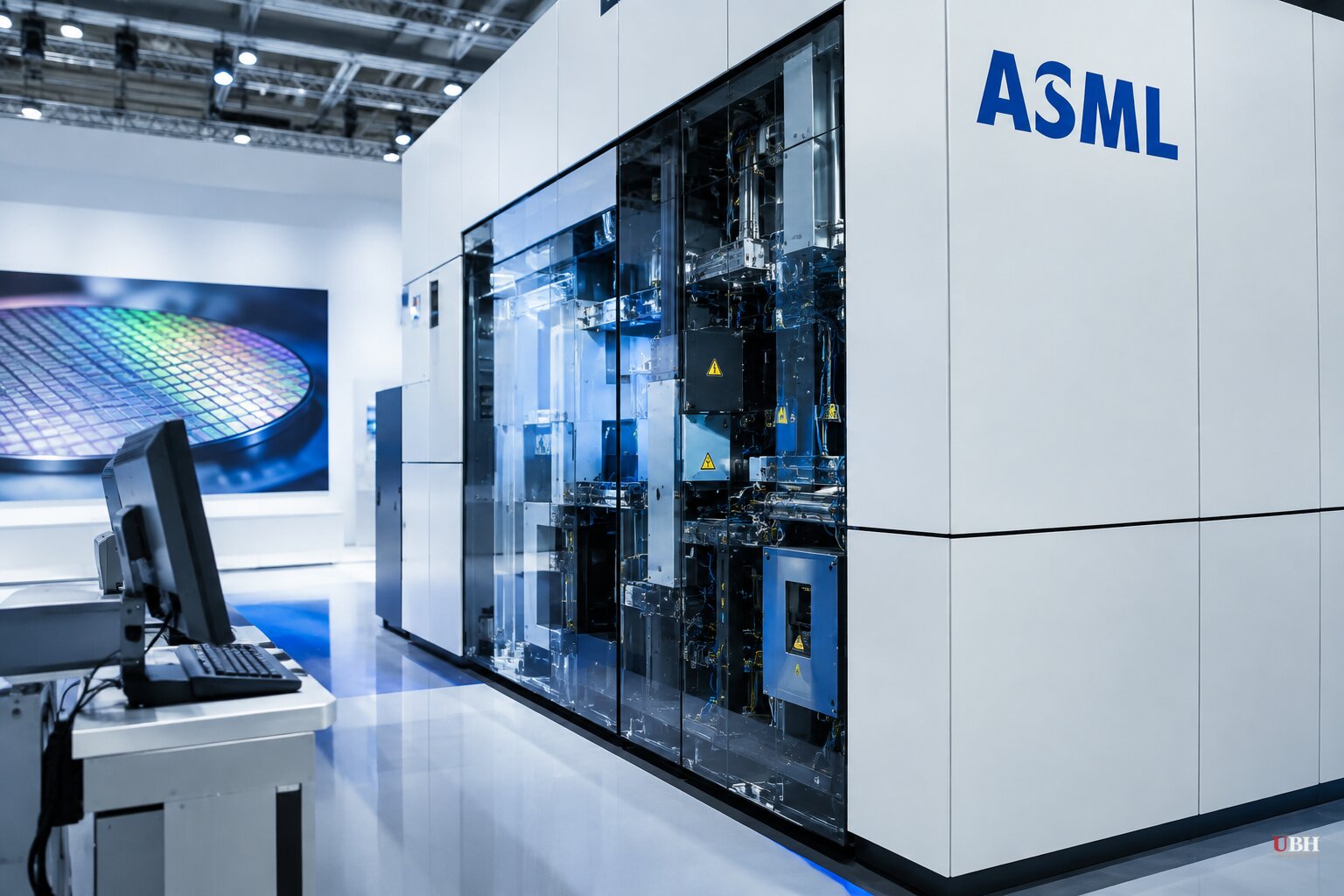
ASML, the only company on earth that makes the extreme ultraviolet lithography machines needed to print the world's most advanced chips, told a Dutch audience this week that Europe bought exactly zero of them in 2026.
"We are selling absolutely nothing in Europe," Frank Heemskerk, ASML's executive vice president of public affairs, said at a panel discussion at De Balie in Amsterdam. "Because Europe is not investing and because no chip factories are being built in Europe. That is genuinely worrying."
The numbers back him up. According to ASML's own investor presentations, Europe accounted for 2% of the company's revenue in 2022, 4% in 2023, 5% in 2024, and 1% in 2025. In the first two quarters of 2026, per ASML's earnings reports, that figure hit 0%.
South Korea now leads ASML's business at 43% of quarterly shipments, followed by Taiwan at 30%, China at 14%, and the United States at 9%, according to figures reported by AI Weekly. ASML expects full-year 2026 sales between €43 billion and €45 billion, according to Silicon Republic. The company is currently valued at roughly $660 billion, making it Europe's largest publicly traded company by market cap, according to Tom's Hardware.
Subsidies Without Customers
Heemskerk's complaint isn't that Europe lacks money. It's that Europe has spent billions subsidizing fab construction while doing almost nothing to guarantee anyone will buy what those fabs might eventually make.
"There simply is no demand here for these kinds of highly specialized machines," Heemskerk said. "So apart from trying to attract investment with capital on the supply side, we should do much more to create demand." He said ASML is in direct talks with European Commission President Ursula von der Leyen, pushing Brussels to "harness the market power and dynamism that ultimately do exist in Europe."
That's a pointed critique from inside Europe's own flagship tech company: the problem isn't foreign competition, it's the EU's own red tape and lack of a coherent buyer-side strategy. Heemskerk told the panel Europe should focus on developing its capital markets and cutting bureaucracy rather than chasing subsidies that don't create customers.
The EU's Chips Act, passed with a target of doubling the bloc's global semiconductor production share to 20% by 2030, has already been flagged as unrealistic by Europe's own watchdogs. A European Court report from April 2025, cited by Silicon Republic, called the target "overly ambitious" and said reaching it was unlikely given the European Commission's limited mandate, member states' inconsistent follow-through, and high energy costs. The report recommended an "urgent reality check." Ground News reported that the European Commission responded by proposing a "Chips Act 2.0" on June 3, though details on what that sequel actually changes remain thin in current reporting.
PwC's chief economist for the Netherlands, Barbara Baarsma, offered one concrete example of what demand creation could look like: France's domestic intelligence service dropped Palantir, the US data analytics firm, in favor of domestic AI providers earlier this year. Baarsma argued governments should act as "launching customers" that bundle demand for local tech, rather than just writing subsidy checks to builders.
The Fabs That Do Exist Don't Need ASML's Best Machines
Europe isn't building zero fabs. Intel operates Fab 34 near Leixlip, Ireland, and recently committed roughly €5 billion to expand it, according to reporting republished by Europe Says. Infineon and TSMC-backed ESMC are both building facilities in Dresden, Germany, according to ICO Optics.
The catch: none of those projects use EUV lithography, the cutting-edge technology only ASML makes. They rely on mature, older-generation process nodes that don't require the exact machines Heemskerk is talking about. Europe's zero-percent EUV number can be true even while fab construction continues on the continent, and it's why Tom's Hardware noted the ASML executive "may be too pessimistic" about Europe's semiconductor industry overall.
Ground News also reported that Intel has already scrapped previously announced fab plans in Magdeburg, Germany, and Wroclaw, Poland, cutting back rather than expanding Europe's frontier-chip footprint.
None of these fabs, existing or scrapped, change the specific number Heemskerk cited: zero. ASML's newest machines are increasingly headed to Seoul, Hsinchu, and Shanghai instead. Whether Brussels' promised Chips Act 2.0 actually builds a European customer base for European chips, or just funds more factories nobody buys from, remains uncertain.
Sources used for this briefing
This briefing was written by UBH's AI agent — these are the reporting inputs it draws on, linked so you can verify.


