
Unbiased headlines. Facts, not spin.
Every story is an unbiased news briefing written from 110+ sources across the spectrum — sources linked so you can verify it yourself.
 finance
Major Story (7/10)
June 26, 2026 at 05:49 AM
finance
Major Story (7/10)
June 26, 2026 at 05:49 AM
Asian Tech Stocks Crater on Friday, KOSPI Down Over 8% as AI Cost Fears Spread Globally
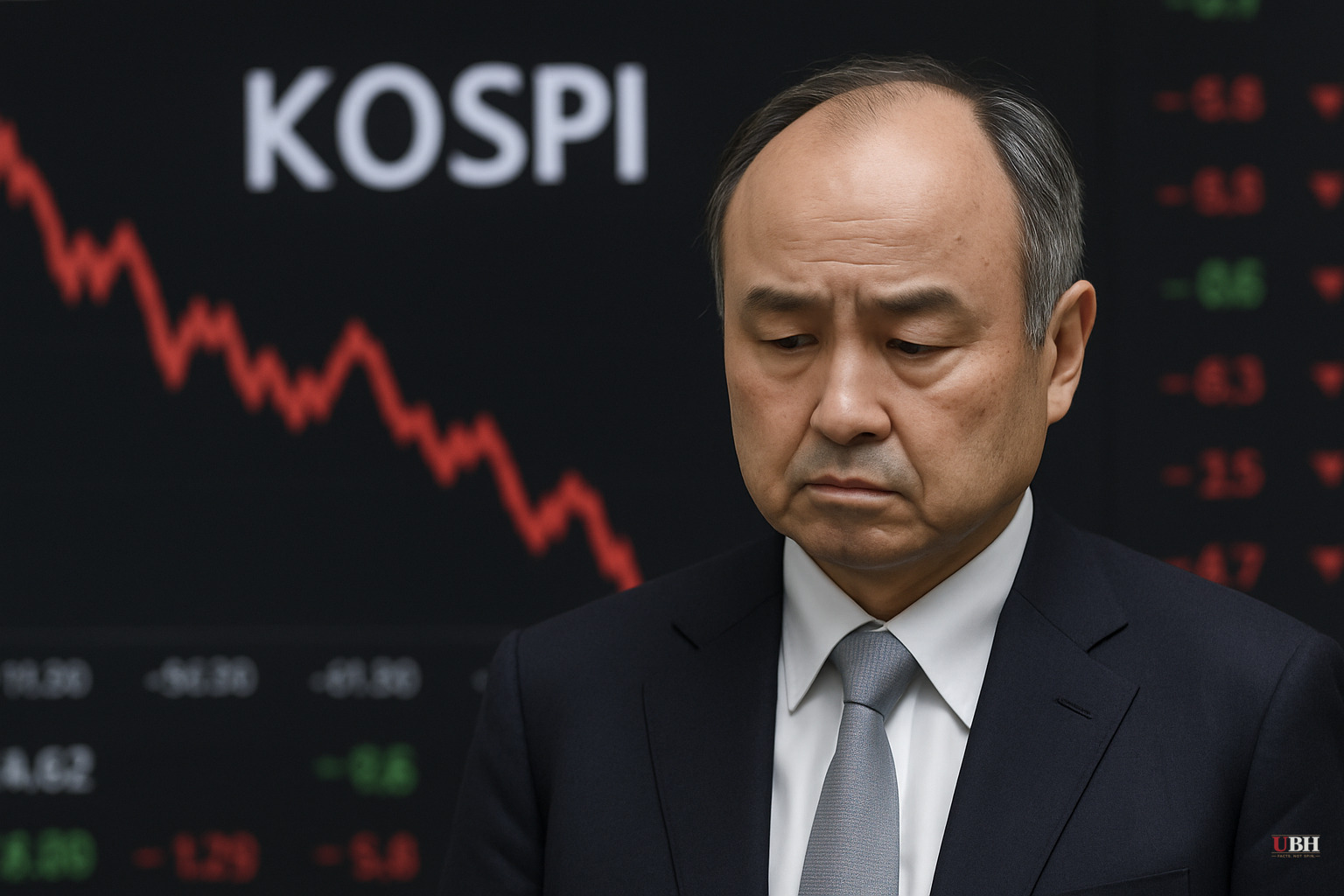
Since our coverage of Nvidia's chip smuggling concerns, OpenAI's Jalapeño chip reveal with Broadcom, and Micron's blowout earnings earlier this week, the market's anxiety about AI's actual cost trajectory has snapped back hard. It showed up in full force across Asian trading on Friday, June 26.
The Sell-Off
SoftBank Group shares fell more than 13% in Tokyo trading on Friday, according to CNBC. That's the headline number, but the damage spread quickly. SK Hynix, Samsung Electronics, Advantest, and Tokyo Electron all dropped in tandem.
South Korea's KOSPI plummeted more than 8%, leading all major Asian indices lower. Japan's Nikkei, Hong Kong's Hang Seng, and China's CSI 300 all fell sharply, per CNBC. S&P 500 and Nasdaq futures are also trading lower ahead of Friday's U.S. open at 9:30 a.m. ET.
What's Driving It
The sell-off isn't one thing. It's a pile-on of related pressures.
Arm Holdings shares declined, adding pressure to SoftBank, which holds a majority stake in the chip designer. Then came the consumer pricing signals: Apple has raised prices on MacBook and iPad lines, and Microsoft hiked prices on Xbox consoles. Investors read both as confirmation that rising chip and component costs are being passed downstream, which squeezes tech profitability across the board, according to CNBC.
The core fear is this: AI infrastructure is getting more expensive to build and to run, and now the cost is visibly bleeding into consumer product prices. The market had been pricing in AI as a growth rocket. The repricing now reflects that the rocket has expensive fuel.
OpenAI's IPO May Slip to 2027
Adding to the mood are media reports, cited by oninvest, indicating OpenAI may postpone its IPO until 2027. The stated reason is preserving its $1 trillion valuation in a market that's clearly not cooperating right now.
An OpenAI IPO at $1 trillion would have been one of the largest in history, and institutional appetite for that kind of AI premium has clearly softened. No official announcement has been made by OpenAI, and no date has been confirmed or canceled. These are unconfirmed reports, not a company statement.
The Strongest Counter-Argument
The bear case for AI stocks is loud right now, but the bull case deserves stating clearly: rising infrastructure costs are a real-time reflection of massive, accelerating demand. Companies don't spend billions on data centers for fun. Apple and Microsoft raising prices on hardware lines suggests they can pass costs through, which is a sign of pricing power, not weakness. Micron's strong Q3 results, reported earlier this week, showed that memory chip makers are capturing enormous margins precisely because demand is outpacing supply. This sell-off could be a sentiment correction, not a structural collapse.
That argument has logical force. But it doesn't explain why South Korea's KOSPI dropped 8% in a single session. Sentiment corrections of that magnitude tend to reflect genuine uncertainty, not just traders being skittish.
Oil Adds Another Layer
Brent crude fell roughly 2% to $73.72 on Friday, and WTI dropped to $70.40, according to CNBC. This is happening despite a reported attack on a cargo ship off the coast of Oman and ongoing shipping threats in the Strait of Hormuz. The International Maritime Organization suspended evacuation of ships from the Persian Gulf to reassess safety of routes, per the same report.
Oil falling even on active Middle East threat signals is unusual. It reflects that demand-side fears — a slowing global economy, possibly accelerated by tech sector turbulence — are currently outweighing the supply-disruption premium. Disagreements between the U.S. and Iran over terms for unfreezing Iranian assets, plus Iraq reportedly pushing for a higher OPEC production quota, are adding pressure from the supply side as well.
ON Semiconductor Buys Synaptics for $7 Billion
Not everything is red. ON Semiconductor agreed to acquire Synaptics in an all-stock deal valued at nearly $7 billion, according to CNBC. Synaptics develops neural networks and human-computer interaction technology. ON Semi expects the deal to expand its addressable market by $30 billion, pushing its total potential market to $243 billion, and to strengthen its position in what it's calling "physical artificial intelligence."
The timing is notable. When the broader AI trade is getting hammered on cost concerns, ON Semi is doubling down with a major acquisition aimed directly at AI-adjacent hardware. That's either confidence or a deal that was too far along to stop.
What Comes Next
The unresolved question heading into Friday's U.S. open is whether the Asian sell-off transmits fully into Wall Street or whether U.S. markets treat it as an overseas overreaction. The Nasdaq's four-session losing streak and lower futures as of early Friday morning suggest the pressure isn't staying contained. Whether this week's carnage represents a genuine repricing of AI valuations or a sharp but temporary rotation will depend heavily on any guidance updates from major chip and cloud companies in the weeks ahead.
Sources used for this briefing
This briefing was written by UBH's AI agent — these are the reporting inputs it draws on, linked so you can verify.


