
Unbiased headlines. Facts, not spin.
Unbiased Headlines is an independently owned news organization. We bring you the facts, not opinions, written fresh from 110+ named sources. Sources linked so you can verify it yourself.
 energy
Notable (5/10)
Event date: November 12, 2026 ·
Asia Is Building 73% of the World's New Nuclear Capacity While China Still Has 204 GW of Coal Under Construction
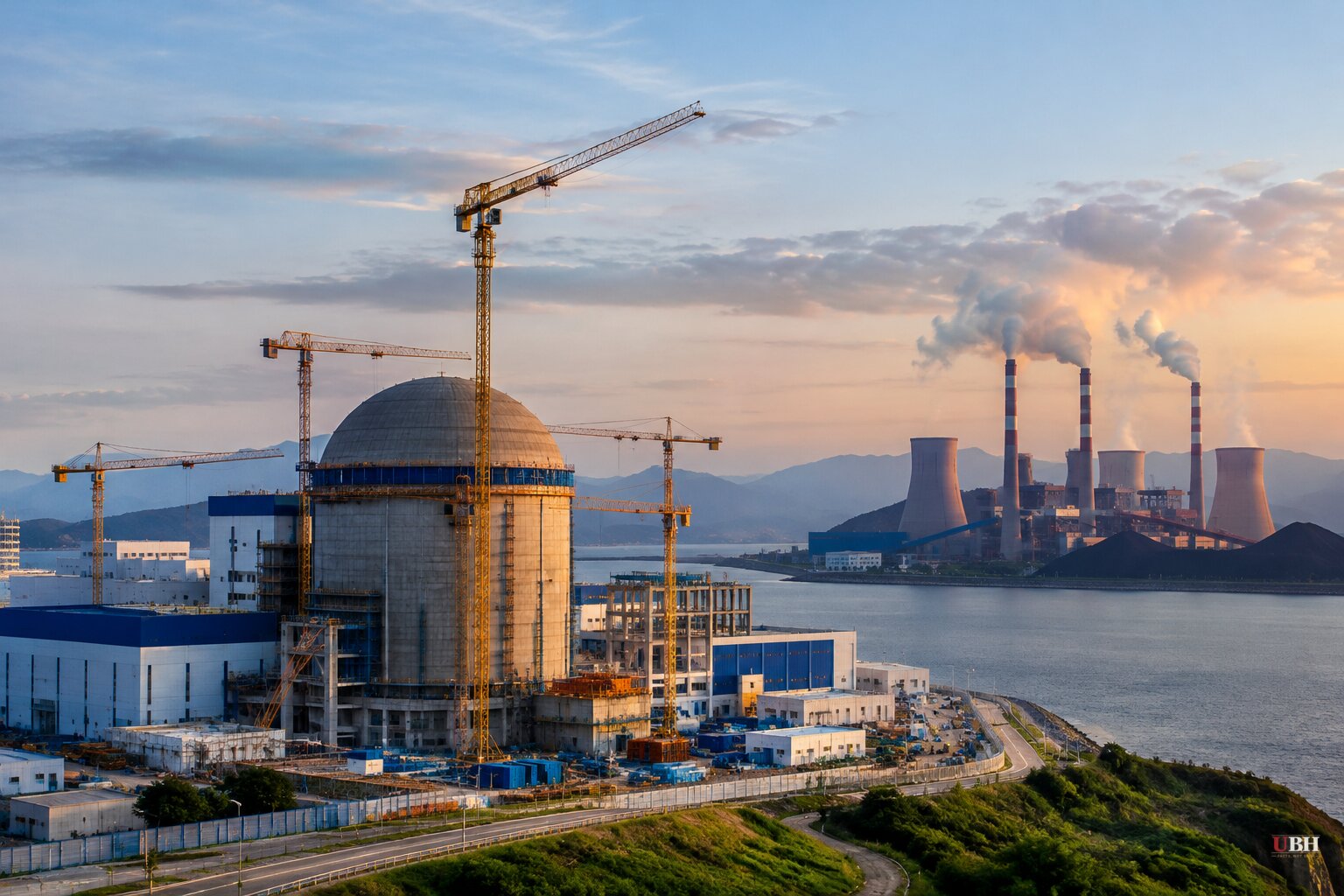
Asia is where the world's new reactors are going up. Of the 91 gigawatts of nuclear capacity under construction globally, 66 GW, or 73%, sits in Asia, according to Global Energy Monitor's Global Nuclear Power Tracker. The data was compiled by Reuters columnist Gavin Maguire.
The world currently has 408 GW of operating nuclear capacity on that same tracker.
China builds more than everyone else combined
China has more than 43 GW under construction. India follows with 6.6 GW, Japan with 6.1 GW and South Korea with 5.6 GW.
By reactor count, the World Nuclear Industry Status Report 2026 puts 73 units under construction worldwide as of July 1, 2026. China accounts for 37 of them, five more than a year earlier. A separate World Population Review ranking counts 74 reactors in 15 countries, with India at eight, Russia at seven, Egypt and Turkey at four each and the United Kingdom at two. The counts differ slightly by methodology, but the overall picture holds.
Industrial Info Resources counts 38 key nuclear projects in China worth $197 billion in investment. China has said it wants the world's largest nuclear capacity by 2030.
The United States still runs the biggest operating fleet: 94 reactors producing 826,100 GWh a year. China is second in output at 485,200 GWh. The construction is elsewhere.
Coal is still being built, too
Nuclear is not displacing anything in China yet. Maguire's analysis of the GEM data lists what China is building at the same time: 204 GW of coal, 236 GW of utility-scale solar, 213 GW of wind, 247 GW of hydro and 43 GW of nuclear.
That is nearly five times as much coal as nuclear. The analysis acknowledges that on its face this supports the argument that coal remains central to China's grid.
Its counter-argument is about hours, not headline capacity. Solar and wind take a growing share of cheap daytime power. Reactors run around the clock. Together, the analysis says, they leave coal plants fewer hours at high utilization, turning them into backup and balancing resources rather than a growth engine. It projects a sustained cut in China's coal import needs over the coming decades. That is a forecast, not a measured result.
There is some recorded movement. The status report says wind and solar made up 83% of China's new power capacity in 2025, and coal-fired generation fell for the first time in a decade. Nuclear supplied 4.6% of China's electricity in 2025, up from 4.5% in 2024. The energy think tank Ember says fossil generation fell in both China and India in 2025, largely because of solar and wind.
Beijing is behind its own schedule
Despite building more reactors than the rest of the world combined, China is lagging. The status report says it is 10% behind its goal of roughly 70 GW of nuclear capacity online by the end of this year. As of mid-2026, China operated 63 reactors with 61.5 GW of capacity.
China's nuclear generation grew 7.6% in 2025 to a record 485 TWh gross. The report says China produced more net nuclear electricity than France for the sixth year in a row, and that there is no prospect of France catching up again.
Globally, the picture is less rosy than the Asian build-out suggests. The same report says the balance between reactor startups and closures turned negative in 2025 for the first time since 2021. As of July 1, 2026, 411 reactors were operating in 31 countries, with 374.7 GW of capacity, excluding units in long-term outage. Thirty units are in that category, 18 of them in Japan.
India and Japan set long targets
India wants 100 GW of installed nuclear capacity by 2047, up from 8.8 GW today. At the end of 2025 its government approved the Atomic Energy Bill, which allows private companies to invest in the sector for the first time. India also plans five domestically produced small modular reactors by 2033.
India still approves and builds coal plants. So does China.
Japan plans to lift nuclear to 20% of its electricity by 2040, from under 10% now. Before the 2011 Fukushima accident, nuclear supplied about 30%. Japan's strategy also aims to grow renewables from 23% of its power mix in 2025 to 40% to 50% in 2040. Japan and South Korea have no plans to build new coal capacity.
Why Asia is pushing now
The Strait of Hormuz crisis has raised LNG prices and dented gas demand across the region, and has shifted Asian priorities toward electricity generated from domestic resources. Almost 90% of the oil and gas that moves through Hormuz is destined for Asian markets, according to Mitsubishi Heavy Industries' Spectra publication. Japan imports about 86% of its total energy supply.
Asia's electricity demand is growing about 5% a year, faster than anywhere else, largely driven by AI data center expansion, with more than 60% of the region's power coming from fossil fuels. The International Energy Agency has called for "bolder action and stronger regional cooperation" and named diversification of energy sources and supply routes a "central priority."
Much of the Asian pipeline is also renewables: 1,364 GW of solar and wind, with Asia home to 78% of all new renewable capacity under construction.
What to watch
Reactors take years to build, so none of this changes Asian coal and gas burn this year. The nearest test is China's end-of-2026 goal of roughly 70 GW of operating nuclear capacity. Its own status report puts the country 10% behind that target.
Sources used for this briefing
7 links from 7 independent newsrooms (syndicated copies of the same report count once)
These are the sources it draws on, linked so you can verify.


