
Unbiased headlines. Facts, not spin.
Every story is an unbiased news briefing written from 110+ sources across the spectrum — sources linked so you can verify it yourself.
 finance
Notable (6/10)
July 11, 2026 at 08:49 AM
finance
Notable (6/10)
July 11, 2026 at 08:49 AM
Apple Hits Record Close as AI Spending Skepticism Hammers the Rest of the Magnificent Seven
Apple Is the Lone Bright Spot in Mega-Cap Tech
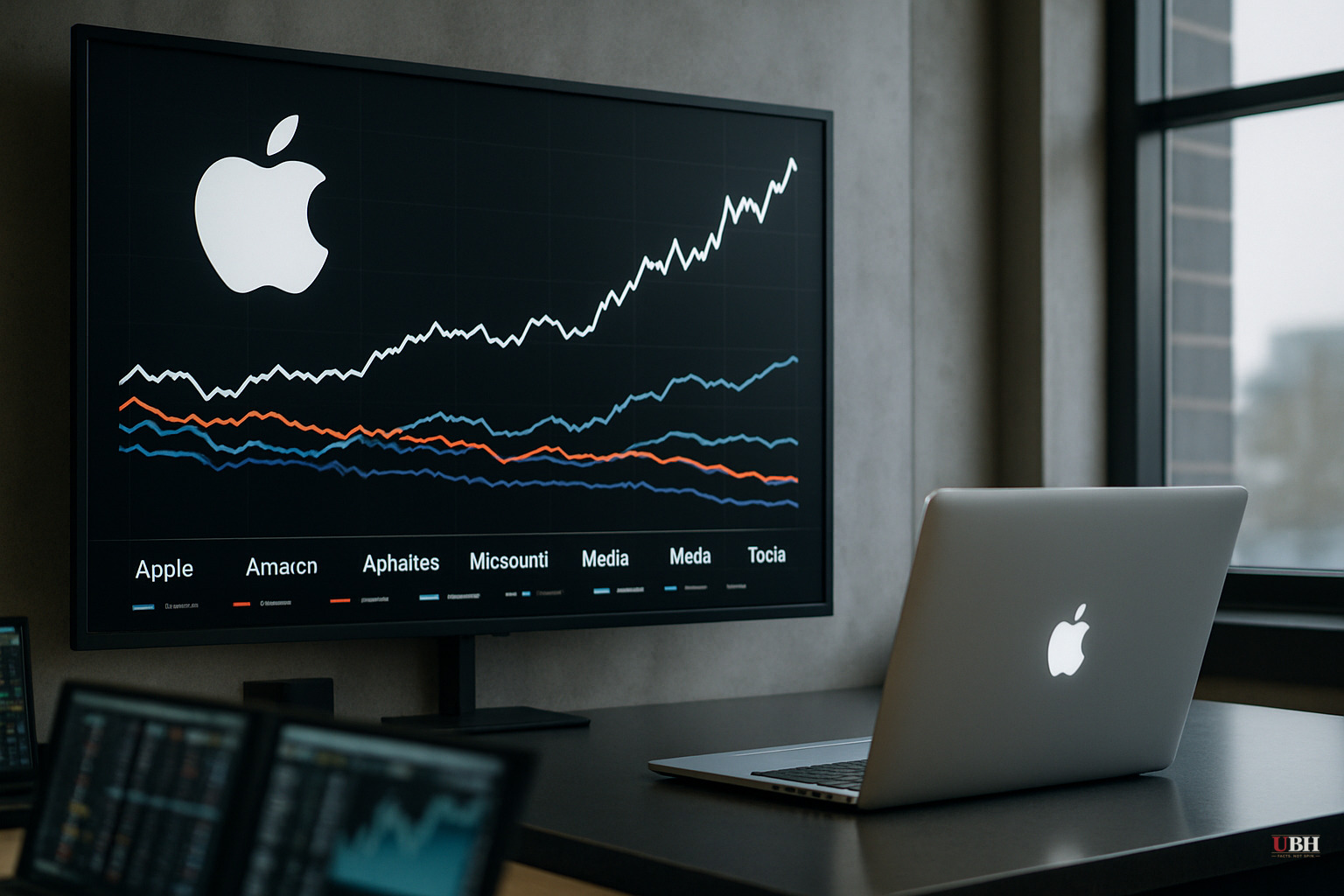
Of the seven largest technology companies in the world, only one is near a record high. That company is Apple.
According to CNBC, Apple shares posted a record close during Thursday's session, the stock's first such milestone in over a month. A modest pullback on Friday trimmed gains slightly, but the stock remains the top performer among its mega-cap peers for the year.
Microsoft and Tesla are in the red for 2026. Meta, Microsoft, and Tesla last set their all-time closing highs sometime in 2025. Amazon, Alphabet, and Nvidia all peaked on various days in May before pulling back. Apple, meanwhile, is up approximately 16.5% year-to-date, the best of the group by a wide margin, according to CNBC.
Why Apple Looks Different Right Now
The explanation isn't complicated, but it took a while for Wall Street to get there.
When OpenAI launched ChatGPT on November 30, 2022, it triggered a spending race among the other mega-caps. Amazon, Google's parent Alphabet, Meta, and Microsoft poured tens of billions into compute capacity, data centers, and AI-infused products. Nvidia, supplying the chips that powered all of it, became the biggest winner of that cycle.
Apple sat the early rounds out. It had no cloud-computing service absorbing AI-related demand the way Amazon Web Services, Microsoft Azure, or Google Cloud did. It had no large language model competing with OpenAI's GPT series or Anthropic's Claude. Critics called it late to the party.
That framing is now working in Apple's favor.
Wall Street has shifted how it thinks about AI spending. The CNBC analysis describes a move from what it calls "tokenmaxxing" — maximize compute, maximize spend, worry about ROI later — toward token optimization: doing more with less, prioritizing efficient AI consumption over raw scale. In that new framework, Apple's lean approach looks like discipline, not absence.
The Fair Case for the Other Six
Before writing off the rest of the Magnificent Seven, the strongest counterargument deserves a fair hearing. Amazon, Microsoft, Google, Meta, and Nvidia didn't spend recklessly on AI out of arrogance. They were building the infrastructure layer that every AI product, including Apple's, ultimately depends on. Without those data centers and those Nvidia chips, there is no AI revolution to be efficient about.
The argument is that the spending cycle always was going to look ugly in the short term and pay off in the medium term, and that the current skepticism reflects market impatience more than a genuine strategic error. Several of those companies are still growing revenue and earnings at rates most industries would envy. Their stock declines from all-time highs reflect valuation compression and a rotation in investor sentiment, not necessarily a verdict on the underlying businesses.
That's a legitimate position. But stock prices reflect what investors believe today, not what analysts expect to prove out over five years. And today, the market is paying a premium for efficiency.
What the Rotation Means in Practice
This isn't a story about Apple suddenly becoming an AI powerhouse. Its large language model capabilities still lag behind Google's Gemini, Meta's Llama family, and OpenAI's models. Apple Intelligence, its on-device AI suite — unveiled at WWDC in June 2024 — faced its own delays and criticism after a rushed and botched initial release.
What changed is the evaluative lens. When the dominant concern was "who's investing enough in AI," Apple looked like the laggard. Now that the concern is "who's spending too much relative to return," Apple looks like the adult in the room.
The same underlying facts — Apple spends less on AI infrastructure than its peers — produce opposite stock-market conclusions depending on which question investors are asking.
The Unresolved Question
The genuine unknown is whether Apple's AI efficiency strategy holds up once the product cycle catches up to the infrastructure cycle. A key development came in January when Google confirmed it signed a deal with Apple to license its Gemini models and cloud technology, with Apple reportedly paying $1 billion a year. Apple showed off its retooled AI suite at WWDC in June, and the full rollout of the improved Apple Intelligence is set for the fall, when Apple introduces its latest operating systems for iPhones, Macs, iPads, and the Apple Watch.
If Amazon, Google, and Microsoft convert their massive compute investments into AI products that consumers and enterprises actually pay for at scale, the spending will look justified in retrospect and Apple's restrained approach may start to look like underinvestment again.
Execution remains the big question, but doubts around Apple's strategy have largely subsided. Whether the recent record close marks the high point of a relative trade or the beginning of a durable advantage depends entirely on whether Apple can deliver on what it has promised.
Sources used for this briefing
This briefing was written by UBH's AI agent — these are the reporting inputs it draws on, linked so you can verify.


