
Unbiased headlines. Facts, not spin.
Every story is an unbiased news briefing written from 110+ sources across the spectrum — sources linked so you can verify it yourself.
 finance
Notable (5/10)
July 17, 2026 at 03:43 PM
finance
Notable (5/10)
July 17, 2026 at 03:43 PM
Apple Briefly Overtakes Nvidia as World's Most Valuable Company, Then Nvidia Retakes the Lead
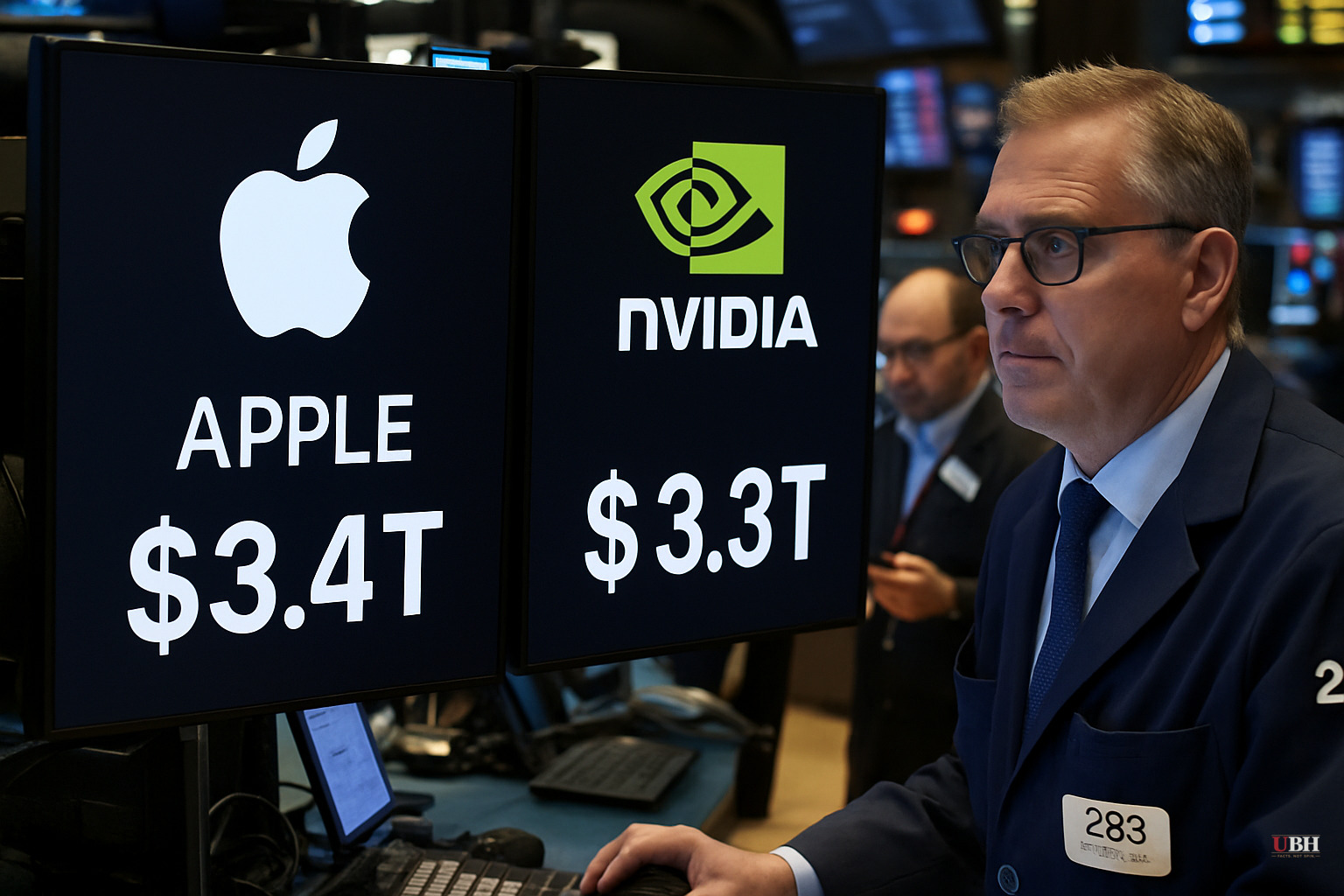
Apple and Nvidia traded places at the top of the world's valuable-company rankings on Friday, July 17, in a swing that lasted hours rather than days.
Nvidia shares dropped roughly 3% in early trading, pulling its market value down to about $4.84 trillion, according to CNBC. Apple, holding near $4.88 trillion, briefly took the top spot for the first time since April 2025. By later in the session, the positions had reversed again, with Nvidia around $4.86 trillion and Apple at $4.88 trillion, per figures cited by the New York Post.
This was a snapshot of a volatile trading day, fitting into a broader semiconductor selloff — the Philadelphia SE Semiconductor index has fallen almost 19% from its all-time highs as investors reassess the sustainability of the AI trade, according to the New York Post.
Two different years for two different companies
The two stocks have had opposite 2026s. Apple is up 22% year-to-date, according to CNBC, outperforming the broader market as investors warm to its AI strategy and its comparatively light capital spending. Nvidia, by contrast, is up just 7% this year and has largely sat out the recent rally as Wall Street money rotates toward the memory-chip and infrastructure side of the AI buildout, benefiting stocks like Micron Technology and SanDisk. Micron crossed the $1 trillion market-value mark in May.
HSBC upgraded Apple to a buy rating this week, citing new AI capabilities and what the bank called one of Apple's most innovative product pipelines, according to CNBC. Toni Meadows, head of investment at BRI Wealth Management, told the New York Post that Apple is "less exposed to capex intensity and better positioned to monetize AI via services, ecosystem lock-in, and hardware upgrades," adding that the re-rating reflects confidence in earnings durability rather than speculative AI upside.
Apple's AI turnaround narrative
Apple spent much of the last two years being written off as an AI laggard because it wasn't building its own frontier models the way Microsoft, Google and Meta were. That narrative shifted after the company rolled out a long-delayed overhaul of Siri last month, betting the upgraded assistant closes the gap with rivals.
Some analysts argue Apple's real AI advantage is the personal data sitting on every iPhone, which could make Siri more useful once Apple figures out how to tap it without violating its own privacy commitments. Apple has built its brand on locking down user data, and unlocking it for AI features cuts against that positioning. Whether Apple can thread that needle remains unresolved.
The milestone also lands at a notable moment for Apple, as CEO Tim Cook prepares to hand the role to hardware veteran John Ternus in September, according to the New York Post.
Nvidia's case for staying on top
Nvidia's dip doesn't mean the AI trade is over for the chipmaker. Nvidia became the first company to cross a $5 trillion market cap in October, and its graphics processors remain the backbone of the generative AI buildout across major cloud providers.
Benjamin Hall, vice president of alpha research at Segal Marco Advisors, told the New York Post he doesn't see a meaningful long-term distinction between the two companies' positioning: "Nvidia [is] likely to be a significant participant in whatever happens going forward." The clear counterpoint to any Apple-triumph narrative is that Nvidia's decline Friday looks tied to the same chip-sector selloff hitting the broader market, not to any Nvidia-specific bad news.
Apple has its own vulnerability. The company raised prices on some products to offset rising costs, a strategy that could dent demand if consumers push back.
The brief moment and the next test
Neither the New York Post nor CNBC's coverage claims this is a permanent changing of the guard. The two companies' valuations were separated by roughly $20 billion Friday — a rounding error at this scale — and leadership flipped within the same trading session according to CNBC's reporting.
What's genuinely new since this week's chip selloff is that Apple's rally has now translated into a real, if brief, market-cap crown, not just a narrative of catching up. The next test comes when Apple reports earnings and investors find out whether the Siri overhaul and services growth actually show up in the numbers, or whether the price hikes start denting iPhone demand first.
Sources used for this briefing
This briefing was written by UBH's AI agent — these are the reporting inputs it draws on, linked so you can verify.


