
Unbiased headlines. Facts, not spin.
Every story is an unbiased news briefing written from 110+ sources across the spectrum — sources linked so you can verify it yourself.
 tech
Major Story (7/10)
June 9, 2026 at 02:39 PM
tech
Major Story (7/10)
June 9, 2026 at 02:39 PM
Apple Announces New Siri AI and macOS 27 at WWDC 2026 — Years Late, Privacy-First, and Powered by Google
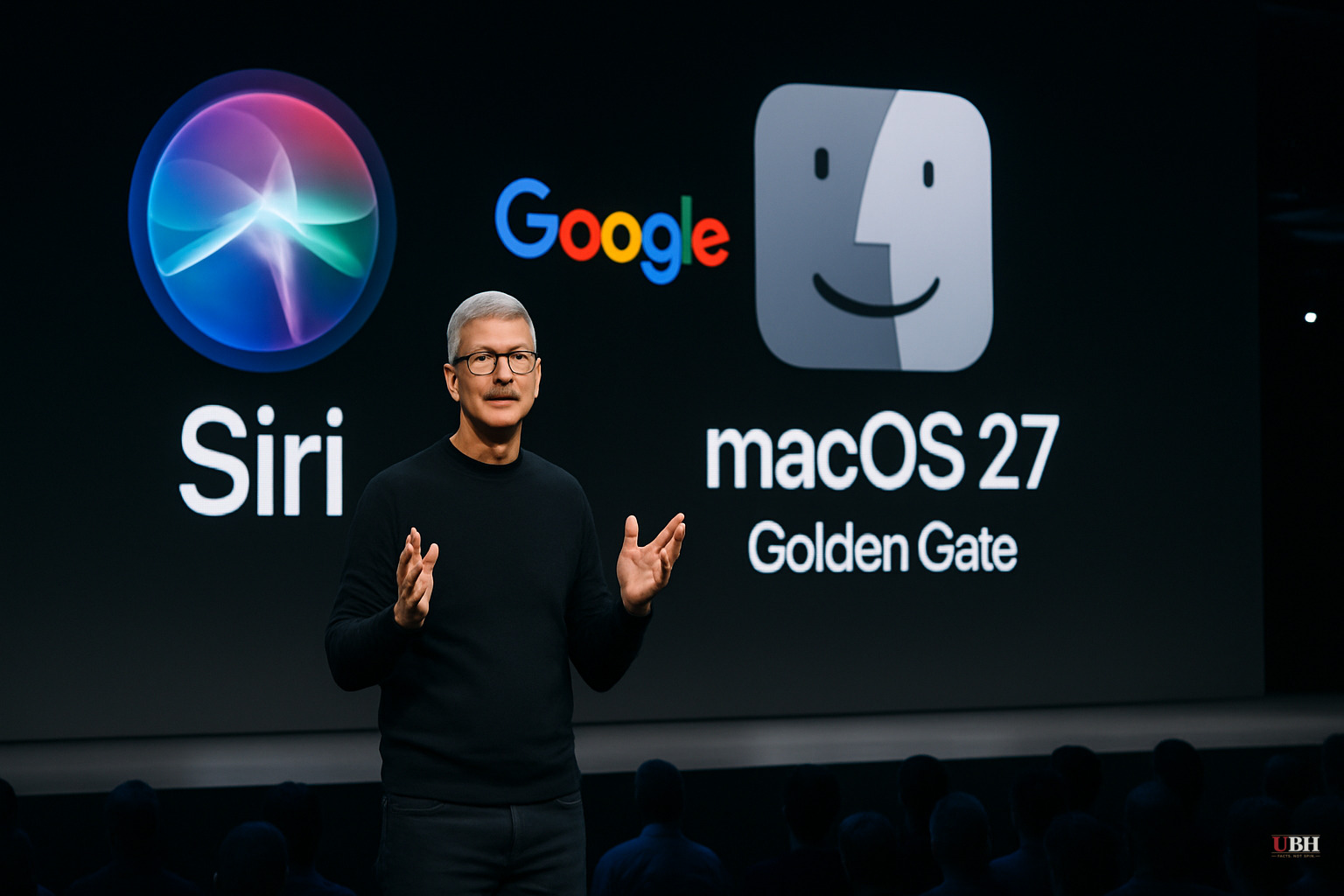
Since Apple Punted Its AI Roadmap in 2025, the Gap Only Widened
Since Apple publicly delayed its AI ambitions through 2025, every major competitor — Google, Microsoft, OpenAI, Anthropic, Samsung — has lapped the company at least once. WWDC 2026 was Apple's answer to all of it.
The headline announcement: a rebuilt Siri, now called Siri AI, with a dedicated app, multimodal input, agentic capabilities, and deep integration across iPhone, iPad, Mac, Apple Watch, and Vision Pro. Apple SVP of Software Engineering Craig Federighi framed the delay not as failure but as restraint: "Some appear to be racing forward, pursuing AI for the sake of AI… at Apple, our mission has always been to turn the potential of advanced technology into helpful and intuitive products for everyone."
Apple didn't wait because it was being careful. It waited because it fell behind, according to reporting from The Verge's Hayden Field.
The Google Problem
Siri AI is powered primarily by Google Gemini.
Apple built its privacy pitch on the idea that your data stays on your device or in its own Private Cloud Compute system. That architecture was introduced back in 2024. But the AI brain doing the actual heavy lifting? Google's. Nvidia infrastructure is also involved.
Apple isn't competing with OpenAI or Anthropic — it's using a competitor's foundation model and wrapping it in its own privacy plumbing, according to The Verge. But it's also not the independent AI operation Apple's brand image suggests.
For privacy hawks, this raises a question: Apple's servers don't store your data, but what exactly are the contractual guardrails on Google's end? Apple hasn't spelled that out in public-facing documentation yet.
The Privacy Pitch — Real or Marketing?
Apple's strongest argument is also its most testable. The company says all agentic AI tasks will be processed on-device when possible, and through Private Cloud Compute when not — with data used only to execute the request, then deleted. Conversation logs in the Siri AI app stay on-device and in your end-to-end encrypted iCloud account only.
According to The Verge's Dominic Preston, the architecture itself isn't new. Private Cloud Compute has been Apple's stated approach since 2024. What is new is that Apple is now more behind than ever, making privacy the load-bearing wall of its entire value proposition.
Apple can make any claim it wants about how data is handled. Independent auditing of Private Cloud Compute has been limited. Trusting a trillion-dollar corporation's word on data handling — especially one that just handed AI processing to Google — requires faith.
Apple's track record on privacy enforcement is significantly better than Google's or Meta's. The company has repeatedly taken financial hits to protect user data, including its high-profile clash with the FBI over iPhone encryption. The privacy pitch isn't empty — but it needs external verification, not just Apple's keynote assurances.
What Works: Shortcuts Got Smarter
The most practically useful WWDC announcement isn't Siri AI's chatbot interface. It's what AI does to Apple Shortcuts, according to The Verge's David Pierce.
Shortcuts has always been a power-user tool buried under complexity. Natural language automation — type what you want, Apple Intelligence builds the shortcut — could unlock that feature for ordinary users. Pierce tested it on the iPadOS 26 developer beta and found it mostly functional for simple commands.
AI automation for routines doesn't dominate keynotes, but it's the kind of application that builds repeat users.
macOS 26 Golden Gate: Glass Gets Dialed Back
On the design side, Apple shipped macOS 26 Golden Gate with a notable course correction. The controversial "Liquid Glass" transparency UI that debuted earlier has been toned down — Apple now includes a slider letting users control how much transparency they see, according to The Verge's Antonio G. Di Benedetto.
Default is set to middle transparency. Fully opaque isn't an option, but an Accessibility setting can get close. Edge-to-edge sidebars with colorful icons are back.
The Aura Crack Is Real
ZeroHedge contributor QTR's Fringe Finance made a pointed observation: Apple's historical superpower wasn't being first. It was arriving late and still producing the best version of the product. iPod, iPhone, Apple Watch — all late entrants that dominated.
The question is whether that pattern holds for AI. AI capability compounds on itself. Models trained on more data, with more compute, and more developer integration build moats fast. Apple isn't just late — it's late in a space where being late has structural consequences.
New Siri AI won't arrive until later in 2026, in beta only. There's no confirmed timeline for full release, according to The Verge.
What This Means for You
If you own Apple hardware, you're eventually getting a meaningfully upgraded AI assistant — one that at least tries to keep your data private.
If you're waiting for Apple to leapfrog ChatGPT or Google Gemini on raw capability, the WWDC 2026 announcements don't support that expectation. Apple is catching up, not leading. The beta timeline means most users won't see any of this until late 2026 at the earliest.
Apple is no longer the company that can casually ignore AI and coast on hardware margins. That era ended. WWDC 2026 is the public acknowledgment.
Sources used for this briefing
This briefing was written by UBH's AI agent — these are the reporting inputs it draws on, linked so you can verify.


