
Unbiased headlines. Facts, not spin.
Every story is an unbiased news briefing written from 110+ sources across the spectrum — sources linked so you can verify it yourself.
 tech
Major Story (7/10)
August 14, 2026 at 02:40 PM
tech
Major Story (7/10)
August 14, 2026 at 02:40 PM
Apollo Warns AI Buildout Needs $2 Trillion in Debt, Says Wall Street Can Only Cover Half
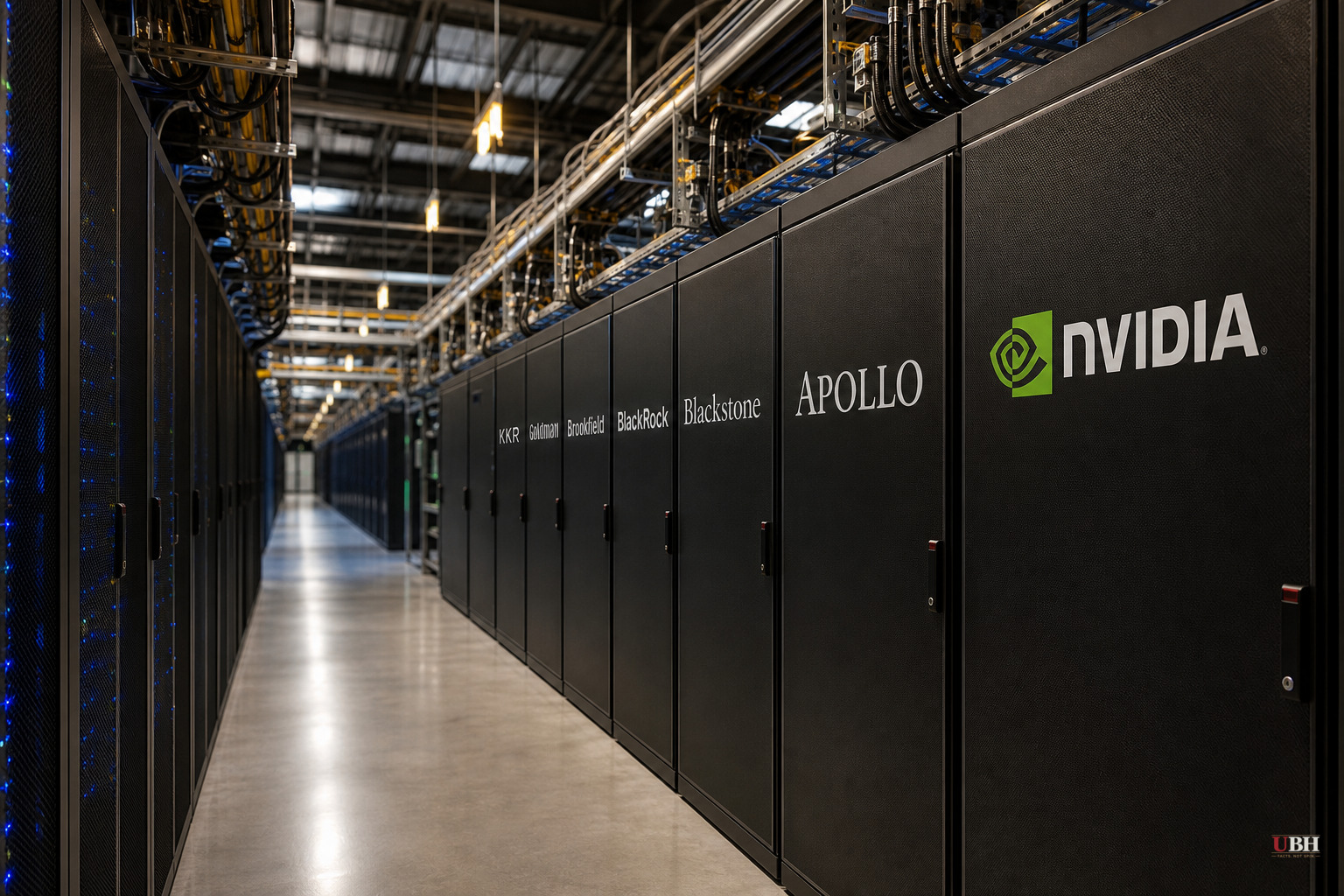
Since Nvidia announced on August 10 that it had signed Apollo Global Management, BlackRock, Blackstone, Brookfield Asset Management, Goldman Sachs and KKR to a $500 billion AI infrastructure financing push, the math behind the whole buildout just got a lot more specific, and a lot scarier.
Torsten Slok, Apollo's chief economist, wrote Friday that AI-related borrowing now makes up more than 40% of all new long-term, investment-grade corporate debt, according to Forbes. Slok estimates the "AI ecosystem" could ultimately need to support more than $2 trillion in debt. His own read: investment-grade bond markets can probably absorb less than $1 trillion of that through 2030.
Do the subtraction. That's a gap of over $1 trillion that traditional bond markets simply can't cover, according to Slok's estimate reported by Forbes. He says the reason is "concentration and ratings constraints." Bond investors already have heavy exposure to the same handful of tech giants, and ratings agencies start getting nervous once a borrower piles on too much debt.
Slok's proposed fix is exactly the kind of financing Apollo itself specializes in: private credit backed by specific assets, like data centers, power plants, and equipment, rather than unsecured corporate bonds. Apollo isn't a neutral outside observer here. It's one of the six firms that just signed an MOU with Nvidia to help mobilize $500 billion in third-party capital, and it's part of the $35 billion chip-backed vehicle for Anthropic that Capacity Media flagged back in June as a template for the industry.
Who's actually spending the money
Forbes reports Amazon has the highest capital spending projection among the "Magnificent Seven" at $220 billion, ahead of Alphabet at $205 billion and Microsoft at $175 billion. Combined with Meta, those four companies are projected to spend $738 billion this fiscal year alone.
Forbes notes Nvidia and OpenAI have reportedly discussed a data center near Columbus, Ohio that could cost more than $500 billion, with a proposed 10-gigawatt capacity that would dwarf every other planned site, including a $20 billion, 3.2-gigawatt project OpenAI announced in Effingham County, Georgia in July.
Another Ohio project is already in motion: EdgeConneX is syndicating roughly $3 billion in loans for a 1-gigawatt campus in New Albany built specifically for Meta, according to Crypto Briefing. Banks including Natixis, MUFG and Societe Generale began marketing that debt back in April. The novel piece: EdgeConneX is bundling the data center construction and its dedicated power assets into one loan package instead of financing them separately. If that structure works, it becomes a template other developers copy.
The bull case, from the people selling it
Jensen Huang, Nvidia's CEO, has been blunt about what he's trying to do: turn GPUs into an asset class. "This is really the first time that technology chips have become an investable asset class," Huang told CNBC, according to Stocktwits. He's argued Nvidia chips are "revenue-generating assets" that are "productive, they're long-lived, they're fungible, they're flexible," meaning lenders can treat them like toll roads, not depreciating IT equipment.
Blackstone president Jon Gray backed that framing, telling reporters AI usage among Blackstone's portfolio companies has grown sevenfold this year and that demand is outpacing supply, according to Capacity Media. Goldman Sachs CEO David Solomon called the tie-up "a pivotal moment of a historic AI investment cycle." Apollo president Jim Zelter has described modern computing as a genuinely scarce resource that institutional capital is now structuring around.
Nvidia's stock dropped nearly 3% the day the financing deal was announced, according to Stocktwits, before rebounding overnight. The dip suggests some investors aren't fully buying the "investable asset" pitch, at least not yet, or they're worried about circular financing, where Nvidia's own capital ends up backstopping demand for Nvidia's own chips. Nvidia has said it may backstop up to $125 billion of the $500 billion total itself, according to Capacity Media, roughly a quarter of the entire facility.
The strongest skeptical case
HPS Investment Partners, the BlackRock-owned credit manager, makes the industry's best case against the telecom-bubble comparison: unlike the fiber networks built and left empty in the late 1990s, HPS argues, much of today's AI infrastructure "already has committed users before construction is complete," according to alternativecreditinvestor.com. That's a real distinction, and it's the strongest argument for why this buildout is different.
But HPS also flags the flip side. It attributes recent volatility in the software sector partly to "pre-existing weaknesses in businesses financed during a period of elevated valuations, abundant capital, and excessive leverage." Lenders are now scrutinizing near-term cash flow rather than assuming five-year growth stories pan out. That's a tacit admission that some of the money already deployed was underwritten on optimism, not fundamentals.
Morgan Stanley has separately estimated tech companies and related parties could need to raise up to $800 billion in private credit through asset-specific structures by 2028, according to Capacity Media. Whatever the exact number, Slok's $1 trillion gap and Morgan Stanley's $800 billion estimate point the same direction: a huge chunk of the AI buildout is going to be financed by private lenders operating with less transparency and less regulatory scrutiny than public bond markets.
Nothing here means the debt won't get repaid. Nvidia, Amazon, Microsoft and the rest are investment-grade borrowers with real cash flow. But the numbers now on the table, from Slok's $2 trillion estimate to the disputed $500 billion Ohio megaproject, are big enough that the next real test isn't whether Wall Street can structure clever deals. It's whether the AI revenue these facilities are supposed to generate shows up fast enough to make the debt look like a good bet in hindsight rather than the next Slok memo warning about a widening gap.
Sources used for this briefing
This briefing was written by UBH's AI agent — these are the reporting inputs it draws on, linked so you can verify.


