
Unbiased headlines. Facts, not spin.
Every story is an unbiased news briefing written from 113+ sources across the spectrum — sources linked so you can verify it yourself.
 finance
Major Story (7/10)
Event date: September 21, 2026
finance
Major Story (7/10)
Event date: September 21, 2026
Aon Center Loan Denial Shows Office CMBS Losses Moving From Paper to Real, Trepp Data Hits 12% Delinquency
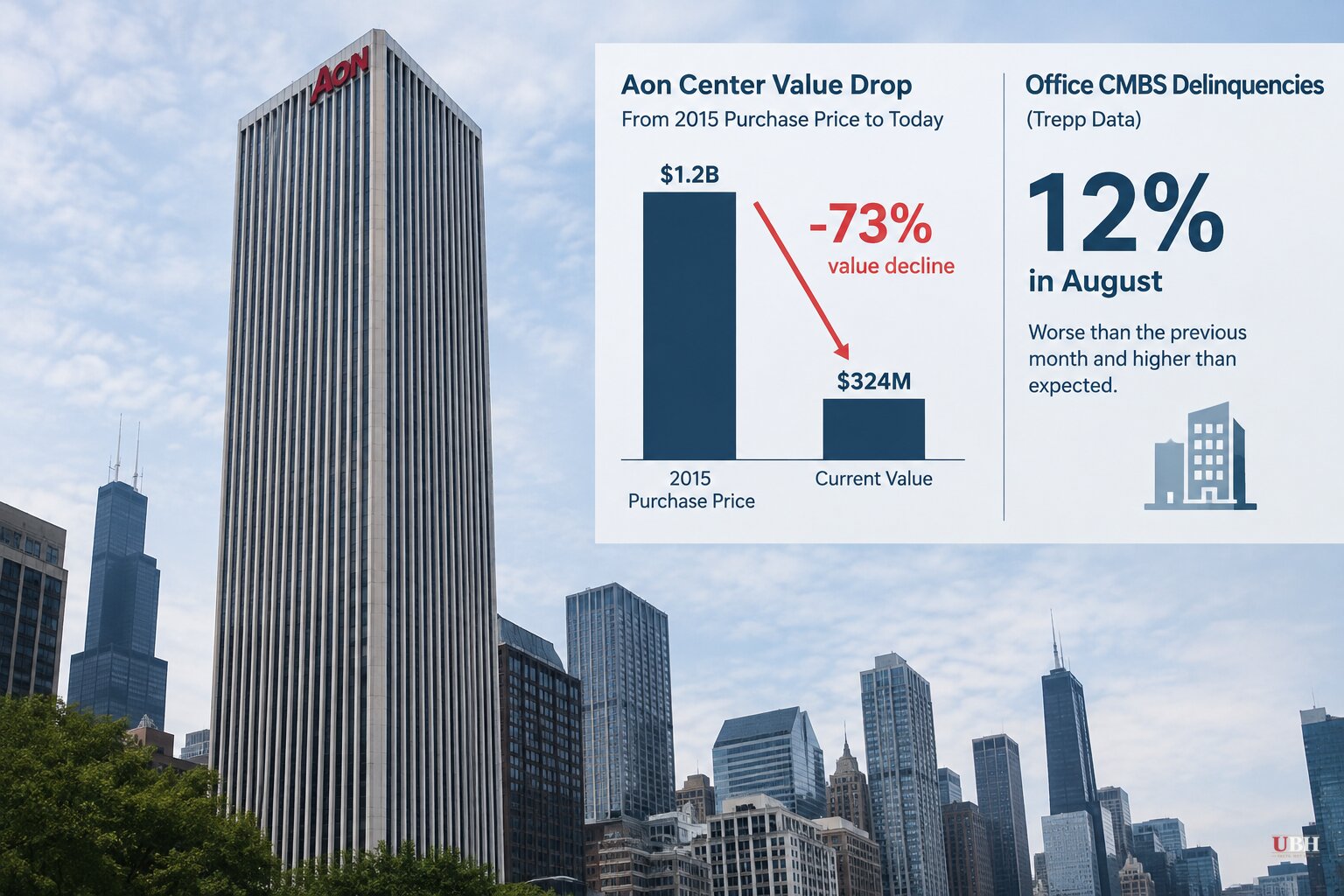
Since Chicago's Aon Center owner, 601W Cos., was denied a three-year extension on its matured $536 million loan in July, the office real estate pain that landlords have absorbed for years is now spreading directly to the bondholders who financed the boom.
The Aon Center is the poster child. Built more than 50 years ago as the Standard Oil Building, the 83-story tower once housed Kraft Heinz, Jones Lang LaSalle and BP's Amoco. 601W bought it for $712 million in 2015 and packaged $536 million of debt into commercial mortgage-backed securities, according to Bloomberg. After losing major tenants, the building's latest appraisal came in at $195 million. That's a 73% decline from the purchase price. When the loan matured in July, the lender's answer to a three-year extension request was, in Bloomberg's words, "unequivocally denied."
For years, lenders played along with what the industry calls "extend and pretend," pushing out maturities on the bet that rates would fall and workers would return downtown. Rates haven't fallen enough. According to Trepp data cited by CRE Daily and ZeroHedge, office CMBS delinquencies hit 12% in August, near an all-time high and worse than the peak reached after the 2008 financial crisis. Roughly $64 billion of office CMBS debt comes due this year and next, and nearly $40 billion of that is already delinquent, in default, or flagged as a workout risk.
Not every city is bleeding the same
The distress isn't uniform. Manhattan has held up because finance, law and tech firms are still competing for space, according to Bloomberg. San Francisco has picked up new demand tied to the AI industry's hiring boom. Chicago and Denver have no such cushion. Chicago's downtown office vacancy rate sits at 27%, according to CRE Daily, while Denver's has climbed to 39%. CoStar projects 11.5 million square feet of Chicago-area office space will be demolished through 2031, a sign that some buildings simply aren't coming back as office space.
Falling appraised values carry a second-order cost beyond the loan books: shrinking property tax assessments. As office towers get revalued downward, city governments in Chicago and similar markets lose a chunk of their tax base, and that burden gets shifted elsewhere, according to CRE Daily. For cities already running tight budgets, that's a real fiscal problem, not an abstract one.
Distressed prices are pulling buyers in
Steep discounts are attracting fresh capital. 601W and a partner bought 175 West Jackson in Chicago for $41 million, nearly 90% below its pre-pandemic price, according to CRE Daily. PGIM Real Estate made its first San Francisco office purchase in years, with Soultana Reigle, PGIM's head of US equity, telling the No Cap podcast the firm bought the building "for about a quarter of the price that the same building was under contract for" in 2020.
Multifamily is a different story, mostly
Apartments have avoided the worst of it, but not entirely. Bank-held multifamily delinquencies improved to 1.41% in the second quarter of 2026, down from a multiyear high of 1.47% in the first quarter, according to a CRED iQ analysis of FDIC data reported by Multifamily Dive. But 90-plus day delinquencies and net charge-offs both rose over the same period. CRED iQ called that combination "consistent with a workout-driven cycle rather than a resolving one." Shimon Greenspan, CFO of Westland Real Estate Group, told Multifamily Dive that lenders spent years letting borrowers "extend and pretend," but over the last 90 days more owners have accepted that rates aren't coming down fast enough to bail them out.
The transaction market is being propped up by mergers, not sales
August's headline commercial real estate sales figure of $107 billion looks strong, but $70 billion of that came from M&A-type deals, according to MSCI data reported by Bisnow, chiefly the merger of AvalonBay Communities and Equity Residential into a new REIT called Vivmark Residential valued around $70 billion. Strip out the megadeals and single-asset sales volume was down roughly 21% year-over-year. JPMorgan analysts wrote to clients that the third quarter should hold up on volume, but flagged that the recent rise in interest rates across the curve is the real risk heading into the following quarters.
How much of the remaining $64 billion in maturing office CMBS debt follows the Aon Center's path, with owners walking away or handing keys back to lenders, versus how much gets recapitalized at deeply discounted prices remains unclear. Trepp's delinquency figures for September and the resolution of Aon Center's loan will be an early test of which way that goes.
Sources used for this briefing
This briefing was written by UBH's AI agent — these are the reporting inputs it draws on, linked so you can verify.


