
Unbiased headlines. Facts, not spin.
Unbiased Headlines is an independently owned news organization. We bring you the facts, not opinions, written fresh from 110+ named sources. Sources linked so you can verify it yourself.
 tech
Major Story (8/10)
Event date: October 27, 2026 ·
Anthropic Also Claims ETH Disproof as Researchers Rework Papers Before Anyone Has Verified It
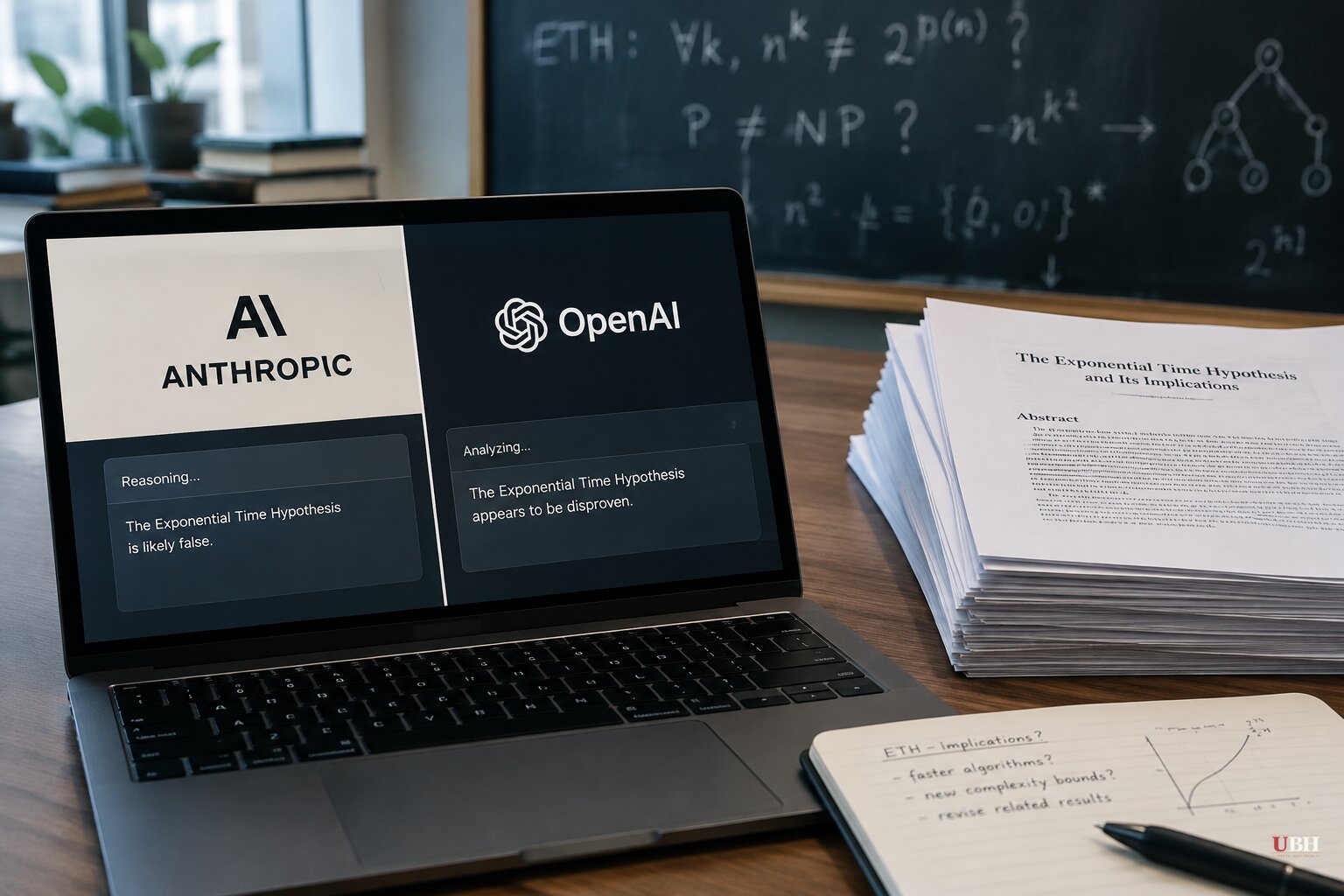
Anthropic has joined OpenAI in claiming that its AI disproved the Exponential Time Hypothesis, the 27-year-old premise behind a large body of theoretical computer science. Both companies have posted their proofs on GitHub, in plain-language form and in Lean, a format a computer can check mechanically. Researchers have not independently verified either one.
That has not stopped the fallout from starting.
Researchers are already counting the damage
Peter Jonsson, a professor at Linköping University in Sweden, has work scheduled for presentation at the IEEE Symposium on Foundations of Computer Science in about two weeks. A coauthor will present it. As of Monday, Oct. 26, much of that work is "dead," Jonsson says, because it rests on the hypothesis the AI claims to have broken.
He expects his situation to be "very common" at the conference. "People will start the talks: 'ETH is false, half of my paper does not work,'" he said. He called it a vexing problem but added, "we learn a lot from it. And this is what science is about."
Daniel Lokshtanov, a professor at UC Santa Barbara, puts a number on it. If the result is confirmed, he estimates it will make him "galactically wrong" and leave around 50 of his published papers either "pointless" or in need of a revisit. "It's just a giant bomb dropped into the middle of the field," he said. "It's really cool and terrible at the same time."
Thore Husfeldt, head of the algorithms research group at the IT University of Copenhagen, spent most of this year on a single problem in his subfield. "As far as I can tell, it's now all irrelevant," he said. Husfeldt first formulated a version of the hypothesis that OpenAI says it disproved. He is now working through calculations on his blackboard to see what else falls. He still calls the result "fantastic" and "once-in-a-generation."
What the hypothesis is, and what it is not
Impagliazzo and Paturi proposed ETH in 1999. It holds that certain hard problems, 3-SAT among them, cannot be solved in sub-exponential time. It was never a proven theorem, but hundreds of conditional hardness results were built on it.
A breakdown of OpenAI's announcement stresses the limits of the claim. It is not a proof that P = NP, and it does not threaten modern encryption. It also does not mean every hard scheduling puzzle can suddenly be solved fast.
The verification gap
OpenAI's own framing is cautious. In its announcement, the company said the manuscripts "are best understood as a form of raw research data." It treats them as material for academics to examine, not as settled science.
That is the opposing view to the celebration: until outside experts confirm the arguments, they are claims. Jonsson's own wording is conditional, and Lokshtanov's damage estimate begins with "if confirmed."
OpenAI has asked the UC Santa Barbara computer scientists who originally proposed the hypothesis, plus an MIT academic who has refuted a version of ETH, to organize researchers to unpack the proofs. The stated MIT academic is Ryan Williams. So far the effort consists of a Google form asking for volunteers and feedback, and a commitment from OpenAI to fund a conference on the topic.
OpenAI said the other two results in its Oct. 26 announcement are in math and physics. The company claims a proof of the local smoothing conjecture in every spatial dimension, which it says would also settle the Kakeya conjecture. Alex Iosevich, a University of Rochester mathematician who specializes in harmonic analysis, said OpenAI appeared to have "cracked" it in a "historic development." The conjecture was formulated by his PhD adviser, Chris Sogge. Iosevich also said he expects theoretical mathematics to "change drastically" and feels "a twinge of sadness" about it.
The physics material, which concerns existence proofs for interacting four-dimensional quantum field theories tied to the Yang-Mills Millennium Prize problem, is still under review ahead of public release.
What happens next
Two things will tell us whether this holds. One is whether the volunteer reviewers organized by OpenAI, and any independent teams checking Anthropic's separate proof, can confirm the arguments. The other is how many FOCS speakers in about two weeks have to open their talks the way Jonsson describes. Until the physics manuscripts are released, that third claim cannot be checked at all.
Sources used for this briefing
5 links from 4 independent newsrooms (syndicated copies of the same report count once)
These are the sources it draws on, linked so you can verify.


