
Unbiased headlines. Facts, not spin.
Unbiased Headlines is an independently owned news organization. We bring you the facts, not opinions, written fresh from 110+ named sources. Sources linked so you can verify it yourself.
 tech
Major Story (8/10)
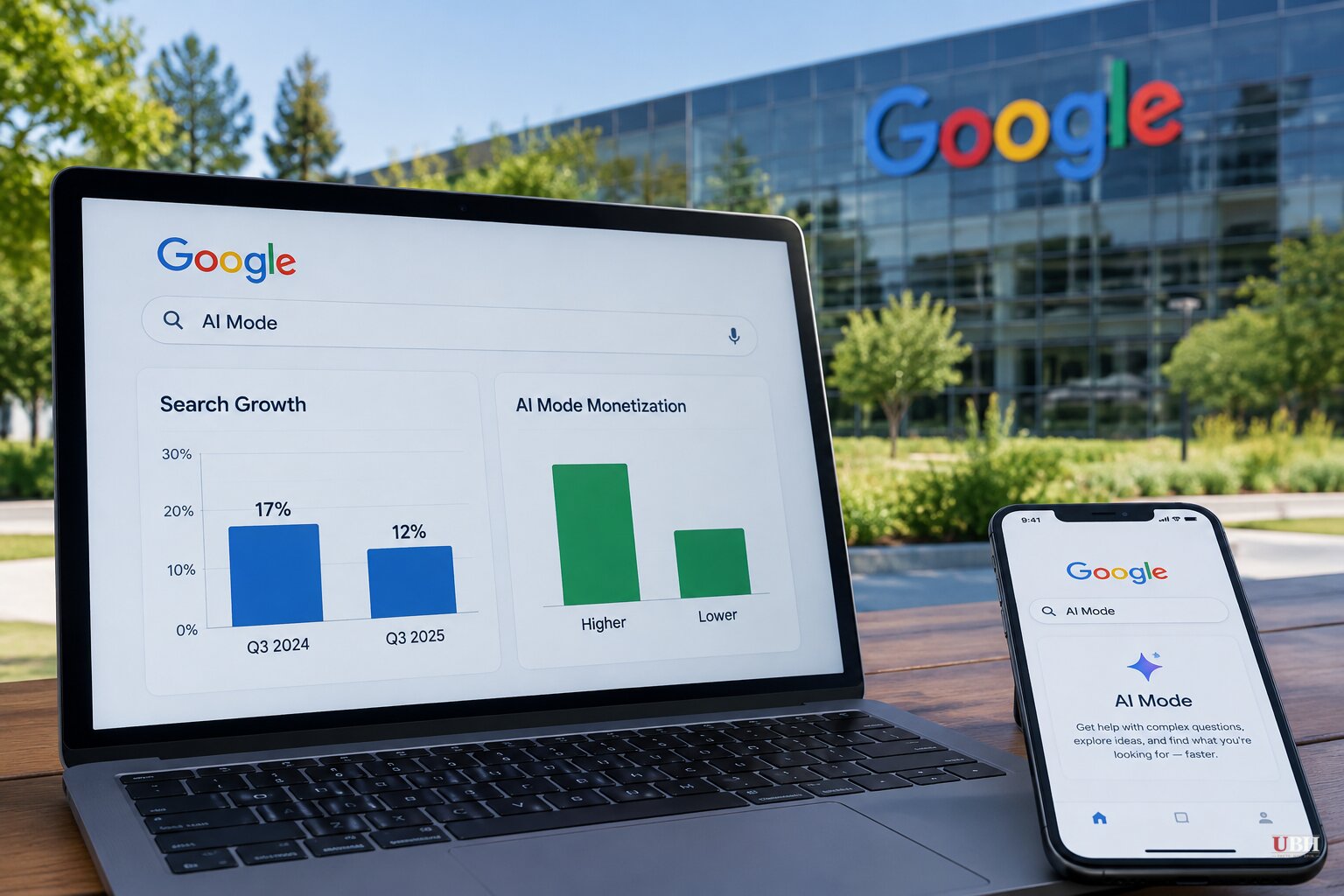
Alphabet Says AI Mode Earns Less Per Query as Google Search Growth Slows to 12% From 17%
Since Alphabet's third-quarter report on Wednesday, Oct. 28 sent the stock down roughly 10% in after-hours trading, the details behind the search slowdown have become clearer. The company has now said, on its own earnings call, why Google's core business decelerated. U.S. regular trading has not yet opened today, Oct. 29, so the after-hours drop is the only market reaction so far.
Alphabet's own explanation for the search slowdown
Google chief business officer Philipp Schindler tied the slowdown directly to AI Mode. "The strong growth in AI Mode queries had an impact [on decelerating Google Search growth] because of the lower monetization we are seeing in AI Mode," he told analysts, as quoted by Adweek.
The numbers: search revenue rose 12% to $63.4 billion, down from 17% growth in the second quarter. Total advertising revenue rose 11% to $82.0 billion, against LSEG expectations of $83.4 billion. That is a $1.4 billion miss.
YouTube advertising grew 9% to $11.2 billion, down from 13% the prior quarter. YouTube Music and Premium passed 150 million subscribers, including trials.
Schindler's fix is more ads. He said ad tests in AI Mode have returned "promising results." Alphabet is expanding ads in AI Mode into international markets and rolling out "multi-turn ads" in the U.S.
Cloud doubles, and TPUs drive it
Google Cloud revenue jumped 103% to $30.7 billion, ahead of analyst expectations. Operating income for the unit tripled to $11.1 billion. Alphabet said sales of its in-house TPU AI chips contributed significantly.
Google is also selling TPUs to outside companies, a growing challenge to Nvidia. Media reports this week say OpenAI plans to buy some.
JPMorgan analyst Mark Schilsky had argued before the report that Cloud revenue could equal Search revenue by late 2028. At $30.7 billion against $63.4 billion, Cloud is now roughly half the size of Search.
The profit and cash picture
Net income fell 25% to $26.2 billion, or $2.12 per share. Adjusted earnings per share were $2.67, below the $3.02 LSEG consensus.
Alphabet booked an $8.7 billion loss on equity investments. The company attributed it to its stake in SpaceX, whose shares have struggled since the company went public in June.
Capital spending hit $51.4 billion for the quarter, more than double the $24 billion a year earlier. Free cash flow was negative $9.1 billion, the second straight negative quarter. The company said spending included a fine paid to the European Union.
To fund the buildout, Alphabet raised $28.7 billion in bonds and $12.4 billion by issuing new shares during the quarter.
CFO Anat Ashkenazi said she expects near-term margin pressure from using third-party cloud capacity. Alphabet's 2026 capex forecast stays at $195 billion to $205 billion, and she said spending will rise significantly in 2027.
What management says, and what investors say
CEO Sundar Pichai framed the spending as strategy, not a short-term bet. "I would broadly think of all of this as a long-range planning process, not a short-term allocation exercise," he told analysts.
Investors quoted after the report see it differently. "In a market worried about AI cannibalizing the franchise, investors need to see search accelerating, not decelerating," said Dave Wagner, portfolio manager at Aptus Capital Advisors. "Cloud is carrying the story, but until search shows AI is additive, the stock's probably going to trade lower."
Microsoft, which reported the same day, saw shares rise more than 5% after hours. It posted positive free cash flow that beat analyst estimates.
Publishers and Waymo
Adweek noted that this quarter's call included no mention of publisher traffic. Last quarter, Pichai had said AI search was "sending billions of clicks to websites every week."
Elsewhere in the report, the Other Bets unit, which includes Waymo, posted revenue of $372 million and an operating loss of $2.0 billion. Waymo now provides more than 500,000 paid rides per week across 15 U.S. metropolitan areas. It aims to reach one million weekly rides by the end of the year.
What comes next
Alphabet has not given a dollar figure for 2027 capital spending. Jeremy Saltsburg, senior investment officer at Check Capital, said a number around $300 billion "could potentially scare the market because free cash flow now is finally negative."
The first test of whether the roughly 10% after-hours drop holds comes when regular trading opens at 9:30 a.m. ET today. The larger open question is whether AI Mode ads close the monetization gap Schindler described, before the 2027 spending number arrives.
Sources used for this briefing
7 links from 5 independent newsrooms (syndicated copies of the same report count once)
These are the sources it draws on, linked so you can verify.


