
Unbiased headlines. Facts, not spin.
Unbiased Headlines is an independently owned news organization. We bring you the facts, not opinions, written fresh from 110+ named sources. Sources linked so you can verify it yourself.
 tech
Major Story (8/10)
Alphabet Shares Fall and Microsoft's Rise After Hours as Free Cash Flow Splits: Negative $9.1 Billion vs. Positive $18.6 Billion
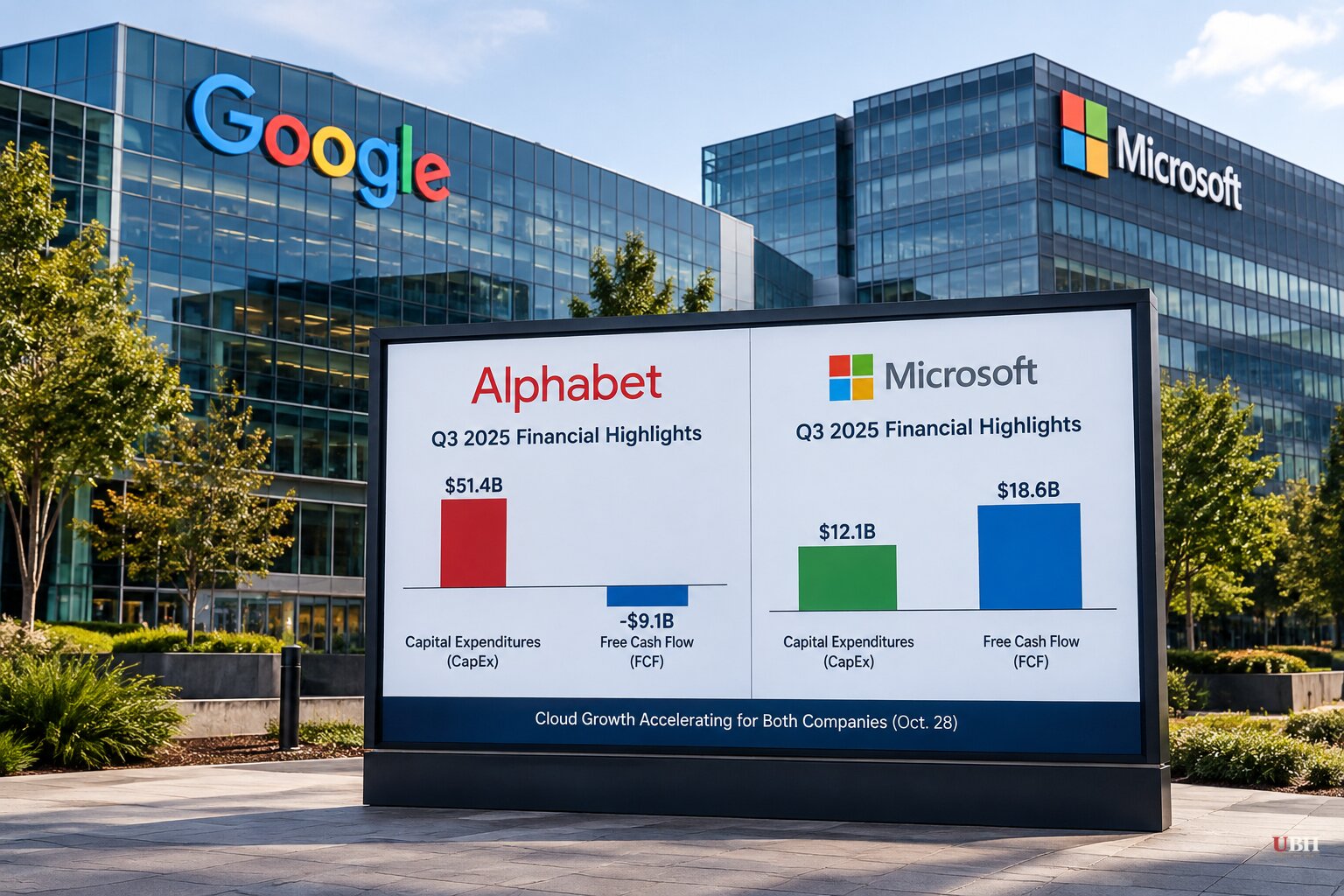
Alphabet's results landed on Wednesday, Oct. 28, beside Microsoft's. The two cloud giants told nearly the same story about demand. They told very different stories about who is paying for it.
Two cloud booms, two cash pictures
Google Cloud revenue more than doubled to $30.7 billion, up 103%. Azure grew 48% to $33.17 billion, the first time Microsoft has disclosed Azure revenue in dollars.
Alphabet's total revenue hit $127.6 billion, up 25%. Il Sole 24 ORE cited a $128.22 billion consensus, while Fortune cited S&P Global Visible Alpha consensus of $127.9 billion, so the result was roughly in line to slightly under. Fortune reported that Google Search rose 12% to $63.4 billion, a slowdown from 17% growth in the second quarter and 19% in the first, against analyst expectations of 15%.
Earnings per share fell from $2.87 a year earlier to $2.12. An $8.7 billion paper loss on equity investments, worth 55 cents a share, explains part of that. Il Sole 24 ORE put the consensus at $2.99, so the drop is not only the securities loss.
The cash is where the split opens. Alphabet spent $51.4 billion on capital expenditures, up from $24 billion a year ago. Free cash flow came in at negative $9.1 billion, worse than the negative $5.9 billion in the second quarter.
The quarter is Alphabet's first full set of results since it announced in June that it raised $84.8 billion in equity, including $10 billion from Berkshire Hathaway, to fund an AI buildout.
Alphabet confirmed its 2026 capex forecast of $195 billion to $205 billion. Fox Business reported the company expects capital expenditures to increase significantly in 2027, and Fortune reported a rise to $300 billion in 2027. CFO Anat Ashkenazi warned that Google Cloud faces near-term margin pressure because it is leaning on third-party computing capacity.
"Our AI infrastructure and solutions are the major drivers for Cloud growth," CEO Sundar Pichai said on the earnings call.
Microsoft is still paying its own way
Microsoft's revenue rose 19% to $92.3 billion. Free cash flow was $18.63 billion, down 27% from a year ago but positive. Including finance leases, capex was $45.2 billion, below the $50.67 billion StreetAccount consensus. CNBC reported that Microsoft flagged a higher growth rate for cash paid for property and equipment than for overall capital expenditures.
CFO Amy Hood said some third-party capacity deliveries expected in the quarter were delayed, with the delays tied to GPU-as-a-service providers. Those shifted into the second half of the fiscal year, when she expects capex spend to accelerate.
Hood guided second-quarter revenue to $96 billion to $97.1 billion, ahead of the $95.60 billion LSEG consensus. She guided Azure growth to 49% to 50% at constant currency. Capex is set to top $50 billion next quarter. CNBC reported Hood cited $170 billion for all of calendar 2027 because of the capacity issues, while Fortune described the $170 billion as calendar-year 2026 spending, so the sources differ on the year. "We still have demand that exceeds supply," she said.
Hood said Microsoft will keep generating free cash flow through fiscal 2027 but will access additional funding when it is attractive to do so, noting the company has not yet tapped debt markets. Commercial remaining performance obligation, the contracted revenue not yet recognized, rose 73% to $677 billion.
The weak spot is the consumer side. Windows OEM and devices revenue fell 22% in a PC market that dropped about 20% in the quarter, according to The Verge. Hood expects another decline in the mid-30s percent range next quarter.
How the market reacted
Microsoft shares rose about 2.5% to 4% in extended trading, according to CNBC and Fortune. Il Sole 24 ORE put the high at up to 5%.
Alphabet fell roughly 9% after hours, per Il Sole 24 ORE, to $296.81 from a $321.89 close. Fortune reported a drop of more than 11% at one point. Independent analyst Luke Lango argued the market was punishing Alphabet for funding the AI buildout with shareholders' money instead of its own cash. That is one analyst's view, not a finding.
Extended-trading moves are indications. They are not the next regular session's price.
The partners are also rivals
Both companies sell capacity to AI labs they also compete with. Anthropic buys Google's custom chips and cloud services, and also lists Google as a competitor for customers, talent, computing capacity and strategic partnerships. Alphabet's losses tied largely to shared AI research and development rose to nearly $8 billion from $4.4 billion a year earlier.
Microsoft and OpenAI revised their partnership last year and loosened it further in April. OpenAI can work more easily with other partners, Microsoft is developing its own models, and OpenAI's revenue-sharing payments are subject to a total cap.
That dependence on a few labs worries some investors. Fox Business, discussing reports that OpenAI's annualized revenue fell short of expectations, quoted David Bahnsen warning of systemic risk to the AI ecosystem from massive capital commitments and negative free cash flow.
The hyperscalers' defense is the order book. Pichai says customers see Google as the leading provider and that demand is huge. Microsoft points to its $677 billion in contracted backlog.
Meta said last week that its quarterly free cash flow turned negative and that capex this year could reach as much as $145 billion. Amazon reports Thursday, Oct. 29. Regular-session trading that day will be the first test of whether investors keep rewarding the company that funds its AI build-out from operations and punishing the ones borrowing to do it.
Sources used for this briefing
8 links from 8 independent newsrooms (syndicated copies of the same report count once)
These are the sources it draws on, linked so you can verify.


