
Unbiased headlines. Facts, not spin.
Unbiased Headlines is an independently owned news organization. We bring you the facts, not opinions, written fresh from 110+ named sources. Sources linked so you can verify it yourself.
 tech
Major Story (7/10)
Google unveils Gemini 4 Carbon, ranks first on Artificial Analysis index, but only vetted cyber defenders get access
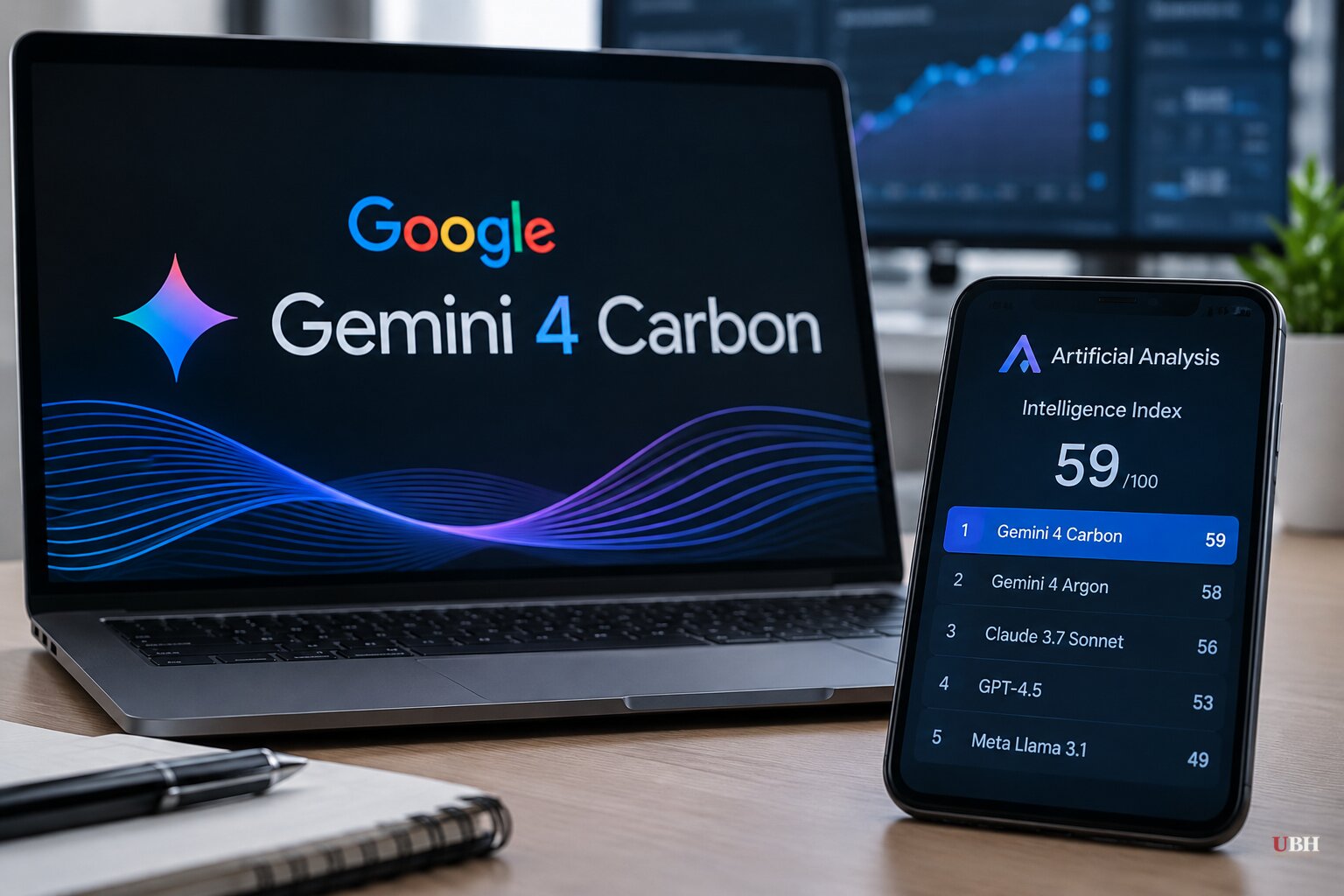
Google announced Gemini 4 Carbon on Wednesday, Oct. 28, calling it its strongest model yet. Koray Kavukcuoglu, SVP of Google DeepMind and Chief AI Architect, wrote in the company blog post that Carbon has "state-of-the-art cybersecurity and long horizon capabilities."
You can't use it. Google is making Carbon available starting this week to a subset of cyber defenders and will phase in more "trusted partners" through its Fairwind Program. Developers, businesses and consumers get it "as soon as possible," in Google's words. No date.
The numbers
Artificial Analysis, an independent testing firm, scores Carbon at 59 on its Intelligence Index v5.0. Claude Opus 5.5 scores 58, GPT-6 Astra 57, and Gemini 4 Argon 50.
That is a one-point lead over Anthropic and a two-point lead over OpenAI. Mashable noted that a one-point lead is thin enough that the next release from OpenAI or Anthropic could easily erase it. Artificial Analysis says Carbon holds the top score in 4 of the index's 9 evaluations: HLE-Diamond, Terminal-Bench-Science, AA-Omniscience and AutomationBench-AA.
In Google's own comparison table, Carbon posts the best result on 15 of 17 benchmarks against Argon, GPT-6 Astra, Claude Opus 5.5 and Claude Fable 5.1. OpenAI's GPT-6 Astra still leads on FrontierSWE 2, a software engineering test. Anthropic's Opus 5.5 leads on OSWorld-2.1, which measures computer operation.
On coding agents, Artificial Analysis has Carbon at 59 on its Coding Agent Index, three points behind Claude Code running Opus 5.5 at 62. The firm noted that Google has historically underperformed there. On agentic knowledge work, Carbon scored 1609 Elo on AA-Briefcase, up 126 points from Argon but behind Grok 4.7, Muse Wonder and Kimi K3.1 Pro.
The cyber claims
Google's headline pitch is cybersecurity. It reports 88.2% on SEC-bench Pro (finding vulnerabilities), 54.8% on ExploitGym (exploitation) and 71.0% on CWE-bench (patching). Google says Carbon more than doubles Argon's success rate at generating secure code on internal benchmarks.
Google also says its Chrome team found Carbon performed more than 10 times better than another lab's large frontier model when generating high-quality patches, and that Carbon blocked every attempted prompt-injection attack in the Grey Swan evaluation. Those are Google's figures.
The 54.8% exploitation score cuts both ways. A model that can exploit software flaws more than half the time on a benchmark is useful to a defender and to an attacker. Google says it is taking a deliberate approach to rollout and is actively engaged in the U.S. government's voluntary process for pre-release model testing. The process is voluntary, so participation is Google's call.
Rolling Out reported that Google measured the cyber scores without guardrails in place, and Google's own post describes the external benchmarks as "evaluated without guardrails." If so, the public version could behave differently from the one that set the records. Kavukcuoglu said Google is still gathering feedback and iterating on guardrails before wider release.
Tradeoffs and open questions
Artificial Analysis found Carbon gained 10 points of accuracy over Argon on its AA-Omniscience v1.1 test, reaching 58%. The hallucination rate on that test rose from 4% to 11%, still the second lowest of any model it tested, behind only Argon.
Google's own account points the other way. The company says internal testing shows Carbon makes roughly half as many unsupported claims as Argon, with a 26% drop in overreach and a 29% drop in under-service on multi-step workflows. The two measure different things, and neither has been independently reconciled.
Google also says teams have watched Carbon run for days on multistep engineering jobs such as root-causing and patching subtle bugs across large codebases. VentureBeat noted Google has not released a technical report.
Ars Technica pointed out that Google presents Carbon as a new model, but it beats Argon by slim margins on every test Google offered and could be a post-training upgrade. The outlet also noted that every frontier model lands in the same neighborhood on these tests, with Carbon separated from rivals by only a few points. VentureBeat reported that Google has not said whether Carbon uses a new model architecture.
On cost, Artificial Analysis puts Carbon at $7.76 per Intelligence Index task at standard pricing, about 23% less than Opus 5.5 at $10.04 and about 1.2 times GPT-6 Astra at $6.25. Carbon uses 123,000 output tokens per task, 29% fewer than Opus 5.5.
Pricing and timeline
Google is launching Carbon at an introductory $2 per million input tokens and $10 per million output tokens, the same as Argon, with cached input tokens 95% cheaper. Subsequent pricing is $4 and $20. Google has not given an end date for the introductory pricing.
The release pace also stands out. Mashable reports that Google announced Argon on Sept. 30 before releasing it to Google AI Pro and Ultra subscribers on Oct. 13. Carbon follows 15 days after that, and Mashable notes the frontier labs have each claimed a new lead within weeks of the last.
Argon remains the most capable Gemini model most customers can actually test. Google has not said when Carbon will reach developers, businesses and consumers, and the benchmark leadership it announced today applies only to a model the public cannot yet use. Mashable noted that Carbon and Meta's Muse Wonder Full are both flagged on the Artificial Analysis leaderboard as having no publicly available API.
Sources used for this briefing
8 links from 8 independent newsrooms (syndicated copies of the same report count once)
These are the sources it draws on, linked so you can verify.


