
Unbiased headlines. Facts, not spin.
Unbiased Headlines is an independently owned news organization. We bring you the facts, not opinions, written fresh from 110+ named sources. Sources linked so you can verify it yourself.
 tech
Major Story (7/10)
Event date: October 22, 2026 ·
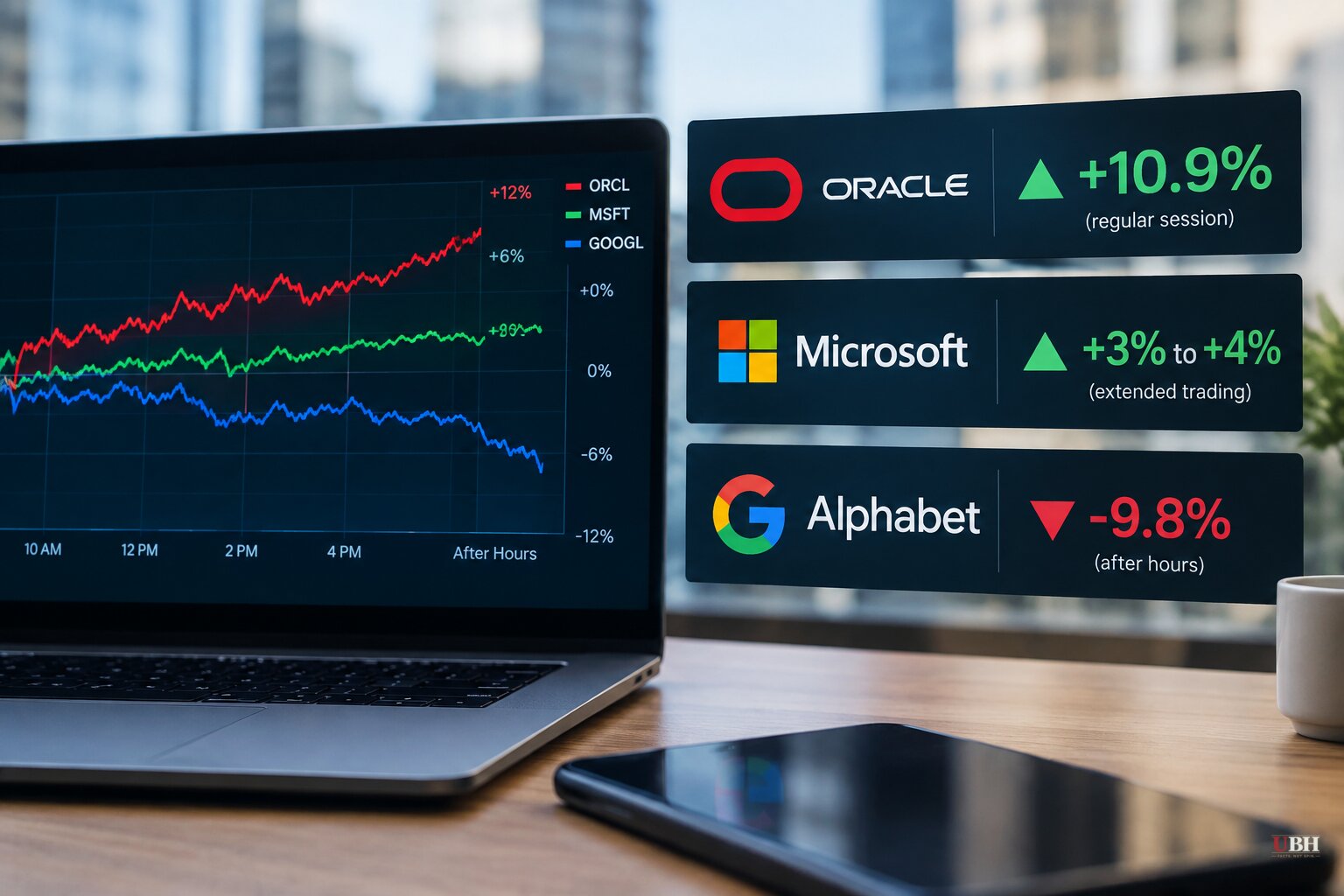
Oracle Closes Nearly 11% Higher After Pledging a Financing Cap; Alphabet Falls Nearly 10% After Hours
Since Meta reported negative free cash flow last week and Alphabet posted its first negative quarter in the June period, the question for Big Tech has been who can pay for the AI buildout out of their own pockets. Wednesday's results, Oct. 28, gave the sharpest split yet.
Oracle, the day's regular-session winner
Oracle ended regular trading on Wednesday nearly 11% higher. The company said it plans to put a ceiling on external financing and expects cash flow to turn positive in the second half of fiscal 2028.
That is a long runway, roughly two years out. Investors cheered it anyway.
Melissa Otto, head of research at S&P Global Visible Alpha, said the shift is clear: after rewarding companies for spending aggressively on computing capacity, often with debt, investors now want evidence the growth can finance the next round of outlays.
Microsoft: strong quarter, spending still climbing
Microsoft shares rose between about 2.5% and 4% in after-hours trading, depending on the moment. These are extended-session indications, not a regular-session close. Regular trading does not open until 9:30 a.m. ET today, Oct. 29.
The numbers behind the move:
- Revenue was $92.3 billion, up 19% from a year earlier. Profit was $36.6 billion.
- Azure grew 48% and is now Microsoft's biggest single business.
- Fiscal second-quarter revenue guidance is $96 billion to $97.1 billion. Analysts polled by LSEG expected $95.6 billion.
- CFO Amy Hood guided Azure growth of 49% to 50% at constant currency. The StreetAccount consensus was 45.1%.
- Free cash flow fell 27% to $18.63 billion, but stayed positive.
Capital expenditures and finance leases came to $45.2 billion, up about 30% from a year ago. Analysts surveyed by StreetAccount had projected $50.67 billion.
Hood explained the gap. "Some third-party capacity deliveries we expected in Q1 were delayed," she told analysts, tying the delays to GPU-as-a-service providers. Those deliveries have shifted to the second half of the fiscal year.
Some of the spending Wall Street expected has been pushed back, not cancelled. Hood said she expects capex to accelerate in the second half, driven by CPUs, GPUs and higher memory and storage costs.
She guided fiscal second-quarter capex above $50 billion, below the $53.10 billion consensus, and about $170 billion for the calendar year. About 75% of capex now goes to short-lived assets such as Nvidia GPUs and Intel chips, up from roughly 66% over the prior three quarters.
"We still have demand that exceeds supply," Hood said.
She also said Microsoft expects to stay free cash flow positive through fiscal 2027, while the company will tap additional funding sources when it is attractive to do so.
Alphabet: search miss and a second cash-burn quarter
Alphabet fell nearly 10% after hours. Google reported revenue of about $127.6 billion against a roughly $128.2 billion consensus. Advertising revenue of about $82 billion missed the roughly $83.4 billion expected. Adjusted earnings per share were $2.67 against $3.02 expected, and net income available to shareholders fell 25% to about $26 billion.
Search revenue grew 12%, short of the 14.7% analysts expected. CEO Sundar Pichai said queries are growing at their fastest pace in five years. Chief Business Officer Philipp Schindler blamed the slower ad growth on greater use of AI Mode, the chatbot-style interface where Google is still testing ads.
Google Cloud revenue more than doubled to $30.71 billion. Free cash flow was negative $9.07 billion, following a burn of about $6 billion in the June quarter, the first negative quarter in Alphabet's history as a public company.
CFO Anat Ashkenazi said 2027 capex will rise significantly from this year's forecast of $195 billion to $205 billion. She gave no figure. She also flagged near-term margin pressure from third-party cloud capacity, and warned that building up tensor processing unit inventory would weigh further on free cash flow.
Otto read the quarter bluntly. "Microsoft's quarter demonstrated very disciplined growth, whereas Google is burning cash and its core business came in below expectations," she said. She added that it may lead investors to ask whether "AI is taking some share" from Google Search.
The dissent on spending
Not every Alphabet holder is worried. Jeremy Saltzberg, vice president and senior investment officer at Check Capital, which owns Alphabet shares, pushed back on the spending concerns. "This is definitely a different business, Google. It's a different business today than it was three, five, 10 years ago," he said.
Saltzberg argued Alphabet needs big outlays to stay competitive while OpenAI and Anthropic appear to be pulling ahead in the model race.
What comes next
The four largest hyperscalers, Amazon, Microsoft, Alphabet and Meta, are collectively expected to spend more than $700 billion on capex in 2026, mostly on data centers. Meta has said its 2026 capex could reach as much as $145 billion.
Amazon is scheduled to report today, Oct. 29, the last of the four. Alphabet has not yet put a dollar figure on its 2027 capex, and Microsoft's guidance for faster second-half spending sets up its next test of the cash-flow claim.
Sources used for this briefing
8 links from 8 independent newsrooms (syndicated copies of the same report count once)
These are the sources it draws on, linked so you can verify.


