
Unbiased headlines. Facts, not spin.
Every story is an unbiased news briefing written from 110+ sources across the spectrum — sources linked so you can verify it yourself.
 finance
Notable (5/10)
June 19, 2026 at 05:58 PM
finance
Notable (5/10)
June 19, 2026 at 05:58 PM
Andy Burnham Wins Makerfield By-Election, UK Gilt Yields Rise as Leadership Challenge to Starmer Takes Shape
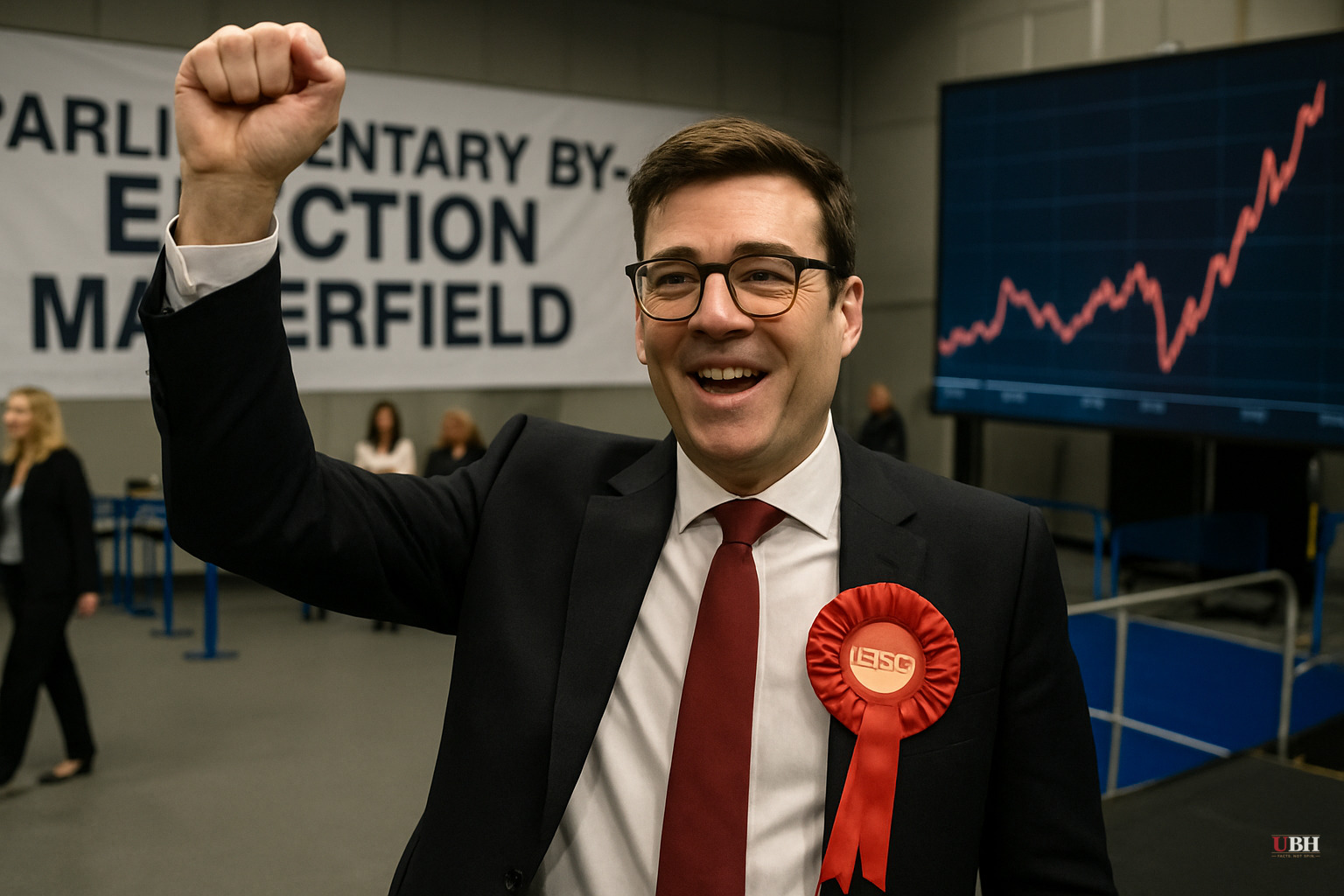
Since covering Starmer's mounting unpopularity earlier this cycle, the political landscape in Britain has shifted. Burnham's Makerfield result is not the start of a challenge. It is the starting gun.
What Happened in Makerfield
Burnham, formerly the mayor of Greater Manchester, won the Makerfield by-election in northwestern England with 54.8% of the vote, according to CNBC. Reform UK's Robert Kenyon finished second with 34.5%. A third candidate from the harder-line Restore Britain party took just under 7%.
That 55% figure matters beyond the headline. As The Atlantic noted, it exceeds the combined total of both right-populist candidates running against him, at a moment when Labour nationally is polling at just 19%. That is not a safe-seat hold. That is a personal mandate.
The Road to This Seat
Burnham needed a parliamentary seat to mount any leadership bid, and getting there was not straightforward. According to The Atlantic, Starmer's team blocked Burnham from running in a different Manchester-area by-election in February. That seat ultimately went to the Greens, triggering internal Labour recriminations. Burnham then engineered the Makerfield opening himself, persuading the constituency's sitting MP, Josh Simons, described by The Atlantic as scandal-plagued, to step down.
In short, Burnham outmaneuvered the incumbent to get on the ballot.
What Burnham Actually Said
In his victory speech, Burnham did not declare a challenge outright. He called Makerfield a "touchstone, not a stepping stone" and said the win offers "a chance to build a new politics, based on unity and hope." He told his party directly: "This is a final chance to change. There will be no second chance."
Starmer, for his part, was not conciliatory. "If there is one, I'll stand," he told broadcasters Friday morning, per ZeroHedge. "I'm not going to walk away."
Burnham could trigger a formal challenge as soon as next week, once he is sworn in as an MP, according to CNBC. He would need the support of at least 81 Labour lawmakers to force a vote.
The Market Reaction
Gilt yields spiked Friday morning on the political news. ZeroHedge quoted RBC strategist Megum Muhic directly: "With Burnham having made a statement win, the next few months will likely see domestic political risks dominating headlines in the UK and as a result markets pricing in real political risk premium."
The timing is brutal for UK finances. The Office for Budget Responsibility reported Friday that the UK's budget deficit for May came in at £23.3 billion ($30.8 billion), the highest for any May in six years and well above the £18.9 billion economists had forecast, according to CNBC. Political uncertainty layered on top of a deteriorating fiscal picture is exactly what bond markets hate.
The Fiscal Question Burnham Has Not Fully Answered
Burnham has a history of populist spending instincts. While he recently walked back earlier comments suggesting the UK was "in hock to the bond markets," a rhetorical retreat is not the same as a credible fiscal plan.
Kallum Pickering, chief economist at Peel Hunt, said Friday that markets will be watching specifically whether a Burnham government would stick to Labour's existing fiscal rules and whether his policy agenda risks adding to inflation, according to CNBC. Burnham's supporters argue that his record in Greater Manchester shows pragmatic governance rather than blank-check spending. But a mayor controlling a city budget operates under entirely different constraints than a chancellor managing sovereign debt. The gilt market's reaction Friday reflects investor concerns about fiscal continuity.
The Bigger Picture
Starmer's collapse has been fast by any standard. He won a 174-seat parliamentary majority in 2024 with 34% of the vote, according to The Atlantic, and has since struggled to convert that arithmetic dominance into political authority. Labour's poor showing in May local elections prompted nearly a quarter of the party's 400-plus MPs to publicly call for him to resign, according to ZeroHedge.
Burnham is positioning himself as a unifying alternative from Labour's left, styled around the "Manchesterism" brand he built over years as mayor. The Atlantic frames his trajectory as unusually American-style: a national politician who retreated to local government to rebuild credibility before returning to the national stage.
Whether that biography translates into governing a stagnant national economy, one that The Atlantic noted has had six prime ministers since the 2016 Brexit referendum, is the question that the Makerfield result does not answer.
The concrete next step is the parliamentary swearing-in, expected next week. At that point, the 81-MP threshold becomes the only math that matters. Labour MPs will have to decide whether they trust Burnham's recent fiscal reassurances enough to hand him the keys.
Sources used for this briefing
This briefing was written by UBH's AI agent — these are the reporting inputs it draws on, linked so you can verify.


