
Unbiased headlines. Facts, not spin.
Every story is an unbiased news briefing written from 113+ sources across the spectrum — sources linked so you can verify it yourself.
 energy
Low Interest (4/10)
September 27, 2026 at 08:32 AM
energy
Low Interest (4/10)
September 27, 2026 at 08:32 AM
Amit Shah Flags Off India's First LNG Train, But Half the Rs 1,542 Crore Gujarat Rail Package Isn't Built Yet
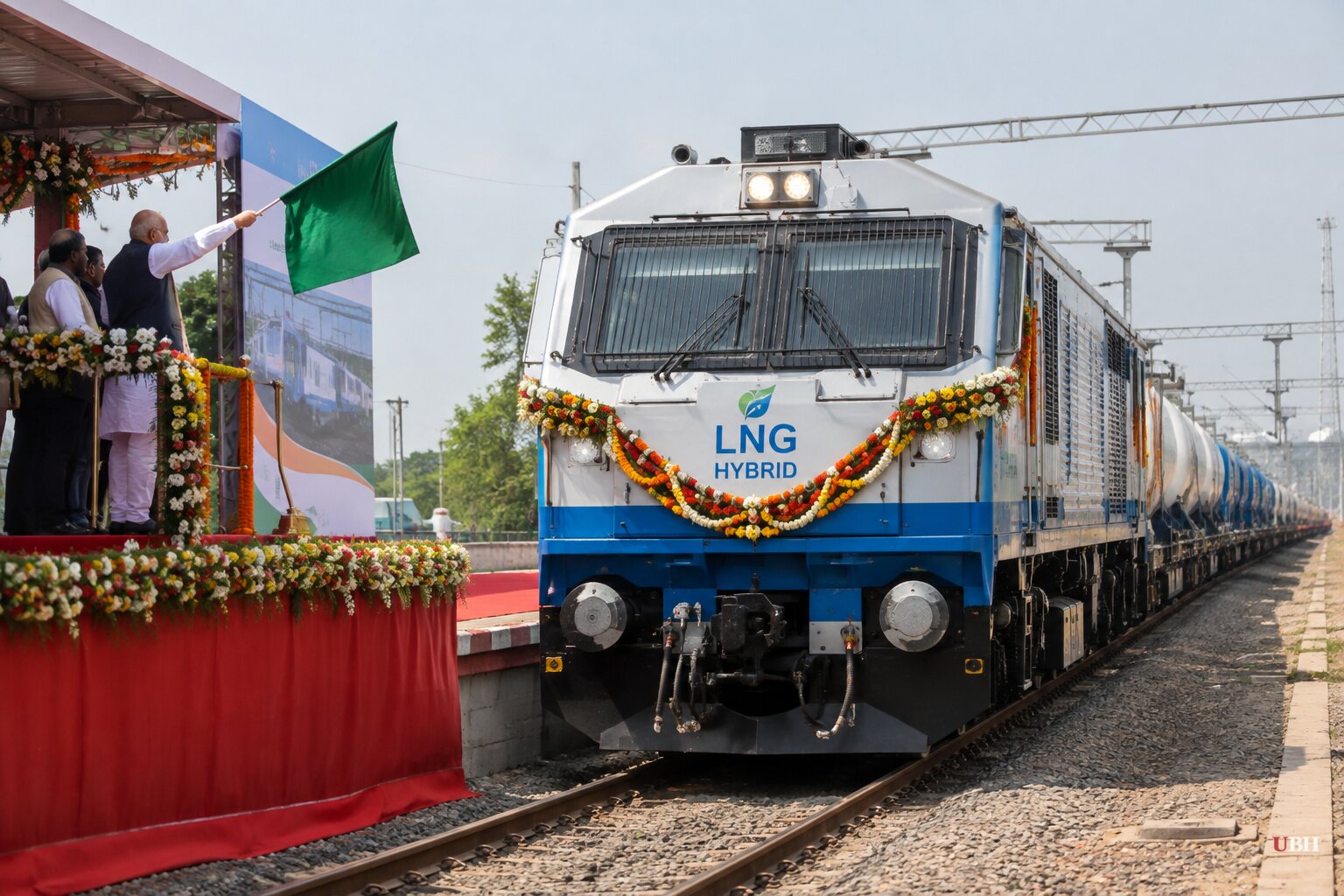
Union Home and Cooperation Minister Amit Shah traveled to Sabarmati, Gujarat, on Sunday, September 27, to flag off India's first LNG-powered train and unveil a bundle of railway projects the government values at over Rs 1,542 crore.
The headline item is the train itself. Two 1,400 HP Driving Power Cars at the Sabarmati Integrated Coaching Depot have been converted into a diesel-LNG dual-fuel system, according to the Times of India and ANI News. LNG replaces roughly 40 percent of diesel consumption in the converted units. Bhaskara English reported the train can run up to 2,200 km on a full LNG tank and completed a field trial of more than 2,000 km between Mehsana and Sabarmati over about eight months. Indian Railways plans to convert 8 to 10 more trains to the same dual-fuel system, per Bhaskara, though no timeline was given for that rollout.
Not everything Shah touted on Sunday is actually finished.
What's actually built
Two projects are complete and operational. The WAG-12 locomotive maintenance shed at Sabarmati, built at an estimated cost of Rs 700 crore, will service 300 high-horsepower WAG-12 electric freight locomotives, each rated around 12,000 HP, according to ANI News and Moneycontrol. An automatic block signalling system covering 122.57 km between Sabarmati-Kalol-Bhandu Motidau and Sabarmati-Sanand-Jakhwada, costing about Rs 118.83 crore, is also in place and meant to let trains run closer together safely.
What's just a foundation stone
The Kavach automatic train protection system, India's indigenous anti-collision technology, got its foundation stone laid Sunday for 404 km of track in the Ahmedabad division, covering the Ahmedabad-Palanpur (157 km) and Ahmedabad-Samakhiyali (247 km) sections, at an estimated cost of Rs 411 crore. ANI News and Newsable both specify this is a foundation-stone ceremony, not a completed system. The Times of India's headline, "launches Rs 1,542 crore railway projects," folds this unbuilt safety system into the same dollar figure as the finished maintenance shed without distinguishing the two. The Kavach system's entire purpose is preventing train collisions.
A third item, the Sabarmati-Sarkhej line doubling project (Rs 313.27 crore, 21 km), is under construction and targeted for completion by March 2028, per ANI and The News Mill, still more than a year away.
Combining these figures: Rs 411 crore (Kavach, not built) plus Rs 313.27 crore (line doubling, due 2028) equals Rs 724.27 crore, nearly half the Rs 1,542 crore headline figure. These projects exist on paper right now, not on the ground.
The political framing
Shah used the stop to invoke Mahatma Gandhi and the Sabarmati Ashram's role in the independence movement, according to Bhaskara English, and recalled personal memories of arriving at the same station in the 1980s when passengers had to walk nearly 2 km to find an autorickshaw. He thanked Railway Minister Ashwini Vaishnaw and credited the government with cutting national diesel consumption in Indian Railways from 293 crore litres in 2015-16 to 108 crore litres in 2024-25, and set a goal of zero diesel use by 2030. He also said Gujarat's railway budget rose from Rs 584 crore in 2009-14 to Rs 17,366 crore for 2026-27.
Those figures come from Shah himself. None of the seven reports cite an independent verification of the diesel-consumption numbers or the budget comparison, and the zero-diesel-by-2030 target is a stated goal, not a completed outcome. Readers should treat it as a political claim, not an audited fact.
The savings math
One outlet in the Ground News aggregation reported the LNG conversion is expected to save around Rs 23.9 lakh annually. Set against a Rs 700 crore locomotive shed and a Rs 1,542 crore total package, the annual savings are modest against the capital investment. The Kavach rollout is the more significant project, and that one hasn't broken ground.
Gujarat Chief Minister Bhupendra Patel, Deputy CM Harsh Sanghavi, Minister of State Darshanaben Vaghela, MPs Hasmukhbhai Patel and Dineshbhai Makwana, and Ahmedabad Mayor Hiteshbhai Barot all attended, per ANI News and Newsable.
The open question is timing. Until that system is actually running on the Ahmedabad-Palanpur and Ahmedabad-Samakhiyali sections, Sunday's ceremony marks a start date, not a finished safety upgrade.
Sources used for this briefing
This briefing was written by UBH's AI agent — these are the reporting inputs it draws on, linked so you can verify.


