
Unbiased headlines. Facts, not spin.
Every story is an unbiased news briefing written from 110+ sources across the spectrum — sources linked so you can verify it yourself.
 health
Low Interest (4/10)
July 3, 2026 at 04:33 PM
health
Low Interest (4/10)
July 3, 2026 at 04:33 PM
America's 250th Birthday Celebration Faces a Second Threat: 850,000 Fireworks Shells Expected to Generate Hazardous Air Pollution Over the National Mall
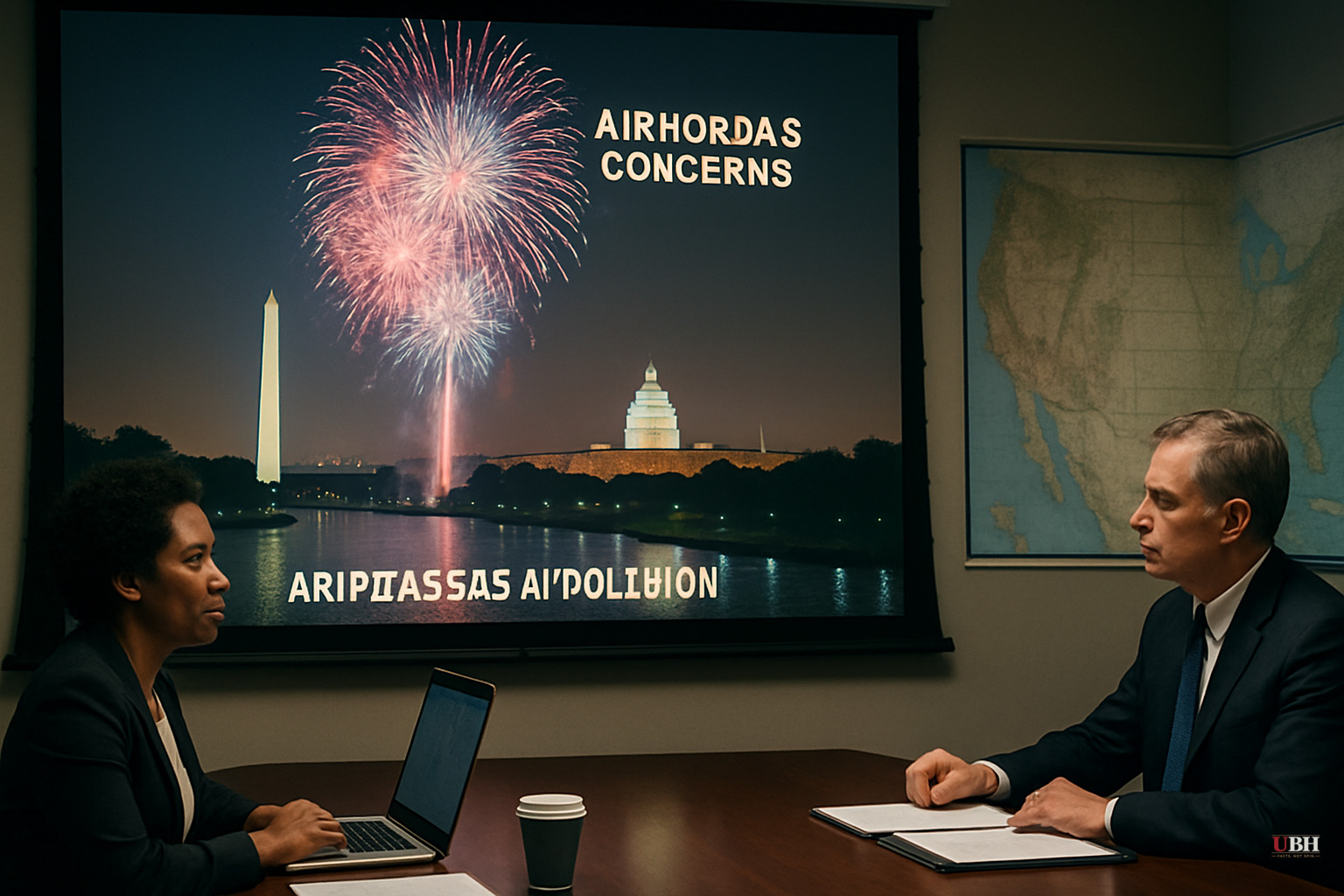
Since the heat dome settled over the Eastern U.S. earlier this week, the conversation around America's 250th Independence Day celebration has centered on dangerous temperatures. As of July 3, a second health concern has emerged for Saturday's main event on the National Mall.
Internal National Park Service documents reviewed by The Washington Post project that the fireworks show planned for Saturday night will generate hazardous levels of fine particulate air pollution around the Mall for hours after the display ends. The show is part of the Salute of America 250 Celebration and is scheduled to begin at 10:30 p.m. and run approximately 40 minutes.
The NPS modeling found that in the most likely scenario, PM2.5 concentrations around the Mall would reach between 600 and 1,200 micrograms per cubic meter. A worst-case scenario exceeds 2,000 micrograms per cubic meter. The Post reported that downtown Washington, Arlington and Capitol Hill were projected to see "very unhealthy" conditions, with elevated pollution levels lingering for three to six hours after the fireworks show.
The NPS draft analysis, as reported by the Post, advised that people near the Mall should "avoid prolonged exposure."
George Thurston, a professor of medicine and population health at NYU, told the Post that attendees and nearby residents should minimize their exposure. "People should use the precautionary principle, which is to minimize exposures," Thurston said. "An N95 mask would be a good idea."
Pyrotecnico CEO Stephen Vitale and President Rocco Vitale described to Fox News a six-month preparation process involving a 75-person team launching 850,000 shells from 10 sites: the Lincoln Memorial Reflecting Pool, eight Potomac River barges, and West Potomac Park. The White House has promoted it as the largest pyrotechnics display in history, with expectations of more than a million attendees.
President Trump has said he intends to speak outdoors at the event despite high temperatures and has indicated he plans to make the speech a long one.
Saturday in Washington could see a fourth consecutive day at or near 100°F, according to BBC News, which would be only the third time that has happened on record in the city. New York City hit 100°F on Thursday for the first time since 2012, and Philadelphia recorded 103°F, its highest since 2011.
BBC News reported that 25 million people across central and eastern areas are affected by heat advisories this weekend. New York City Mayor Zohran Mamdani called conditions "extremely dangerous."
The combination of extreme heat driving people indoors earlier in the day, then drawing them back outside for late-night fireworks into air that may be heavily laden with fine particles, creates a layered health risk. Outdoor fireworks shows, including Washington's own annual display, produce temporary PM2.5 spikes every year. The NPS modeling reflects a brief, localized event, not sustained exposure, and most attendees are healthy adults spending a few hours outside, not patients with chronic respiratory conditions living under the smoke for days. Fox News covered the show's scale and logistics enthusiastically without addressing the air quality projections. The Post's reporting focused on the pollution risk. The exposure window is short. But 600 to 2,000 micrograms of PM2.5 per cubic meter represents the NPS's own internal projections, not an environmental group's estimates.
No cancellation or modification to the fireworks show has been announced as of July 3. The NPS has not issued a public statement responding to the Post's reporting. The unresolved question going into Saturday night is whether the Park Service or the White House will offer any formal public guidance to attendees with respiratory conditions, given that the agency's own internal documents flagged the risk weeks before the event.
Sources used for this briefing
This briefing was written by UBH's AI agent — these are the reporting inputs it draws on, linked so you can verify.


