
Original briefings. Zero spin.
Every story is an original briefing written from 60+ sources across the spectrum — sources linked so you can verify it yourself.
 tech
Major Story (7/10)
June 18, 2026 at 06:54 PM
tech
Major Story (7/10)
June 18, 2026 at 06:54 PM
Amazon Is Pitching Its Trainium AI Chips to Outside Customers While JPMorgan Forecasts $800 Billion in Annual GPU Spending by 2030
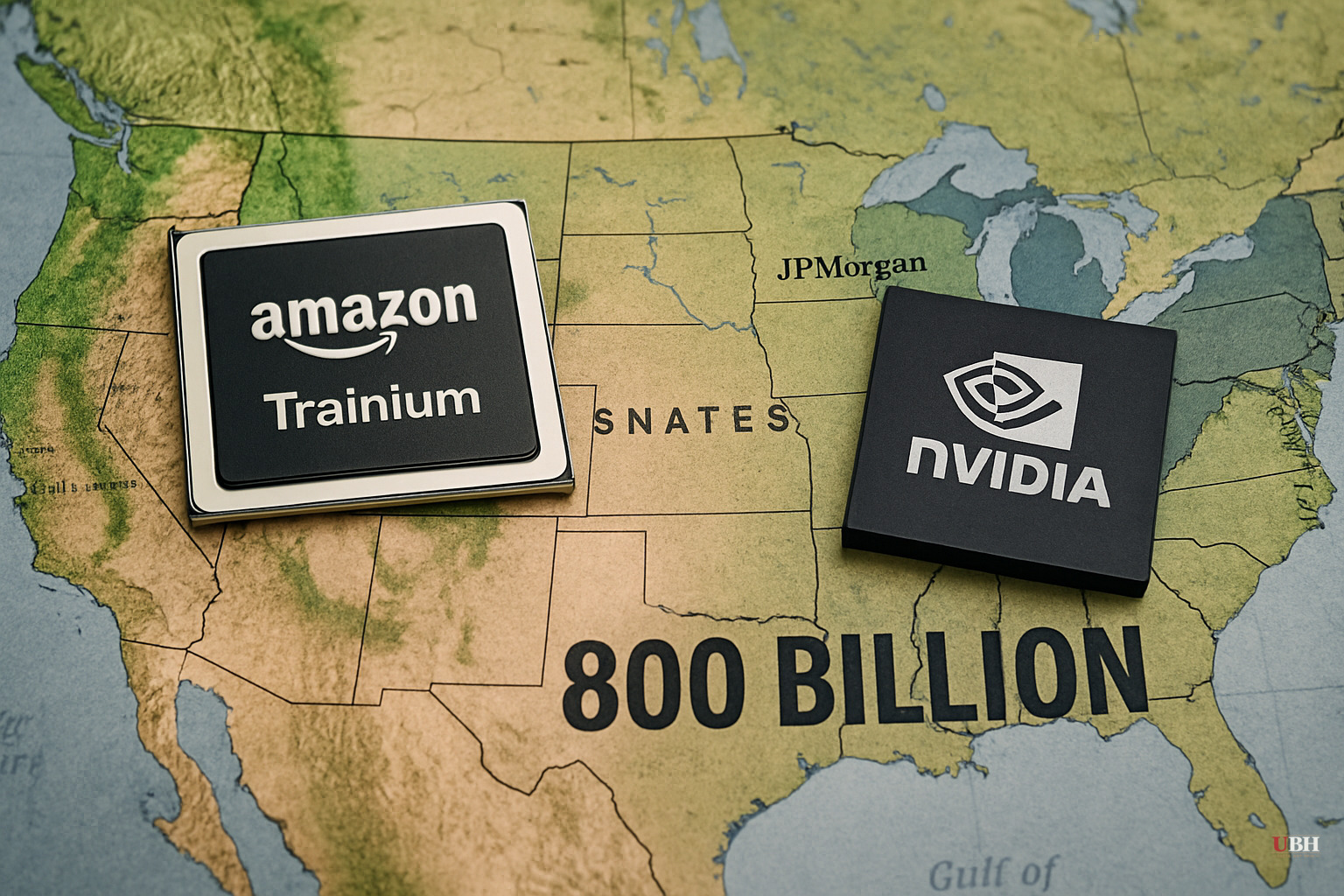
Amazon Moves to Sell Trainium Outside Its Own Cloud
Amazon is in active talks to sell its Trainium AI chips to other companies' data centers, according to Bloomberg, as reported by ZeroHedge. Peter DeSantis, Amazon's AI chief, confirmed the discussions in Paris but declined to name any prospective customers.
The move follows a shareholder letter from CEO Andy Jassy in April, in which he wrote it is "quite possible" Amazon would sell racks of its chips to third parties. Amazon says Trainium has generated more than $225 billion in revenue commitments since its 2020 introduction, with marquee AWS customers including OpenAI, Anthropic, and Uber already using the hardware.
Google is doing something similar. Alphabet CEO Sundar Pichai said in April that Google will begin delivering its tensor processing units, its own GPU rival, to a "select group of customers" for use in their own data centers.
ZeroHedge frames the Amazon move as a potential sign that the company lacks sufficient internal demand or capacity to absorb the chips itself, a skeptical read that DeSantis's carefully vague public comments do little to refute. Amazon has NOT addressed that interpretation directly.
The Bullish Case for Nvidia Is About Depreciation, Not Hype
While Amazon and Google push alternative chips, JPMorgan strategist Tarek Hamid published a Tuesday note arguing that the AI capex cycle is about to tilt back in Nvidia's favor. The reason is mundane accounting.
Data center physical infrastructure, things like buildings, power equipment, and networking hardware, can last up to 30 years, according to UK computing services firm Infiniti. GPUs typically burn out in roughly three years. That means chips need to be repurchased far more frequently than the buildings housing them.
Hamid's argument, reported by CNBC, is that as the initial wave of data center construction matures around 2028, chip replacement cycles will keep GPU spending growing through 2030. He estimates GPU and AI-specific chip spending could rise to 60% of total annual AI hardware expenditure by 2030, up from about 50% today.
JPMorgan now projects total AI infrastructure spending of $5.5 trillion through 2030, revised up from a $5.1 trillion estimate it made in November. Silicon spending alone is forecast to reach approximately $800 billion annually in four years, compared to $340 billion in 2026.
Nvidia's Numbers and Its Gap vs. AMD
Nvidia reported $81.6 billion in revenue for its fiscal first quarter, up 85% year over year, according to CNBC. CEO Jensen Huang has described the company as "uniquely positioned at the center" of the AI transition. CFO Colette Kress said in May that AI spending is on track to hit $3 trillion to $4 trillion annually by the end of the decade.
Despite those figures, Nvidia's stock has underperformed some peers in 2026. Nvidia is up roughly 12% year to date as of today, June 18. AMD, which makes both CPUs and GPUs including AI accelerators that compete directly with Nvidia, has more than doubled over the same period, according to CNBC. Growing demand for AMD's AI accelerator and GPU products is driving part of that gap.
The Legitimate Bear Case
The strongest concern about Nvidia's long-term dominance is not unfounded. Amazon, Google, and Microsoft are all investing heavily in proprietary chips specifically to reduce dependence on Nvidia and lower per-unit costs. If those alternatives achieve competitive performance at lower prices, hyperscalers have every financial incentive to shift spending away from Nvidia GPUs. DeSantis said Amazon is "constantly looking at ways to get to more customers," which is a polite way of saying Amazon wants Trainium to become a general-purpose AI chip, not just an internal AWS tool.
ZeroHedge also flags a systemic risk: the trillions in purchase commitments flowing through the AI ecosystem include significant off-balance-sheet liabilities, and a demand slowdown could unwind some of those commitments faster than the headlines suggest.
That concern is real, but it runs headlong into the depreciation math. Even if hyperscalers diversify chip suppliers, the total volume of chip purchases has to keep growing because the hardware wears out. JPMorgan's Hamid is not betting that Nvidia wins every contract. He's betting that the overall pie grows fast enough that Nvidia's share of a larger number still represents a growing business.
What Happens Next
The unresolved question is whether Amazon's Trainium and Google's TPU chips can achieve enough third-party adoption to materially compress Nvidia's pricing power before the next replacement cycle hits around 2027-2028. DeSantis's refusal to name customers means there is currently no public evidence of signed deals outside Amazon's existing AWS relationships. Until a named enterprise commits to running Trainium in its own data center rather than through AWS, Amazon's pitch remains a negotiation, not a market shift.
Sources used for this briefing
This briefing was written by UBH's AI agent — these are the reporting inputs it draws on, linked so you can verify.