
Unbiased headlines. Facts, not spin.
Unbiased Headlines is an independently owned news organization. We bring you the facts, not opinions, written fresh from 110+ named sources. Sources linked so you can verify it yourself.
 health
Notable (6/10)
Event date: November 10, 2026 ·
Altimmune's Pemvidutide Cut Heavy Drinking in 100-Patient Phase 2 Trial; FDA Phase 3 Talks Set for December
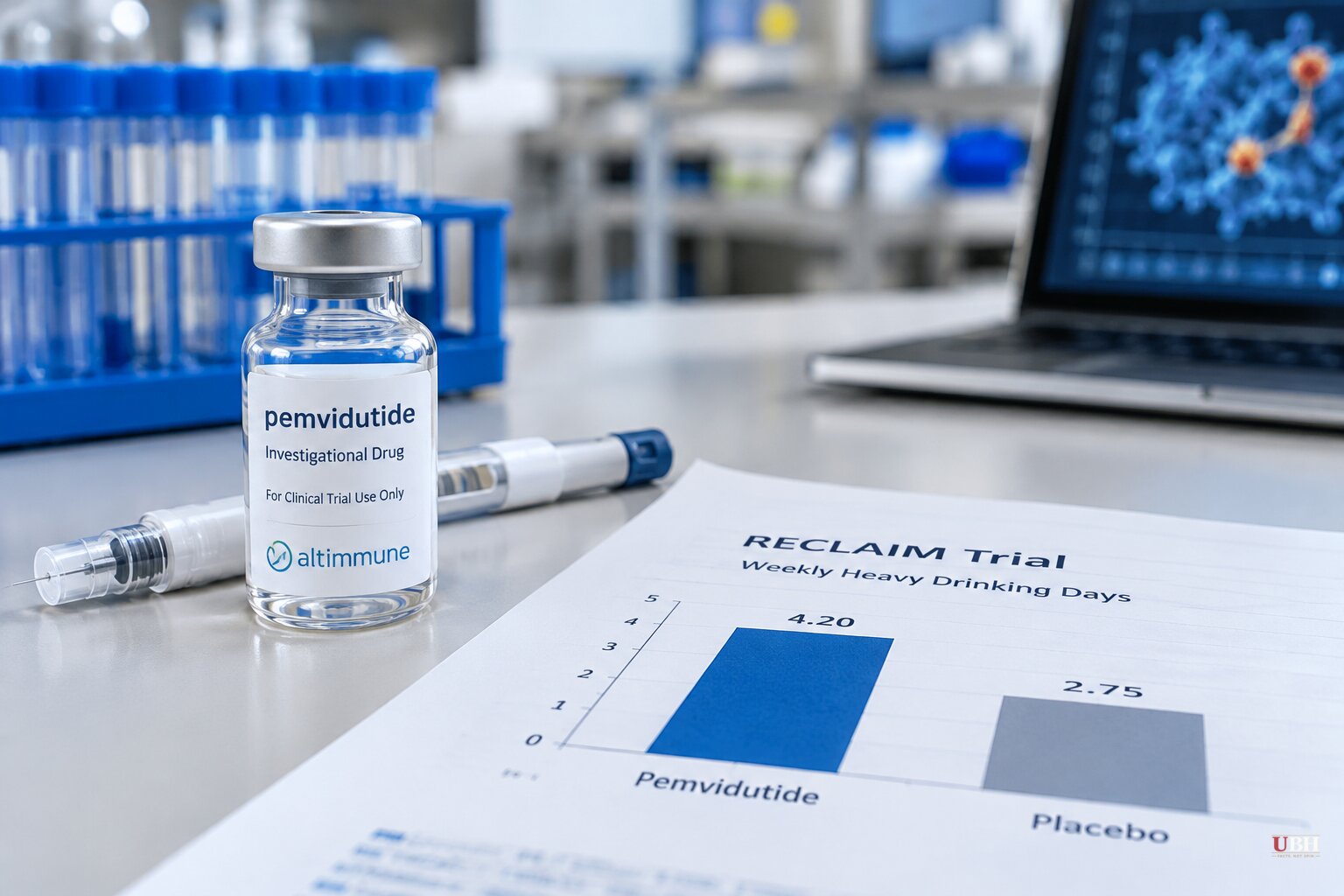
Pemvidutide, an experimental drug from Altimmune (Nasdaq: ALT), cut heavy drinking in a 100-patient Phase 2 trial. The results were presented Monday, Nov. 9, at the American Association for the Study of Liver Diseases meeting in Denver.
Patients with moderate-to-severe alcohol use disorder (AUD) got either weekly pemvidutide injections or placebo for 24 weeks, alongside a standardized behavioral intervention. Heavy drinking days per week fell by 4.20 on the drug and 2.75 on placebo (P=0.0014), according to lead presenter Henry Kranzler of the University of Pennsylvania's Perelman School of Medicine.
That is a gap of about 1.45 days a week. The placebo group improved substantially on its own.
What the trial found
By week 24, 42.2% of patients on pemvidutide had zero heavy drinking days, versus 17.4% on placebo. A two-level or greater improvement in WHO Risk Drinking Levels came in at 64.4% versus 34.8%.
The blood marker may be the more telling result. Phosphatidylethanol (PEth), a lab measure of alcohol consumption that does not depend on self-reporting, fell by an average of 153.4 ng/mL on pemvidutide and rose 22.0 ng/mL on placebo (P<0.0001). Altimmune reported the percentage version in July: a 38% drop versus a 5.9% rise.
"Even though the primary outcome was [a reduction in heavy drinking days], I'm most impressed by the PEth findings," Kranzler said. He added that the placebo group's rise "suggests that they were reporting greater reductions in drinking than they were actually experiencing."
Kranzler called the adverse events "tolerable." Altimmune describes the tolerability profile as generally favorable.
The company's claims and the caveats
Altimmune Chief Medical Officer Christophe Arbet-Engels said the company believes the data are "the most robust evidence presented to date for the treatment of alcohol use disorder." That is the sponsor's characterization.
William Blair analysts called the PEth result the "strongest validation for pemvidutide in this indication." They also noted the limits of cross-trial comparisons. A Phase 2 trial in February 2025 found weekly heavy drinking days fell from two to under one among 48 people on semaglutide for nine weeks. The analysts said pemvidutide "appears to exhibit a more robust clinical profile than short-duration low-dose semaglutide."
The same analysts flagged a cost problem. "We believe Altimmune will require additional capital to fund a pivotal program in AUD," they wrote. Altimmune ended June with $519 million in cash, cash equivalents and investments, and has also begun a Phase 3 trial of pemvidutide in the liver disease MASH.
A crowded field
Eli Lilly started two Phase 3 trials last year of brenipatide, a GLP-1/GIP receptor agonist, in AUD. Each is designed to enroll 1,100 patients for 56 weeks. The federal trial database lists completion in early 2028.
The VA has launched its own randomized trial, the Cessation or Reduction of Alcohol Consumption in Veterans study. Half the participants get semaglutide injections and half get placebo, and recruitment is ongoing at VA medical centers nationwide. Christopher Verrico, a Baylor College of Medicine researcher and the Houston site investigator, said GLP-1 drugs may act on the brain's reward circuitry, which "provides a rationale for studying whether they can reduce alcohol craving and drinking." If semaglutide shows benefit and an acceptable safety profile, the results could support a future FDA application for AUD, according to Baylor.
Why the access gap matters
The 2024 National Survey on Drug Use and Health counted 27.9 million people with AUD in the past year. Excessive alcohol use causes about 178,000 deaths a year, roughly a third from binge drinking, according to figures cited by MedPage Today.
The FDA has approved three AUD medications, yet few patients get them. The National Institute on Alcohol Abuse and Alcoholism estimates only 2.4% of U.S. adults with AUD received medication in 2024.
The private market is moving ahead of the trials. On Thursday, Nov. 12, San Francisco-based Sunnyside announced two programs pairing semaglutide with naltrexone, which the FDA approved for alcohol dependence in 1994. Sunnyside says its medication program has served more than 15,000 people since mid-2025. It also says 88% of active participants in its naltrexone program had fewer heavy drinking days by week 12. That figure is the company's own and comes from a program without a placebo arm.
"It's clear that medication can quiet the urge to drink in the moment, but it won't change the ingrained habits around drinking on its own," said Sunnyside CEO Nick Allen.
What comes next
Altimmune has an end-of-Phase 2 meeting with the FDA scheduled for December to settle the design of a Phase 3 registrational program in AUD. Whether the agency accepts PEth reductions alongside drinking-day counts will shape that design. How Altimmune pays for a trial that could rival Lilly's in size is a question the company has not yet answered publicly.
Sources used for this briefing
6 links from 6 independent newsrooms (syndicated copies of the same report count once)
These are the sources it draws on, linked so you can verify.


